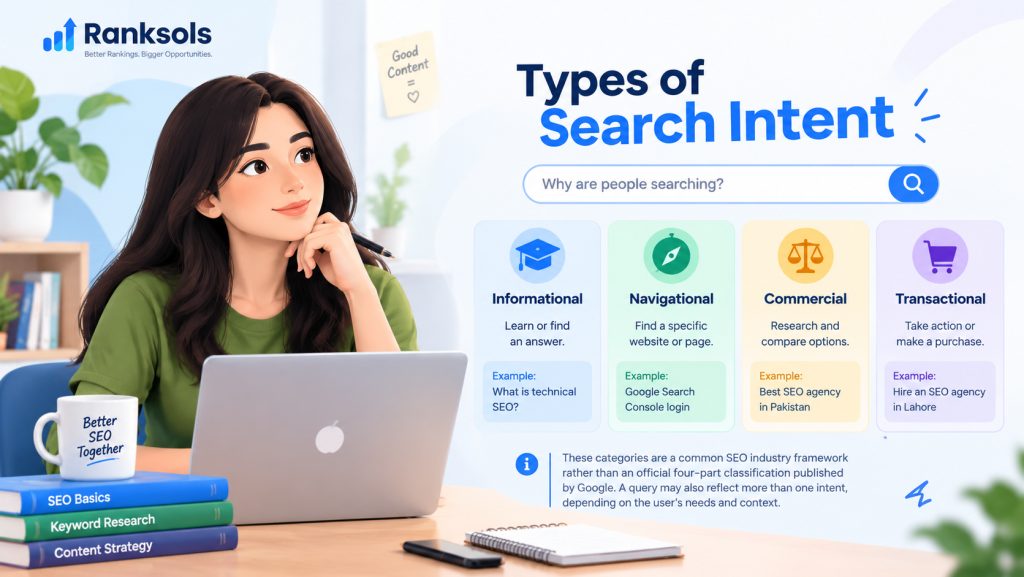
Search intent is the reason behind a user’s search query. Understanding the different types of search intent helps SEO professionals and website owners create content that matches what people want to learn, find, compare, or do.
In SEO, search intent is commonly grouped into four categories: informational, navigational, commercial, and transactional. Understanding these categories helps guide keyword targeting, content planning, and decisions about which page type best serves a particular search query.
What Are the Four Types of Search Intent?
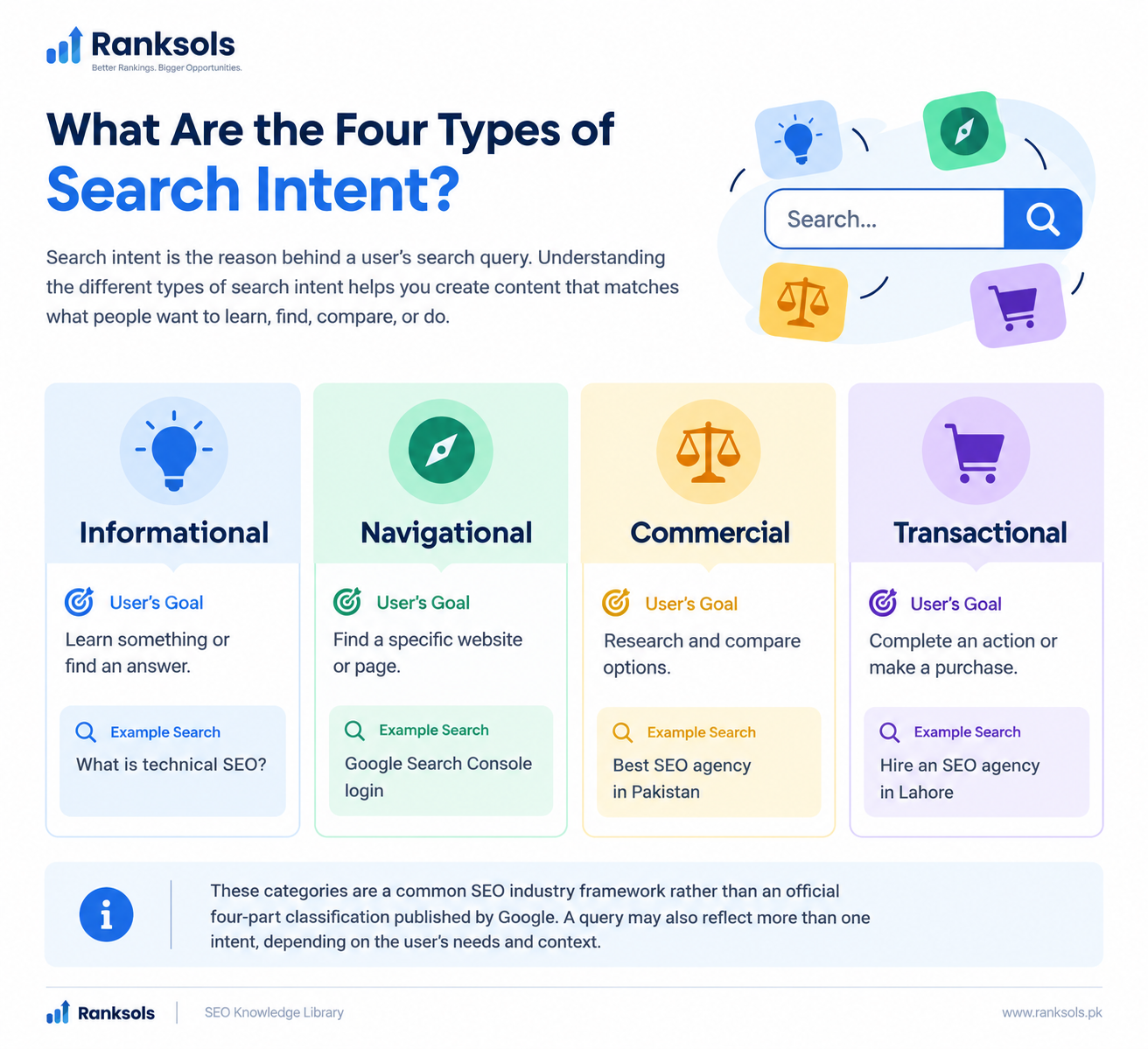
The four main types of search intent are:
| Search Intent | User’s Goal | Example Search |
|---|---|---|
| Informational | Learn something or find an answer | What is technical SEO? |
| Navigational | Find a specific website or page | Google Search Console login |
| Commercial | Research and compare options | Best SEO agency in Pakistan |
| Transactional | Complete an action or make a purchase | Hire an SEO agency in Lahore |
These categories are a common SEO industry framework rather than an official four-part classification published by Google. A query may also reflect more than one intent, depending on the user’s needs and context.
1. Informational Search Intent
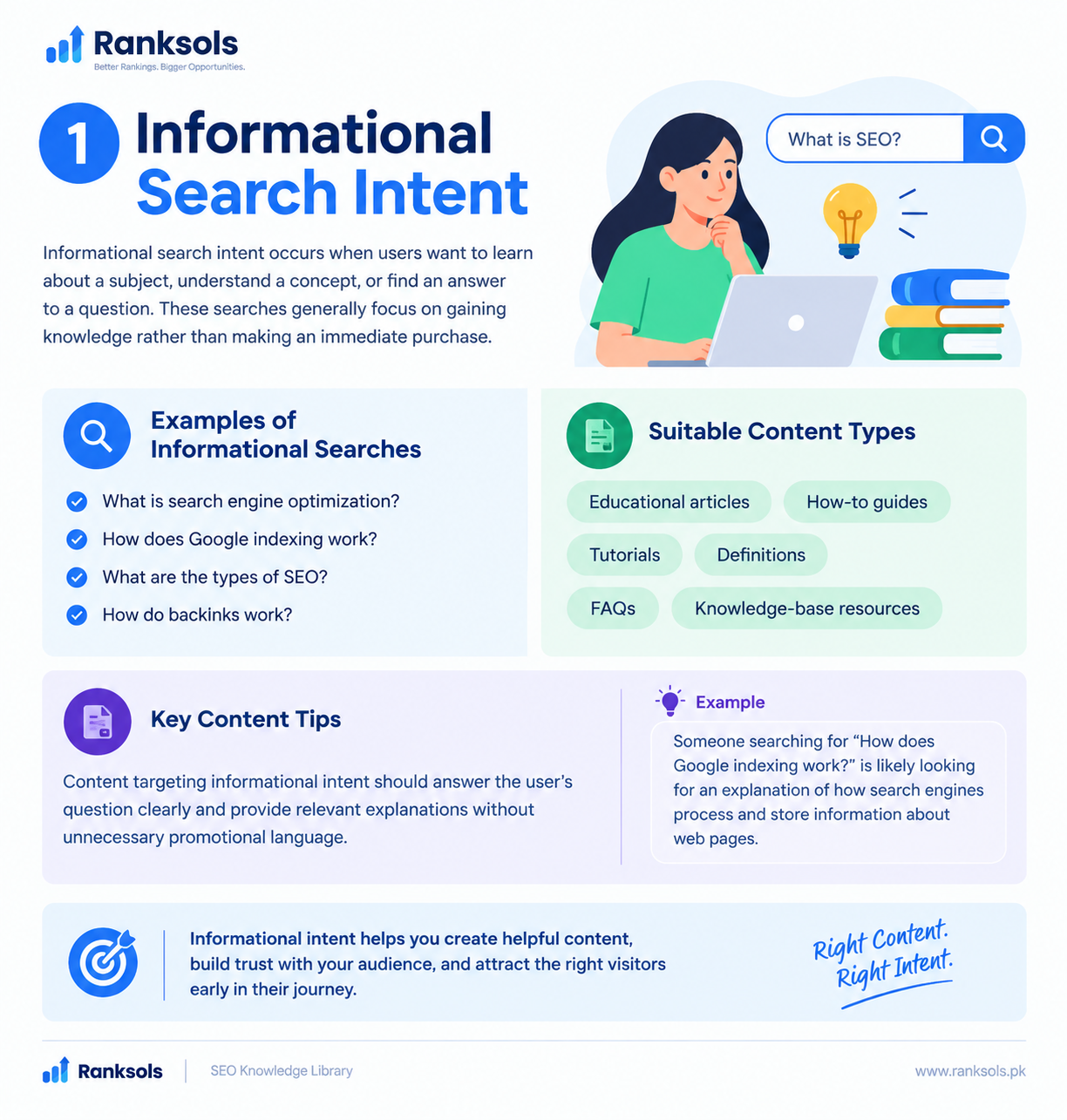
Informational search intent occurs when users want to learn about a subject, understand a concept, or find an answer to a question.
These searches generally focus on gaining knowledge rather than making an immediate purchase.
Examples of informational searches:
What is search engine optimization?
How does Google indexing work?
What are the types of SEO?
How do backlinks work?
Suitable content types: Educational articles, how-to guides, tutorials, definitions, FAQs, and knowledge-base resources.
Content targeting informational intent should answer the user’s question clearly and provide relevant explanations without unnecessary promotional language.
For example, someone searching for “How does Google indexing work?” is likely looking for an explanation of how search engines process and store information about web pages.
2. Navigational Search Intent
Navigational search intent occurs when users want to reach a particular website, brand, or webpage.
They generally know where they want to go and use a search engine to find the destination.
Examples of navigational searches:
Ranksols.pk
Google Analytics login
Ahrefs dashboard
Ranksols contact page
Suitable page types: Homepages, login pages, contact pages, official product pages, and account dashboards.
Businesses can support navigational searches by maintaining clear website navigation, descriptive page titles, and accessible brand-related pages.
For example, someone searching for the Ranksols contact page should be able to find the relevant destination without navigating through unrelated articles.
3. Commercial Search Intent
Commercial search intent, also called commercial investigation intent, occurs when users research products or services before deciding which option best meets their needs.
They may be considering a purchase or hiring a service provider, but they still need information to make a decision.
Examples of commercial searches:
Ahrefs vs Semrush
WordPress hosting reviews
Suitable content types: Comparison articles, product reviews, buying guides, service comparisons, and detailed evaluation pages.
Commercial content should help readers assess their options using relevant information, meaningful comparisons, and realistic explanations of benefits and limitations.
For example, a business comparing SEO agencies may want to evaluate service scope, reporting practices, experience, and suitability before contacting a provider.
The goal is to help users make informed decisions rather than push them toward a particular choice prematurely.
4. Transactional Search Intent
Transactional search intent occurs when users are ready to complete an action. This may involve purchasing a product, hiring a service, booking an appointment, or signing up for an offer.
Compared with commercial searches, which emphasize evaluating options, transactional searches place greater emphasis on taking the next step.
Examples of transactional searches:
Hire an SEO agency in Lahore
Buy WordPress hosting
Order a laptop online
Book an SEO audit
Suitable page types: Service pages, product pages, pricing pages, booking pages, and conversion-focused landing pages.
Pages targeting transactional intent should make the intended action clear and provide the information users need to proceed.
For example, someone searching for an SEO audit service may expect to find details about the service, its scope, available pricing information, and a straightforward way to request an audit.
For businesses, matching transactional queries with relevant service pages can make it easier for potential customers to take action.
Can a Search Query Have More Than One Intent?
Yes. Search intent does not always fit neatly into a single category. The same query can reflect different needs depending on the user’s situation.
For example, someone searching for “SEO services” might want to understand what an SEO agency does, compare providers, or find a company to hire. Although these goals are related, they may require different types of content.
To estimate the dominant intent, review the current search engine results page (SERP). Examine:
The types of pages appearing most frequently.
The topics and questions those pages address.
Whether the results focus mainly on education, comparison, or conversion.
SERP analysis provides useful evidence of likely search intent, but it does not prove that every searcher has the same goal. Search results can also vary with the query and its context.
The aim is to choose a page format that best serves the intended audience rather than assuming that every keyword has one fixed meaning.
Why Do Types of Search Intent Matter in SEO?
Understanding search intent helps website owners align their content with the purpose behind a search.
It can help you:
Choose the right content format: Decide whether a query needs an educational article, comparison page, or service page.
Improve keyword targeting: Group keywords according to the needs they represent, rather than relying only on similar wording.
Reduce content overlap: Avoid creating multiple pages that serve essentially the same search purpose.
Support the customer journey: Connect educational resources with relevant comparison and service pages.
Improve the user experience: Give visitors information or actions that match their expectations.
Search intent is one part of an effective SEO strategy. A page that matches the likely intent still needs useful content, appropriate technical implementation, and other elements relevant to its purpose. Matching intent alone does not guarantee higher rankings.
How to Identify the Search Intent of a Keyword
Use these practical steps when planning content around a target keyword.
Examine the query. Identify whether the wording suggests learning, finding a specific destination, comparing options, or taking action.
Review the SERP. Look at the dominant page types and the questions or needs those pages address.
Determine the likely goal. Consider what the searcher would regard as a useful answer or next step.
Select the appropriate page type. Choose an educational article, comparison page, service page, or another format that fits the likely intent.
Reassess when necessary. Review the SERP again when updating important content or when the results appear to have changed.
Do not classify a keyword from wording alone. Use the query and its search results together to make a reasoned decision.
Final Thoughts
The four main types of search intent—informational, navigational, commercial, and transactional—provide a useful framework for understanding why people search online.
The key is to identify what users want to accomplish and create a page that serves that purpose. Educational articles should answer questions, comparison content should support decisions, and service or product pages should make relevant actions straightforward.
If your business needs help aligning website content with search intent and broader SEO goals, Ranksols can help you explore an SEO strategy tailored to your website and audience.