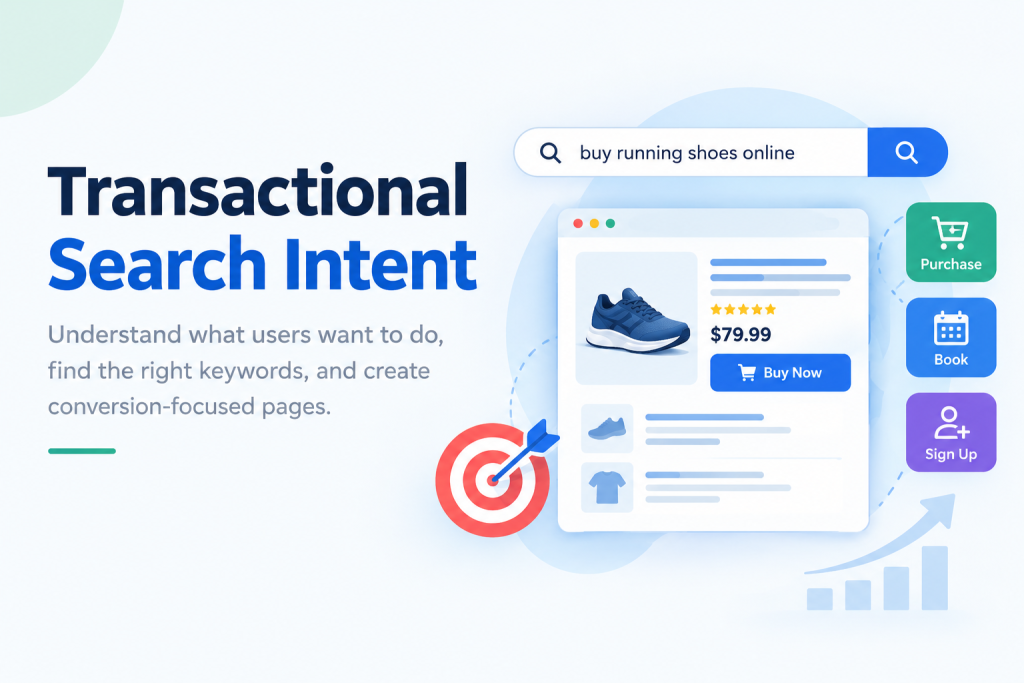
What Is Transactional Search Intent?
Transactional search intent occurs when users search with the goal of completing an action, such as purchasing a product, booking a service, or signing up for a platform. These searches often indicate a strong intention to act, although users may still need to review details or make a final decision.
In SEO, understanding transactional intent helps businesses create relevant product pages, service pages, booking pages, and other conversion-focused landing pages that meet users’ immediate needs.
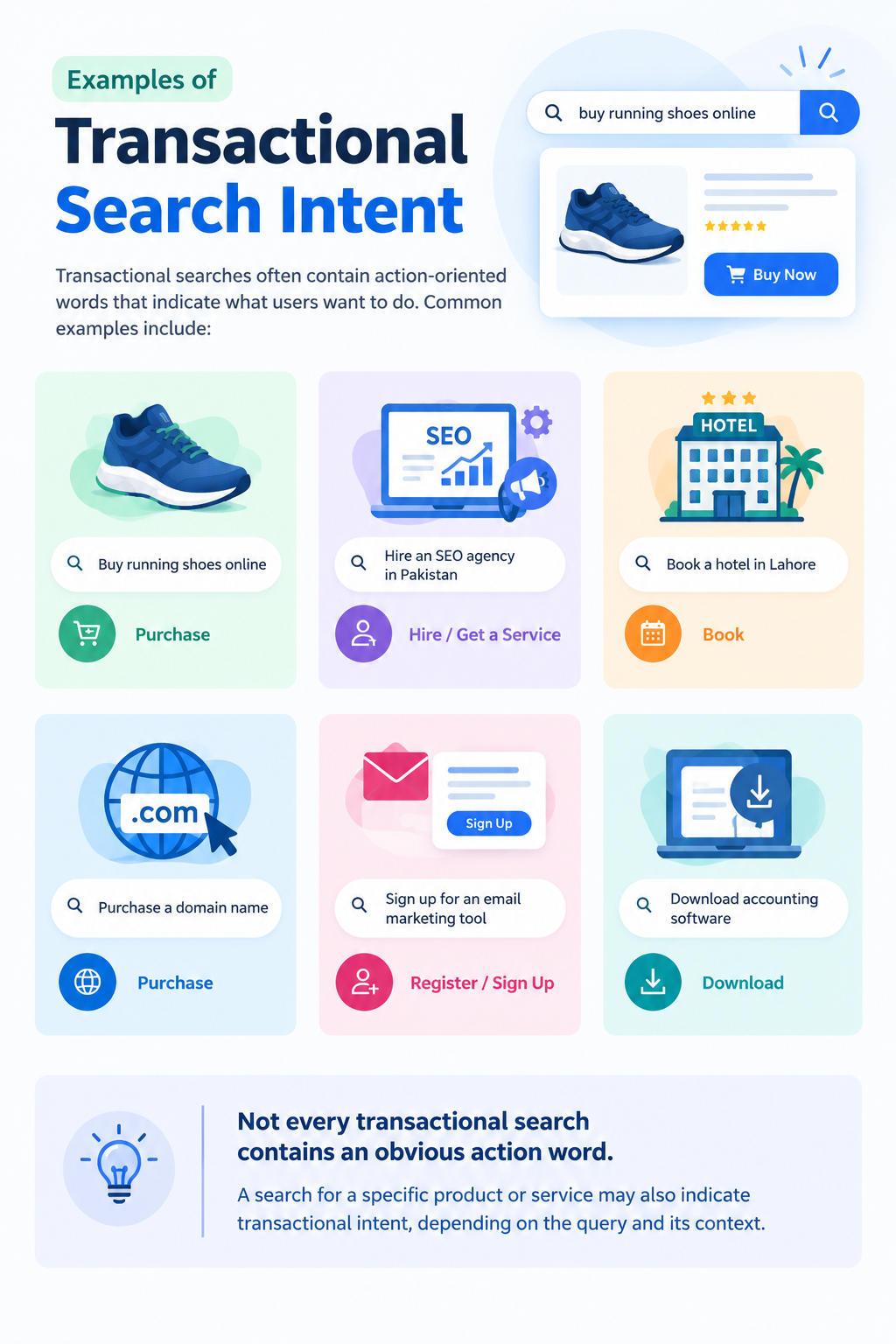
Examples of Transactional Search Intent
Transactional searches often contain action-oriented words that indicate what users want to do. Common examples include:
Buy running shoes online
Hire an SEO agency in Pakistan
Book a hotel in Lahore
Purchase a domain name
Sign up for an email marketing tool
Download accounting software
These queries suggest that users want to complete a purchase, booking, registration, or download.
However, not every transactional search contains an obvious action word. A search for a specific product or service may also indicate transactional intent, depending on the query and its context.
How to Identify Transactional Keywords
Transactional keywords are search terms that indicate a user’s goal of completing an action. They often include words and phrases such as:
Buy: Buy a laptop online
Purchase: Purchase web hosting
Hire: Hire an SEO consultant
Book: Book a consultation
Order: Order office furniture online
Sign up: Sign up for project management software
Download: Download a free image editor
These modifiers provide useful clues, but they do not establish search intent on their own. For example, a download-related search may be informational if the user wants to learn how a download works rather than download the software itself.
Validate Intent by Reviewing Search Results
Review the search engine results pages (SERPs) for your target keywords to understand what users are likely expecting.
Look for patterns such as:
Product pages with prices and purchase options
Service pages with inquiry or quote-request forms
Booking pages with availability and reservation options
Registration pages with account-creation options
If these page types dominate the relevant results, they can provide evidence that the query has transactional intent. However, search results may contain mixed intent, so consider the wording of the query and the needs of your target audience as well.
Transactional Search Intent vs. Other Search Intents
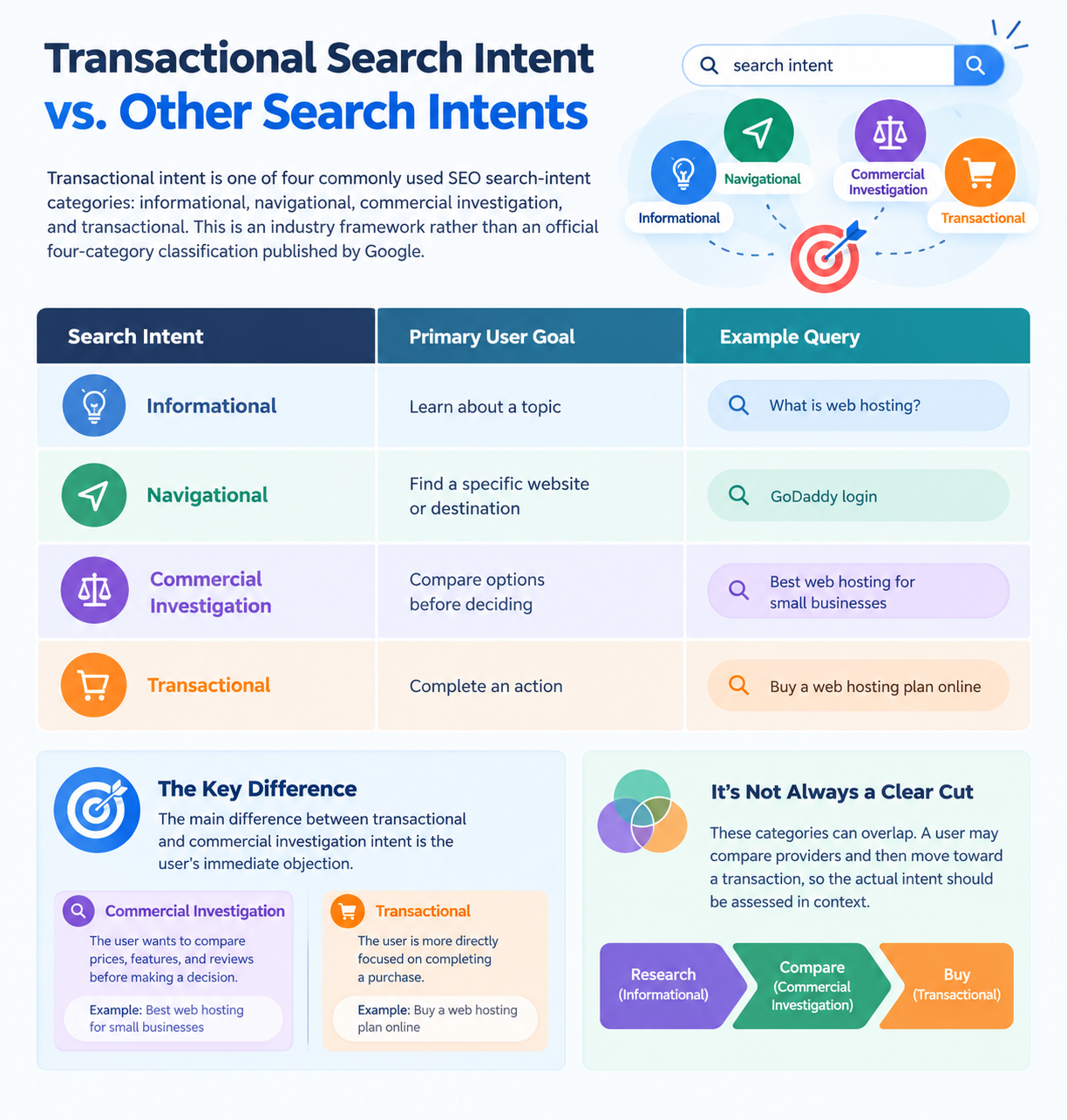
Transactional intent is one of four commonly used SEO search-intent categories: informational, navigational, commercial investigation, and transactional. This is an industry framework rather than an official four-category classification published by Google.
| Search intent | Primary user goal | Example query |
|---|---|---|
| Informational | Learn about a topic | What is web hosting? |
| Navigational | Find a specific website or destination | GoDaddy login |
| Commercial investigation | Compare options before deciding | Best web hosting for small businesses |
| Transactional | Complete an action | Buy a web hosting plan online |
The key difference between transactional and commercial investigation intent is the user’s immediate objective.
For example, someone searching for the best web hosting provider may want to compare prices, features, and reviews before making a decision. Someone searching to buy a specific hosting plan is more directly focused on completing a purchase.
These categories can overlap. A user may compare providers and then move toward a transaction, so the actual intent should be assessed in context.
How to Optimize Content for Transactional Search Intent
To target transactional keywords effectively, match the page type and content to the action users want to complete.
1. Choose the Right Page Type
Different transactional searches require different destinations.
| User’s intended action | Suitable page type |
|---|---|
| Purchase a specific product | Product page |
| Explore and purchase products within a category | Relevant category or product listing page |
| Hire a service provider | Service page |
| Book an appointment or consultation | Booking page |
| Register for a platform | Sign-up or registration page |
The page should satisfy the searcher’s goal rather than simply include the target keyword.
2. Use Relevant Transactional Keywords
Identify keywords that match the products or services you actually offer. Use them naturally in page titles, headings, descriptions, and relevant page content.
Avoid targeting transactional terms on pages that cannot fulfill the user’s expectations. For example, a general article explaining SEO may not be the most appropriate destination for someone searching to hire an SEO agency.
3. Make Calls to Action Clear
Use descriptive calls to action that communicate the next step, such as Buy Now, Book a Consultation, Request a Quote, or Sign Up.
Ensure that buttons and links lead to the expected destination and work correctly across desktop and mobile devices.
4. Provide Essential Decision-Making Information
Users need enough information to understand the offer and decide how to proceed. Depending on the page, include relevant pricing, product specifications, service details, availability, delivery information, or terms and conditions.
Clear, accurate information helps users assess whether the offer meets their needs.
5. Improve the Conversion Path
A relevant landing page is only one part of the user journey. Slow loading, confusing navigation, unexpected costs, and complicated forms can create barriers to completing an action.
Review the path from the landing page to the final purchase, booking, or registration. Identify unnecessary steps and usability problems without making unsupported assumptions about what will improve conversion rates.
Common Mistakes When Targeting Transactional Intent
Avoid these common mistakes when optimizing pages for transactional searches:
Using informational content for purchase-focused queries: Educational content may not meet the needs of users who want to complete a transaction.
Targeting irrelevant keywords: Transactional keywords should match the actual products, services, or actions available.
Ignoring search results: Optimizing a page type without checking what users are likely expecting can lead to an intent mismatch.
Hiding essential information: Missing prices, unclear service details, or confusing terms can make decisions more difficult.
Using misleading calls to action: Buttons should accurately describe what happens when users click them.
Assuming transactional intent guarantees conversions: Intent indicates a likely goal, not a guarantee that every visitor will take action.
Why Transactional Search Intent Matters for SEO
Understanding transactional search intent helps businesses align organic search visibility with pages designed to support meaningful actions.
For example, an SEO company targeting a query such as “hire an SEO agency in Pakistan” should provide a relevant service page with clear service information and an appropriate inquiry option. A general article explaining SEO may not satisfy the same immediate need.
For businesses seeking to align their keyword targeting, search intent, and website content with business goals, Ranksols can help develop a more focused SEO content strategy.
Conclusion
Transactional search intent describes searches in which users aim to complete an action, such as making a purchase, booking a service, or registering for a platform.
By identifying transactional keywords, validating intent through search results, and matching queries to appropriate landing pages, businesses can create a more relevant search experience and support their conversion objectives.