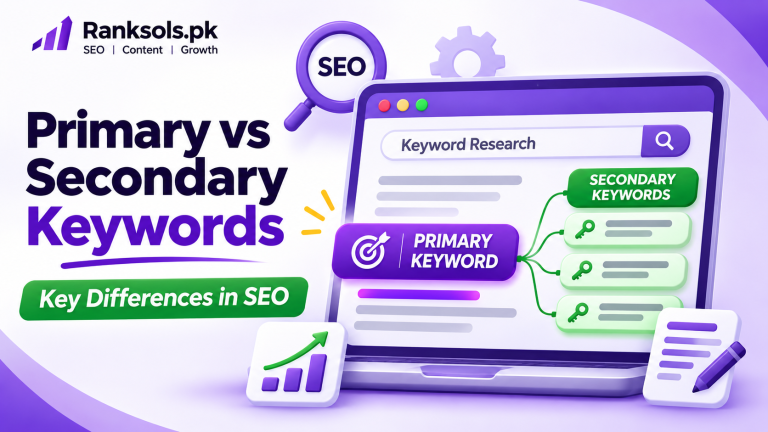
A webpage should generally focus on one primary keyword and several closely related secondary keywords that support the same topic and search intent. However, there is no fixed number of keywords that every page should target.
The goal is to create content around one clearly defined subject while naturally covering relevant search terms, variations, and user questions. This approach helps maintain topical focus, avoid unnecessary keyword repetition, and reduce overlap between webpages.
Understanding how many keywords a page should target helps SEO professionals plan content more effectively and organize website topics around users’ search needs.
One Primary Keyword Per Page
A primary keyword represents the main topic and search query that a webpage is designed to address. It provides a central focus for content planning and helps determine what information the page should cover.
For example, if a webpage explains how keyword research works, its primary keyword could be how to conduct keyword research.
The primary keyword can guide important content elements, including:
SEO title and main heading.
Introduction and relevant content sections.
Page structure and supporting headings.
Internal linking strategy.
URL slug, where appropriate.
The primary keyword should accurately represent the page’s subject. It does not need to appear repeatedly throughout the content.
Important: Targeting one primary keyword is an SEO content-planning practice, not a requirement imposed by Google. Google’s language-matching systems can understand how a webpage relates to different search queries, even when their exact wording does not appear in the content.
Google for Developers+1
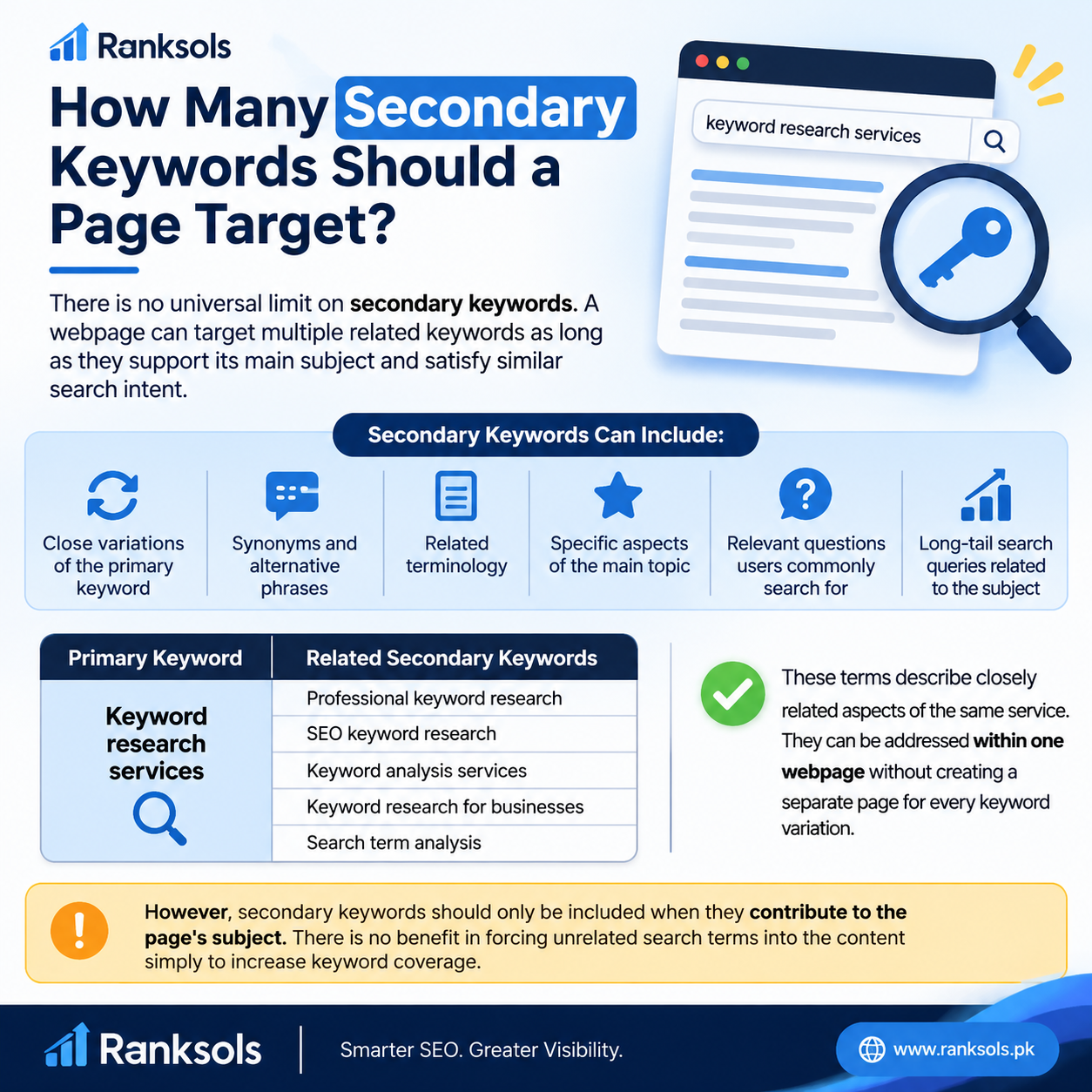
How Many Secondary Keywords Should a Page Target?
There is no universal limit on secondary keywords. A webpage can target multiple related keywords as long as they support its main subject and satisfy similar search intent.
Secondary keywords can include:
Close variations of the primary keyword.
Synonyms and alternative phrases.
Related terminology.
Specific aspects of the main topic.
Relevant questions users commonly search for.
Long-tail search queries related to the subject.
For example, a page targeting keyword research services may naturally cover these related terms:
Primary Keyword | Related Secondary Keywords |
|---|---|
Keyword research services | Professional keyword research |
Keyword research services | SEO keyword research |
Keyword research services | Keyword analysis services |
Keyword research services | Keyword research for businesses |
Keyword research services | Search term analysis |
These terms describe closely related aspects of the same service. They can be addressed within one webpage without creating a separate page for every keyword variation.
However, secondary keywords should only be included when they contribute to the page’s subject. There is no benefit in forcing unrelated search terms into the content simply to increase keyword coverage.
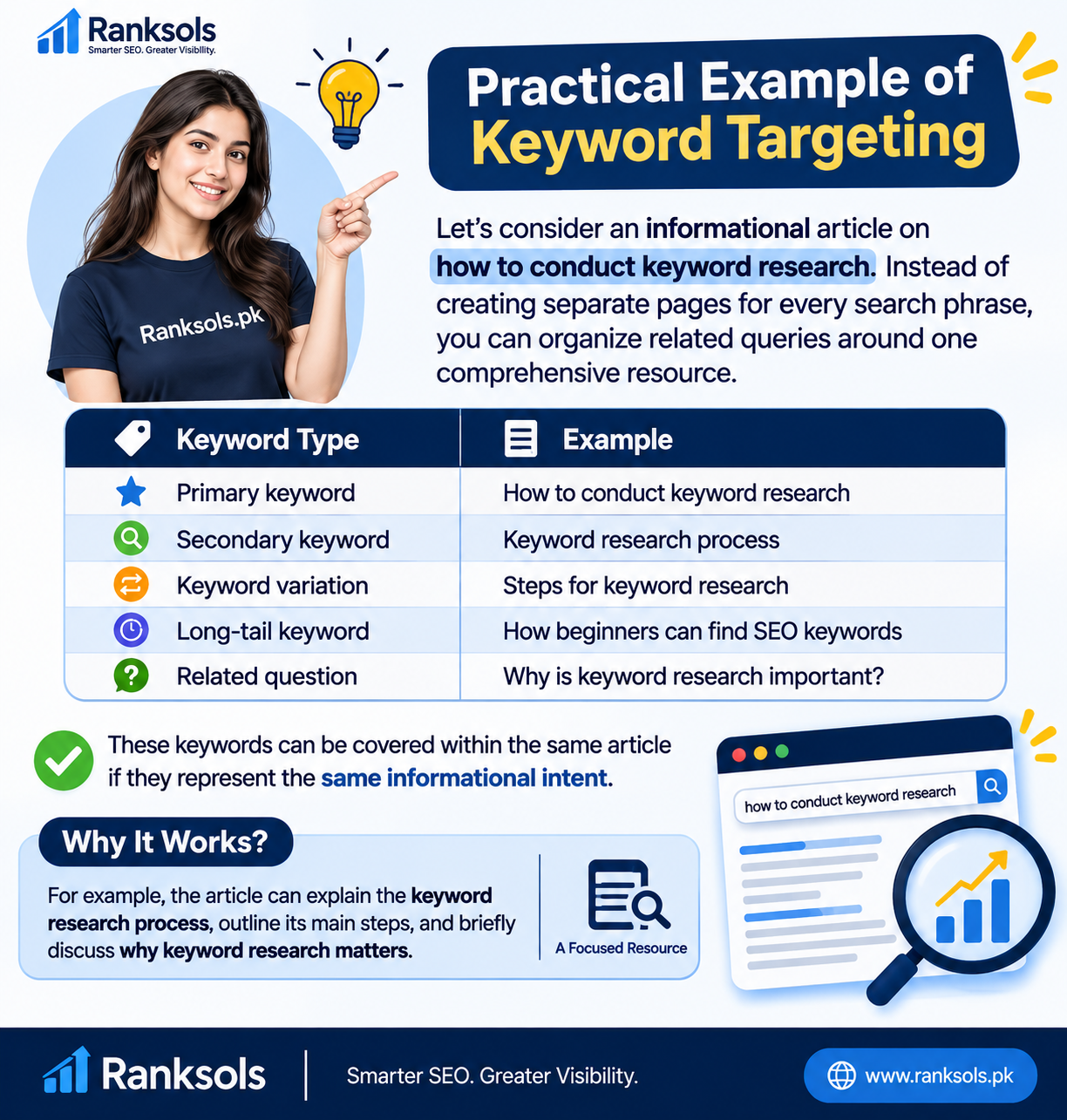
Practical Example of Keyword Targeting
Consider an informational article targeting the topic how to conduct keyword research.
Instead of creating separate articles for every closely related search phrase, a content writer can organize relevant queries around one comprehensive resource.
Keyword Type | Example |
|---|---|
Primary keyword | How to conduct keyword research |
Secondary keyword | Keyword research process |
Keyword variation | Steps for keyword research |
Long-tail keyword | How beginners can find SEO keywords |
Related question | Why is keyword research important? |
These keywords can be covered within the same article if they represent the same informational intent.
For example, the article can explain the keyword research process, outline its main steps, and briefly discuss why keyword research matters.
This creates a focused resource that addresses related user questions without unnecessary repetition.
Should Every Keyword Have a Separate Page?
No. Creating a separate webpage for every keyword variation is usually unnecessary when those keywords represent the same topic and search intent.
For example, the following queries can often be addressed by one well-organized article:
What is keyword research?
Keyword research meaning.
Keyword research explained.
How does keyword research work?
These searches have closely related informational intent, so one useful article may satisfy them together.
However, keywords with different user needs may require separate pages.
Keyword | Likely Suitable Page |
|---|---|
What is keyword research? | Educational article |
Keyword research services | Service page |
Best keyword research tools | Comparison article |
The decision should depend on the actual search intent and the information users expect to find, rather than keyword wording alone.
When Should Keywords Have Separate Pages?
Separate webpages may be appropriate when keywords represent meaningfully different topics or search intents.
Consider creating separate pages when:
Search intent differs: One keyword requires an informational article, while another requires a service or product page.
Content requirements differ: Each topic needs substantial information that cannot be covered effectively within one resource.
User expectations differ: Searchers are looking for different solutions, information, or actions.
Each page offers independent value: A separate resource provides useful information rather than repeating another page.
For example, an article explaining keyword research and a service page offering professional keyword research address different user needs.
Both can exist on the same website because they serve different purposes.
Before creating another page, examine the search results and compare the content types appearing for the relevant queries. This helps determine whether the topics belong together or deserve separate resources.
How to Choose the Right Keywords for a Page
Instead of following an arbitrary keyword limit, use a structured approach to select keywords that support the page’s main topic.
1. Select One Primary Keyword
Identify the main search query that best represents the webpage’s purpose. Choose a phrase that accurately describes the subject and matches the audience’s needs.
2. Identify Relevant Secondary Keywords
Find related search terms, keyword variations, and questions that support the primary topic.
Prioritize relevance over search volume or the number of keywords discovered during research.
3. Analyze Search Intent
Examine the search engine results pages (SERPs) for the selected keywords.
Check whether Google displays similar content types for those queries. If the results indicate different user expectations, consider targeting them through separate webpages.
4. Organize Keywords Around Relevant Sections
Use secondary keywords to identify useful content sections and supporting questions.
For example, an article about keyword research may naturally include sections about the research process, keyword selection, and search intent.
However, do not create headings simply to insert additional keywords. Every section should contribute to the reader’s understanding.
5. Review Keyword Performance
After publishing, use Google Search Console to examine the search queries generating impressions and clicks for the webpage.
Pay attention to:
Relevant queries generating impressions.
Search terms attracting clicks.
Queries with impressions but limited clicks.
Related searches that reveal useful content opportunities.
If a relevant query is not adequately addressed, consider improving the existing content. However, do not automatically add new sections for every query appearing in Search Console.
The Performance report provides query and page-level information that can help evaluate search visibility and identify content improvement opportunities.
Search Console Help+1
Common Keyword Targeting Mistakes
Avoid these common mistakes when deciding how many keywords a webpage should target.
Targeting too many unrelated keywords: Combining unrelated subjects on one page can weaken its focus and make the content less useful.
Using only the exact-match keyword: Natural variations and related terminology help explain a topic more completely. Repeating one exact phrase is unnecessary.
Creating separate pages for every variation: Publishing multiple pages for minor keyword variations can lead to repetitive content and overlapping page purposes.
Ignoring search intent: Keywords may look similar but represent different user needs. Consider the information users expect before grouping them together.
Following a fixed keyword density: There is no universal keyword density percentage that guarantees better rankings. Write naturally and use relevant terms where they make sense.
Google identifies excessive keyword repetition and unnatural keyword placement as keyword stuffing. Its SEO guidance recommends useful, naturally written content rather than unnecessary keyword repetition.
Google for Developers+1
How to Avoid Keyword Cannibalization
Keyword cannibalization is commonly used to describe situations where multiple pages on the same website target overlapping search queries and serve substantially similar purposes.
For example, publishing three separate articles targeting:
How many keywords should a page target?
How many keywords per webpage?
Ideal number of SEO keywords per page.
may create unnecessary overlap if all three articles answer the same question.
A better approach is to consolidate closely related queries into one useful resource.
However, multiple pages appearing for similar search queries do not automatically indicate a problem or Google penalty. The important consideration is whether each page serves a distinct purpose and provides independent value.
To reduce unnecessary overlap:
Assign a clear primary topic to each webpage.
Group closely related keywords when their search intent matches.
Avoid publishing repetitive articles for minor keyword variations.
Create separate resources when topics have genuinely different purposes.
Use relevant internal links to connect related pages.
For a deeper understanding, explore [primary and secondary keywords] and keyword clustering when planning website content.
Practical Recommendation: Focus on Topic Relevance, Not Keyword Count
The most effective approach is to build each webpage around one clearly defined topic and include relevant search terms that naturally support it.
Use this framework when planning content:
Keyword Type | Recommended Approach |
|---|---|
Primary keyword | One central target |
Secondary keywords | Several closely related terms |
Keyword variations | Include naturally where relevant |
Long-tail keywords | Cover when they support the same intent |
Unrelated keywords | Consider separate pages |
This is an SEO content-planning framework, not a fixed Google ranking rule or required keyword limit.
The number of secondary keywords should depend on the subject, search intent, and information needed to satisfy the reader.
If you need help organizing keyword targets, evaluating search intent, or planning content around related search queries, Ranksols can help your business develop a structured SEO content strategy focused on relevance, content organization, and user needs.
Frequently Asked Questions
Can one page rank for multiple keywords?
Yes. A single webpage can appear in Google Search results for multiple related queries, including keyword variations and long-tail searches. These queries do not all need to be included as exact phrases in the content.
Is one primary keyword enough for a page?
One primary keyword provides a clear content focus, but the webpage should also address relevant secondary keywords and related concepts where they improve the reader’s understanding.
Should I use every keyword from my keyword research?
No. Select keywords based on topical relevance, search intent, and their relationship with the page’s subject. Exclude unrelated terms rather than forcing them into the content.
Does Google require a specific number of keywords per page?
No. Google does not prescribe a fixed number of keywords that a webpage must target. Its guidance focuses on useful content, natural language, and helping search engines understand the page.
Should I use the primary keyword in every heading?
No. Use headings to organize information and explain different aspects of the topic. Include the primary keyword or related terms where they fit naturally, but avoid repetitive or keyword-focused headings.
Can multiple pages target the same keyword?
Yes, when the pages serve different purposes and satisfy different user needs. However, creating multiple pages with substantially similar content and intent may lead to unnecessary overlap.
Final Thoughts
There is no ideal keyword count for every webpage. A practical SEO strategy is to target one primary keyword, support it with relevant secondary keywords, and cover related search queries naturally.
Rather than trying to rank for as many keywords as possible, focus on creating a webpage that satisfies a clear search intent and provides useful information about one subject.
This approach helps maintain a focused content structure, reduces unnecessary keyword overlap, and supports a more organized SEO strategy.