Choosing the right keywords is an important part of building an effective SEO strategy. The most suitable keywords are not necessarily those with the highest search volume. They are the search terms that match your website’s content, reflect your audience’s needs, and support your business objectives.
A well-selected keyword helps you create relevant content, reach the right audience, and improve your opportunities to appear in relevant search results.
This guide explains how to evaluate keyword relevance, search intent, search volume, competition, and business value to select the most suitable keywords for your website.
Understand Your Target Audience
Before selecting keywords, understand what your target audience is searching for and what information or services they need.
Consider their questions, problems, interests, industry, and level of knowledge. These factors help identify search terms that reflect their actual needs.
For example, people searching for SEO-related information may use queries such as:
How does SEO work?
Benefits of SEO for businesses.
However, people looking for professional assistance may search for:
Professional website SEO services.
These searches reflect different audience requirements. Understanding these differences helps you select keywords that attract visitors who are more likely to engage with your content or services.
Identify the Search Intent
Search intent refers to the reason behind a user’s search query. Understanding it helps determine whether a keyword is suitable for a particular webpage.
Search queries generally reflect four common types of intent:
Informational: Users want to learn something, such as “what is keyword research?”
Navigational: Users want to find a particular website or brand, such as “Ranksols.”
Commercial: Users want to compare products or services, such as “best SEO agencies in Pakistan.”
Transactional: Users are ready to take an action, such as “hire an SEO company.”
Before selecting a keyword, examine its Google search results to understand what type of content appears for that query.
For example, an informational keyword is generally better suited to an educational article, while a service-related keyword may be more appropriate for a dedicated service page.
Matching keywords with search intent helps ensure that your content meets users’ expectations.
Check Keyword Relevance
Keyword relevance should be one of the most important factors in keyword selection.
A keyword should closely relate to your website, business, products, services, or the specific subject of your content.
For example, an SEO agency may find these keywords relevant:
SEO services
Technical SEO
Website SEO audit
Local SEO services
SEO consulting
However, targeting unrelated keywords simply because they have high search volumes may attract visitors who have little interest in your website.
Choose search terms that naturally connect with the information you provide or the services you offer.
Evaluate Keyword Search Volume
Search volume indicates how frequently people search for a particular keyword within a specific period and location.
It helps estimate search demand and compare potential keyword opportunities. However, search volume should not be the only consideration when selecting keywords.
Keywords can generally be evaluated according to their search demand:
High-volume keywords: Often attract broader search interest but may have stronger competition and less specific intent.
Medium-volume keywords: May offer a useful balance between search demand and topic relevance.
Low-volume keywords: Often represent more specific searches and may attract a narrower, highly relevant audience.
For example, “SEO” is a broad keyword, whereas “technical SEO audit for WordPress” describes a more specific requirement.
A keyword with lower search volume can still be valuable when it closely matches your audience’s needs.
Important: Search volume is an estimate, not a prediction of website traffic. Actual organic traffic depends on several factors, including ranking position, search intent, search features, and user behavior.
Analyze Keyword Competition
Keyword competition helps you understand how challenging it may be to gain visibility for a particular search term.
SEO tools such as Ahrefs and Semrush provide keyword difficulty scores to estimate organic ranking competition. These scores are calculated differently by different tools and should be treated as comparative estimates rather than official Google ranking metrics.
When evaluating organic competition, examine:
The relevance and quality of currently ranking pages.
How thoroughly competing pages address the subject.
The authority and reputation of competing websites.
The type of content appearing in search results.
Whether your website can provide a more useful and relevant resource.
It is also important to distinguish SEO competition from advertising competition.
For example, Google Keyword Planner provides an advertising competition metric related to advertisers competing for paid placements. It does not directly measure organic SEO difficulty.
For organic keyword selection, focus on the relevance and quality of ranking pages alongside the estimates provided by SEO tools.
Consider Long-Tail Keywords
Long-tail keywords are specific search phrases that usually target a narrower subject or user requirement.
They help websites reach audiences searching for particular information, products, or services.
For example:
Broad Keyword | Long-Tail Keyword |
|---|---|
SEO | SEO services for small businesses |
Web hosting | Managed VPS hosting for businesses |
Keyword research | How to find keywords for a new website |
Local SEO | Local SEO services in Lahore |
Long-tail keywords may have lower search volumes than broad search terms, but their specificity can make them more relevant to particular audiences.
They can also provide opportunities for smaller websites to target specific topics. However, long-tail keywords are not automatically easy to rank for, particularly when they have strong commercial intent.
Review Google Search Results Before Choosing a Keyword
Keyword research tools provide useful information, but reviewing actual search engine results pages (SERPs) helps you understand how Google currently addresses a search query.
Examine the top-ranking pages and consider:
Content type: Are the results mainly articles, service pages, product pages, or landing pages?
Search intent: Do the results match the purpose of your planned content?
Content relevance: How closely do ranking pages address the search query?
Content coverage: What important information do competing pages provide?
Content opportunities: Can your webpage answer the query more clearly or address an overlooked user need?
For example, if a keyword primarily displays educational articles, creating a service page for that search may not satisfy the expected intent.
SERP analysis helps you determine whether a keyword is appropriate for your planned webpage before investing time in content creation.
Consider Location and Language Relevance
For businesses targeting specific geographical markets, keyword selection should reflect the locations and languages of their potential customers.
Search demand and keyword relevance can vary between countries, cities, and language groups.
For example, an SEO agency serving customers in Pakistan may consider:
SEO services in Pakistan
SEO agency in Lahore
SEO consultant in Karachi
SEO services for Pakistani businesses
Location-specific keywords can help businesses target relevant local searches rather than competing only for broad terms.
Similarly, consider the language your audience actually uses when searching. Keyword variations, spelling differences, and regional terminology can influence which search terms are most relevant.
Google Keyword Planner and other keyword research tools can help evaluate search demand using geographical and language settings.
Evaluate the Business Value of Keywords
Not every relevant keyword contributes equally to your website’s business objectives.
Some keywords attract visitors looking for general information, while others indicate that users are comparing services or preparing to make a purchase.
Consider the following examples:
Keyword | Potential Value | Suitable Content |
|---|---|---|
What is SEO? | Educational awareness | Informational article |
How does SEO work? | Topic understanding | Knowledge-base article |
Best SEO agency in Pakistan | Service comparison | Commercial landing page |
SEO services in Lahore | Local service discovery | Service page |
Hire an SEO company | Purchase or service action | Conversion-focused page |
A suitable keyword should support both the audience’s requirements and the purpose of the webpage.
For businesses, this means considering not only how many people search for a term but also whether those searches are relevant to the products or services being offered.
Choose Primary and Secondary Keywords
Once you have evaluated potential keywords, organize them according to their importance and relationship to your content.
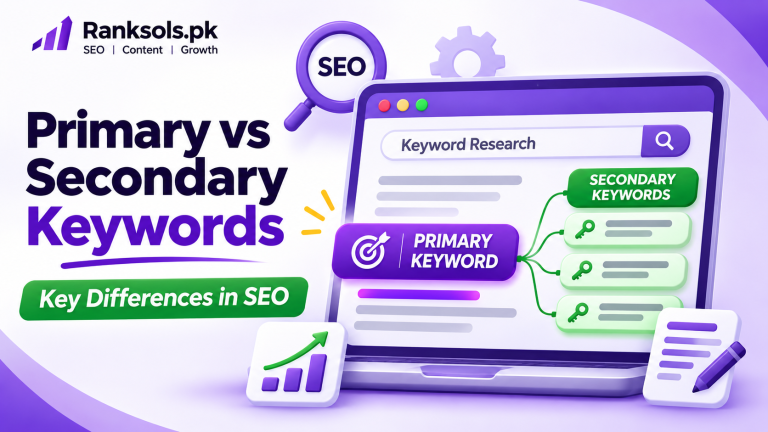
Primary keyword: The main search term that represents the central topic of a webpage.
Secondary keywords: Related search terms that support the primary topic and provide additional context.
For example, an article about keyword research might use:
Keyword Type | Example |
|---|---|
Primary keyword | Keyword research |
Secondary keyword | SEO keyword research |
Secondary keyword | Keyword research process |
Secondary keyword | Finding relevant keywords |
Secondary keyword | Keyword research techniques |
The primary keyword should clearly represent the page’s main subject, while secondary keywords should naturally support the topic.
Avoid assigning unrelated keywords to the same page simply to increase keyword coverage.
Related search queries can often be addressed together when they share the same intent and subject. If two keywords require substantially different content or serve different user needs, separate webpages may be more appropriate.
Use Keyword Research Tools to Compare Options
Keyword research tools help evaluate potential keywords using search volume, competition estimates, related search terms, and other useful information.
Some commonly used tools include:
Google Keyword Planner: Provides keyword ideas, search estimates, and advertising competition information.
Google Search Console: Shows the search queries generating impressions and clicks for your existing website.
Ahrefs: Provides keyword research data and organic keyword difficulty estimates.
Semrush: Helps evaluate keyword opportunities, related search terms, and organic competition.
Ubersuggest: Offers keyword ideas and estimated search metrics.
For existing websites, Google Search Console is particularly useful because it provides actual performance information from Google Search.
You can examine:
Queries generating impressions.
Queries receiving clicks.
Pages appearing for relevant searches.
Search terms that may reveal additional content opportunities.
However, Search Console does not provide a complete list of all searches people make. Its reports focus on the performance data available for your own website.
Use multiple sources when appropriate, and evaluate keyword opportunities based on relevance and search intent rather than relying on a single tool or metric.
Avoid Common Keyword Selection Mistakes
Choosing keywords without evaluating their suitability can lead to ineffective content planning and missed opportunities.
Avoid these common mistakes:
Choosing keywords only because of high search volume: Popularity does not necessarily mean a keyword is valuable to your audience.
Ignoring search intent: A keyword should match the information or service users expect.
Targeting overly competitive keywords: Evaluate the actual search results and your website’s ability to compete.
Ignoring long-tail keywords: Specific searches can reveal valuable audience requirements.
Using unrelated keywords together: Keep each webpage focused on a clear subject.
Ignoring business objectives: Select keywords that support the purpose of your website.
Creating duplicate keyword-targeted pages: Check whether an existing webpage already serves the same search intent before publishing another one.
Avoiding these mistakes helps create a more focused keyword strategy and improves the relevance of your website’s content.
Finalize Your Keyword Selection
Before choosing a keyword for a webpage, evaluate it against the following criteria.
Selection Criteria | What to Check |
|---|---|
Relevance | Does it match your website and content topic? |
Search intent | Does it reflect what users want to find? |
Search volume | Is there measurable search demand? |
Competition | Can your website realistically compete? |
Specificity | Does it target a clear subject or audience? |
Business value | Does it support your website’s objectives? |
Location and language | Does it match your target market? |
Content suitability | Can you create useful content around it? |
Existing coverage | Does another page already target the same search intent? |
A keyword does not need to perform equally well in every category. The objective is to identify the most suitable opportunity based on your audience, content purpose, and business goals.
Once selected, use the keyword naturally in relevant page elements and create content that addresses the subject clearly. Avoid repeating exact-match phrases unnecessarily.
How Ranksols Can Help With Keyword Selection
Choosing effective keywords requires more than identifying popular search terms. It involves understanding search intent, evaluating organic competition, and selecting keywords that align with your website’s content and business objectives.
At Ranksols, we emphasize practical SEO strategies that help businesses identify relevant search opportunities and develop focused content strategies.
If you need professional guidance with keyword selection, keyword research, and SEO planning, explore Ranksols to learn more about our SEO solutions.
Frequently Asked Questions
1. How do I choose the right keywords for SEO?
Start by understanding your target audience, identifying search intent, and evaluating keyword relevance, search volume, and competition. Select keywords that closely match your content and website objectives.
2. Should I always choose keywords with high search volume?
No. High search volume does not automatically make a keyword valuable. Specific, lower-volume keywords may attract a more relevant audience and better match your content goals.
3. How do I know if a keyword is too competitive?
Review its organic search results, examine the quality and relevance of ranking pages, and compare keyword difficulty estimates from SEO tools. Consider whether your website can provide content that competes meaningfully with existing results.
4. How many keywords should I target on one page?
There is no fixed number. Focus on one clear primary topic and naturally include related search terms and variations. The content should address the subject effectively rather than target an arbitrary number of keywords.
5. Are long-tail keywords better for SEO?
Long-tail keywords can be useful because they target specific search queries and audience needs. However, their value depends on relevance, search intent, competition, and business objectives.