Introduction
Keyword research helps businesses and content creators identify the search terms their target audience uses. However, mistakes during keyword selection can lead to irrelevant traffic, poor content decisions, and missed SEO opportunities.
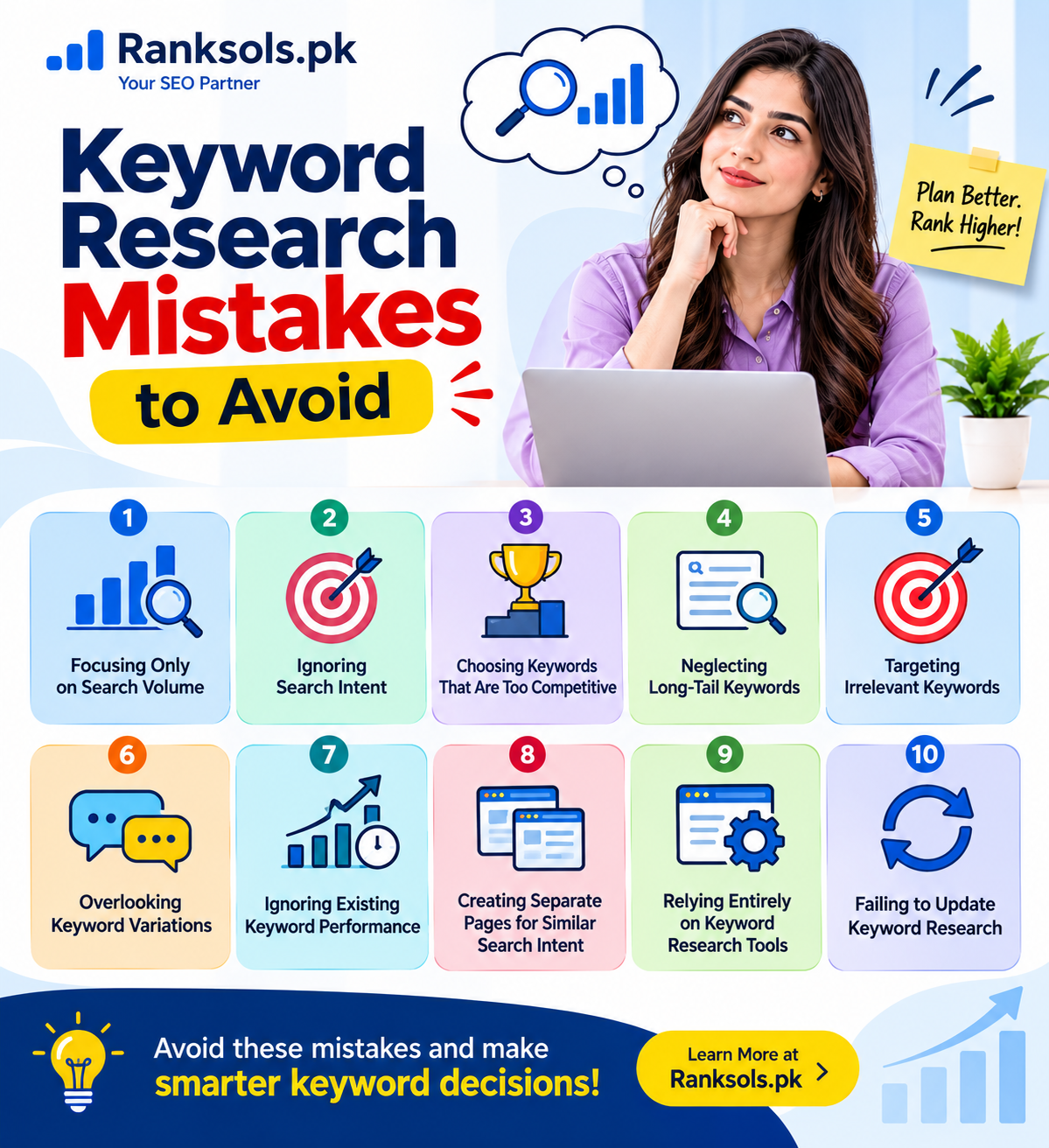
Common keyword research mistakes include focusing only on search volume, ignoring search intent, overlooking long-tail keywords, and targeting terms that do not match a website’s audience or objectives.
Understanding these mistakes helps create a more focused keyword strategy, improve content relevance, and identify better opportunities for organic search visibility.
Common Keyword Research Mistakes to Avoid
1. Focusing Only on Search Volume
One of the most common keyword research mistakes is selecting keywords based entirely on monthly search volume.
High-volume keywords may attract considerable search interest, but they are not necessarily the most valuable choices for every website. A keyword may have thousands of monthly searches while attracting visitors who have little interest in the website’s content or services.
For example, an SEO agency may find that the broad keyword “SEO” has considerably more search demand than “local SEO services for small businesses.” However, the more specific phrase may better match its target audience and business objectives.
How to avoid it:
Evaluate keyword relevance before considering search volume.
Consider the audience and business value behind each search query.
Examine search intent and ranking competition.
Prioritize keywords that support your website’s content and objectives.
Search volume is useful for estimating demand, but relevance and search intent should guide keyword selection.
2. Ignoring Search Intent
Search intent refers to the reason behind a user’s search query. Ignoring it can result in content that does not satisfy what searchers expect to find.
For example, someone searching for “what is keyword research” likely wants an educational explanation, while someone searching for “best keyword research tools” may want to compare available tools.
These queries have different needs and may require different content formats.
How to avoid it:
Identify whether the query has informational, navigational, commercial, or transactional intent.
Examine Google’s search results to understand the content users expect.
Compare the types of pages currently ranking for the query.
Match the purpose and format of your webpage with the searcher’s needs.
Do not determine search intent from keywords alone. Actual search results provide useful context about what users are looking for.
3. Choosing Keywords That Are Too Competitive
Targeting highly competitive keywords without evaluating the existing search results can make keyword targeting unnecessarily difficult.
Established websites may have relevant content, strong backlink profiles, and considerable topical coverage for popular search terms. Competing against them may require more resources than a website can reasonably invest.
Keyword difficulty scores from third-party SEO tools can help compare opportunities, but they are estimates rather than official Google ranking metrics.
How to avoid it:
Examine the websites and pages currently ranking for the keyword.
Evaluate competing content quality and topical relevance.
Use keyword difficulty scores as guidance, not guarantees.
Identify specific search queries that better match your website’s expertise.
Consider realistic opportunities based on your website’s current content and authority.
The objective is not to avoid competitive keywords entirely, but to prioritize opportunities that make sense for your website.
4. Neglecting Long-Tail Keywords
Some content creators focus exclusively on short, broad keywords and overlook more specific search queries.
For example, targeting only “SEO services” may overlook related phrases such as:
SEO services for small businesses
Affordable local SEO services
SEO services for ecommerce websites
These longer phrases can reveal more specific audience needs and provide useful content opportunities.
However, long-tail keywords do not automatically have low competition or high conversion potential. Their value depends on relevance, search intent, and actual search demand.
How to avoid it:
Research specific search phrases related to your main topic.
Explore questions and problems your audience wants to solve.
Evaluate long-tail keywords according to their relevance and intent.
Include useful variations naturally in your content planning.
Long-tail keyword research helps uncover specific search opportunities that broad keyword research may overlook.
5. Targeting Irrelevant Keywords
A keyword may have attractive search volume but still be unsuitable for a website if it does not match its subject, audience, or business objectives.
For example, an SEO agency targeting keywords related to free graphic design software may attract visitors who have little interest in professional SEO services.
This creates a mismatch between the audience a keyword attracts and the purpose of the website.
How to avoid it:
Understand your target audience before selecting keywords.
Relate keywords to your website’s subject and services.
Consider the purpose of the target webpage.
Evaluate whether the search query supports your content or business objectives.
Avoid selecting keywords simply because they have high search demand.
Effective keyword targeting should attract relevant visitors rather than focusing exclusively on increasing website traffic.
6. Overlooking Keyword Variations and Related Terms
Focusing on one exact-match keyword can limit your understanding of how people search for related information.
Users may express the same need through different phrases, synonyms, questions, and related terminology.
For example:
Keyword research methods
Methods of keyword research
How to research keywords
These phrases may represent similar informational needs and can often be addressed within one well-organized resource.
How to avoid it:
Explore relevant keyword variations and synonyms.
Identify related questions and search phrases.
Consider the meaning behind different queries.
Include relevant terminology naturally in your content.
Avoid creating separate pages simply to target minor keyword variations.
The goal is to cover the subject comprehensively, not to insert every possible keyword variation into a webpage.
7. Ignoring Existing Keyword Performance
Starting keyword research without reviewing a website’s existing organic search performance can result in missed opportunities.
A webpage may already receive impressions for relevant search queries that were not included in the original keyword plan. These queries can reveal opportunities to improve existing content or address additional audience needs.
Google Search Console provides useful data through its Performance report, including:
Queries: Search terms that generated website impressions.
Clicks: Visits generated from Google Search results.
Impressions: How often website pages appeared in search results.
CTR: The percentage of impressions that resulted in clicks.
Average position: An aggregated indication of where the website appeared in search results.
How to avoid it:
Review the Search Console Performance report.
Identify relevant queries generating impressions.
Examine queries with opportunities for better content alignment.
Look for related search terms that your existing content could address.
Compare query performance over relevant time periods.
For example, an article about keyword research may receive impressions for searches related to keyword selection methods. These queries could reveal useful opportunities to improve the article’s coverage.
Remember that average position is an aggregated metric, not a guaranteed or fixed ranking position for every search.
8. Creating Separate Pages for Similar Search Intent
Another common keyword research mistake is creating multiple webpages for closely related search queries without considering whether they represent different user needs.
For example, creating separate articles for “keyword research methods” and “methods of keyword research” may be unnecessary if both queries have substantially similar search intent and require the same information.
However, similar keywords do not automatically cause keyword cannibalization. Separate pages can be appropriate when they serve meaningfully different purposes.
How to avoid it:
Compare the search intent behind similar keywords.
Examine overlapping search results and competing page types.
Group related queries when one page can satisfy their shared needs.
Create separate pages when the topics or expected content are meaningfully different.
Review existing website content before planning another article.
Keyword grouping helps create a more organized website structure and reduces unnecessary content duplication.
9. Relying Entirely on Keyword Research Tools
Keyword research tools provide useful information about search volume, keyword suggestions, competition, and estimated difficulty. However, their metrics should not be treated as a complete representation of search demand or ranking potential.
Different tools may provide different estimates because they use their own data sources and calculation methods.
Relying entirely on these figures can result in poor keyword decisions.
How to avoid it:
Use keyword tools to discover and compare opportunities.
Examine actual Google search results.
Review Google Search Console data for existing websites.
Evaluate search intent and content relevance independently.
Treat keyword metrics as estimates rather than guarantees.
Keyword research tools should support SEO decision-making, not replace professional judgment.
10. Failing to Update Keyword Research
Keyword research should not remain unchanged when audience needs, business objectives, or search behavior evolve.
Previously selected keywords may become less relevant, while new search queries can reveal opportunities for content improvements.
Regularly reviewing keyword performance helps keep content planning aligned with current website objectives.
How to avoid it:
Monitor significant changes in search impressions and clicks.
Review new relevant queries in Google Search Console.
Reassess keywords when business services or products change.
Identify new audience questions and search opportunities.
Update existing content when it no longer satisfies search intent.
Keyword research reviews are particularly useful when planning new content, improving existing webpages, or responding to changes in an industry.
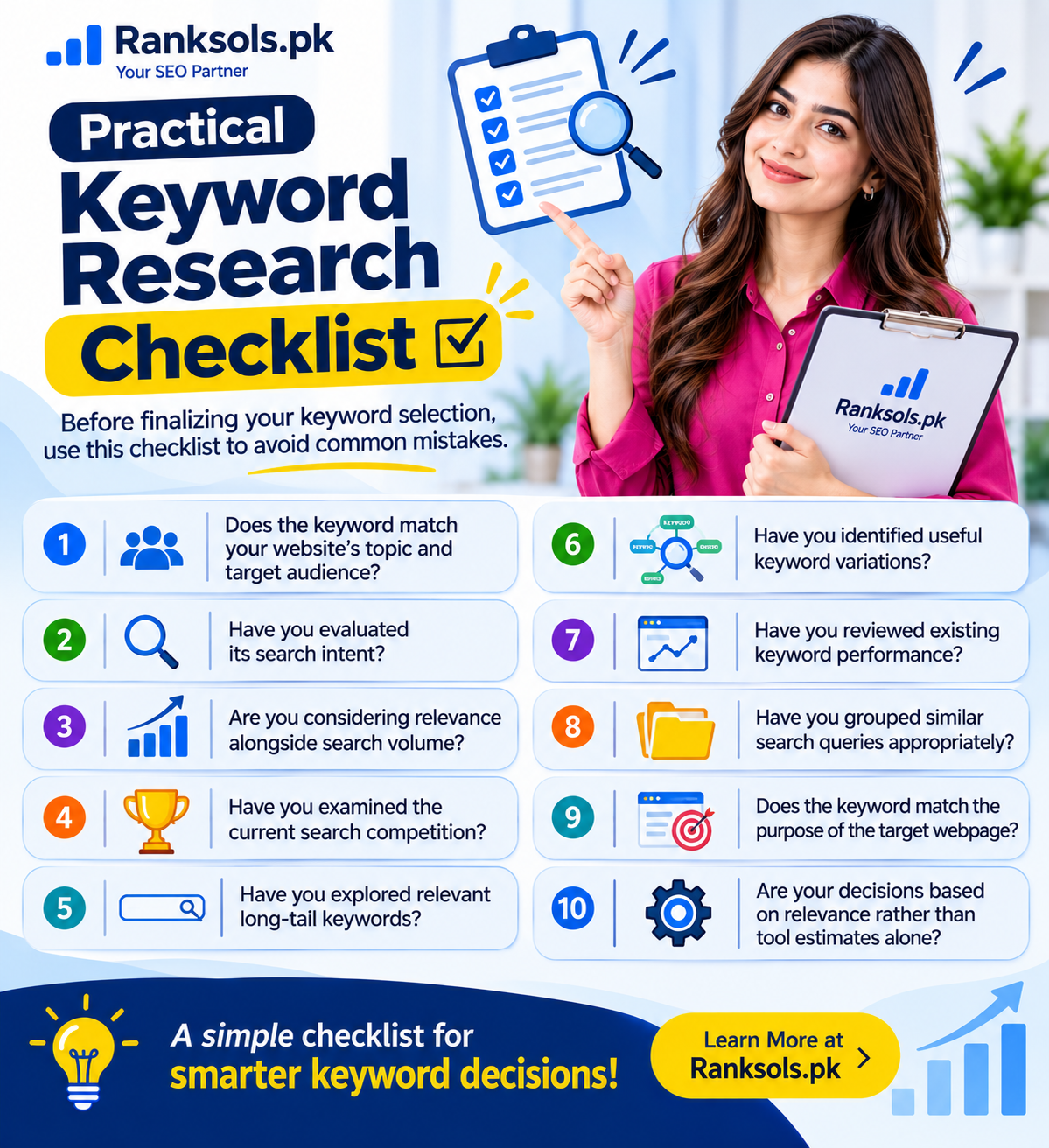
Practical Keyword Research Checklist
Before finalizing your keyword selection, use this checklist to identify potential mistakes and improve your keyword decisions.
This checklist can help content creators and SEO professionals make more informed keyword selection decisions.
How Ranksols Can Help
Effective keyword research requires more than collecting search terms and comparing search volumes. It involves understanding audience needs, evaluating search intent, identifying relevant opportunities, and selecting keywords that support a website’s objectives.
At Ranksols, we focus on strategic SEO practices that help businesses improve search visibility through relevant keyword targeting, content optimization, and effective SEO planning.
Explore Ranksols.pk to learn more about professional SEO services and website optimization.
Conclusion
Avoiding common keyword research mistakes helps build a more focused and effective SEO content strategy. Selecting keywords based on relevance, search intent, competition, and audience needs can improve content planning and help identify valuable organic search opportunities.
Rather than choosing keywords simply because they have high search volume, prioritize search terms that align with your website’s purpose and provide value to your target audience.