
The improved version below incorporates the evaluation recommendations while preserving the article’s original purpose as a supporting resource for the Ranksols SEO Knowledge Library.
The revision focuses on clearer definitions, more accurate SEO explanations, a stronger practical example, reduced repetition, and natural keyword usage. It also clarifies that primary and secondary keywords are SEO content-planning concepts, not formal Google ranking categories.
What Are Primary Keywords?
A primary keyword is the main search term a webpage is primarily designed to target. It represents the central subject of the content and establishes its main SEO focus.
For example, if a website publishes an article about keyword research, its primary keyword could be:
– Keyword research
The primary keyword should accurately reflect the page’s subject and align with the search intent it aims to satisfy.
SEO professionals commonly use the primary keyword when planning important content elements, including:
Page title (title tag).
Main heading (H1).
Introduction.
Relevant subheadings, where appropriate.
URL slug, when suitable.
Meta description, where it fits naturally.
These are content optimization considerations, not mandatory Google requirements. The keyword should help communicate the page’s subject without being repeated unnaturally.
What Are Secondary Keywords?
Secondary keywords are related search terms that support the primary keyword by covering connected concepts, variations, and subtopics.
They help expand the content’s topical coverage and allow a webpage to address related user questions without creating separate pages for every keyword variation.
For example, if the primary keyword is keyword research, relevant secondary keywords might include:
SEO keyword research
Keyword analysis
Keyword research process
Search volume
Keyword relevance
Long-tail keywords
Keyword difficulty
These terms can be incorporated into relevant paragraphs and subheadings when they contribute to the reader’s understanding.
Secondary keywords should support the same central topic rather than introduce unrelated subjects.
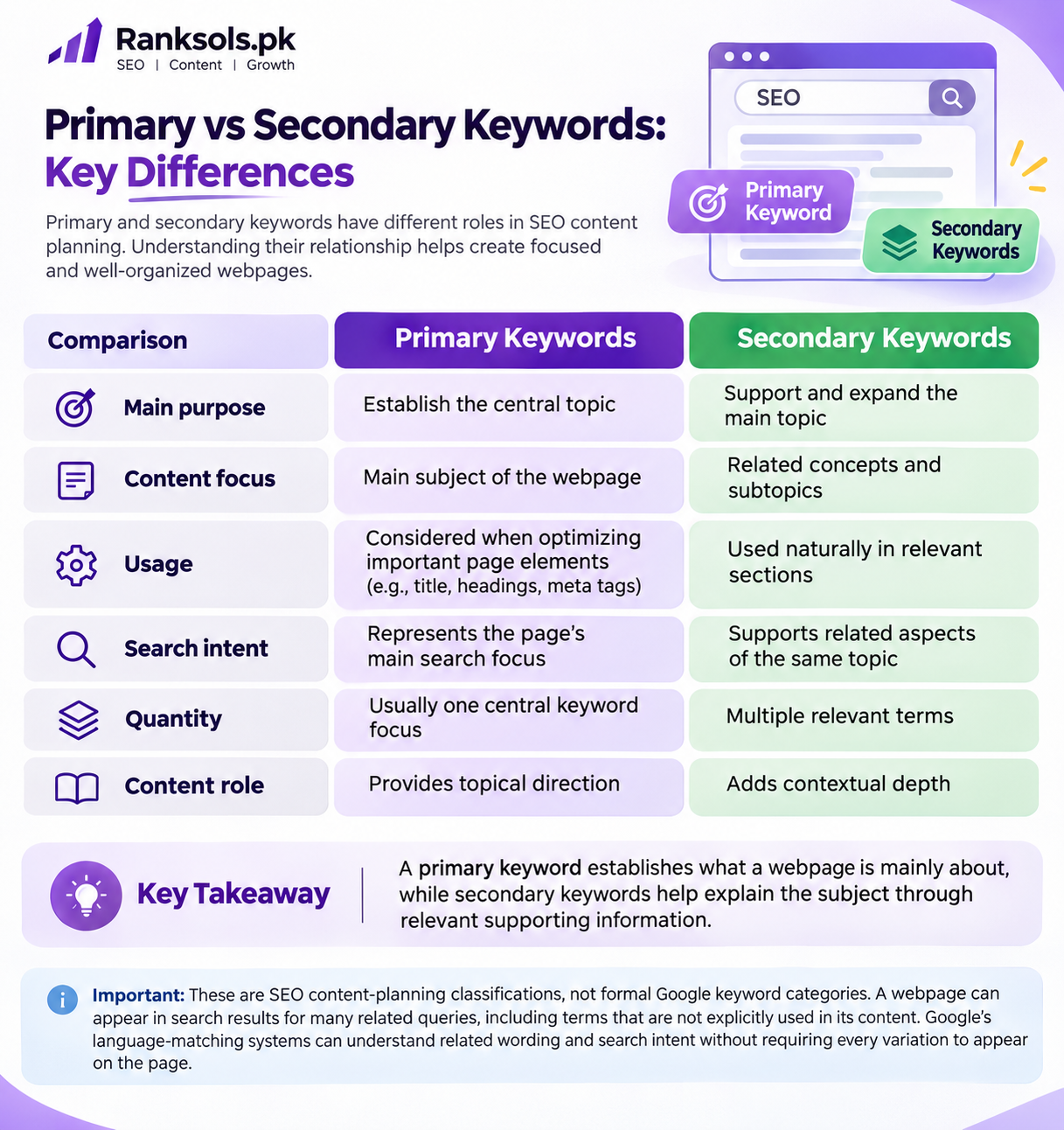
Primary vs Secondary Keywords: Key Differences
Primary and secondary keywords have different roles in SEO content planning. Understanding their relationship helps create focused and well-organized webpages.
Comparison | Primary Keywords | Secondary Keywords |
|---|---|---|
Main purpose | Establish the central topic | Support and expand the main topic |
Content focus | Main subject of the webpage | Related concepts and subtopics |
Usage | Considered when optimizing important page elements | Used naturally in relevant sections |
Search intent | Represents the page’s main search focus | Supports related aspects of the same topic |
Quantity | Usually one central keyword focus | Multiple relevant terms |
Content role | Provides topical direction | Adds contextual depth |
A primary keyword establishes what a webpage is mainly about, while secondary keywords help explain the subject through relevant supporting information.
Important: These are SEO content-planning classifications, not formal Google keyword categories. A webpage can appear in search results for many related queries, including terms that are not explicitly used in its content. Google’s language-matching systems can understand related wording and search intent without requiring every variation to appear on the page.
Example of Primary and Secondary Keywords
Consider a website publishing an educational article about technical SEO.
Its keyword structure could look like this:
Keyword Type | Example |
|---|---|
Primary keyword | Technical SEO |
Secondary keyword | Technical SEO checklist |
Secondary keyword | Website crawlability |
Secondary keyword | Website indexing |
Secondary keyword | XML sitemap |
Secondary keyword | Website architecture |
Secondary keyword | Technical SEO audit |
The primary keyword defines the article’s central subject, while secondary keywords identify relevant areas that can be covered within the content.
For example, the article could use the following structure:
H1: Technical SEO: An Introduction
H2: Understanding Website Crawlability
H2: How Website Indexing Works
H2: The Role of XML Sitemaps
H2: Understanding Website Architecture
Each section addresses a related aspect of technical SEO while maintaining the same overall topic.
This approach creates a logical content structure and helps readers understand how different concepts relate to the main subject.
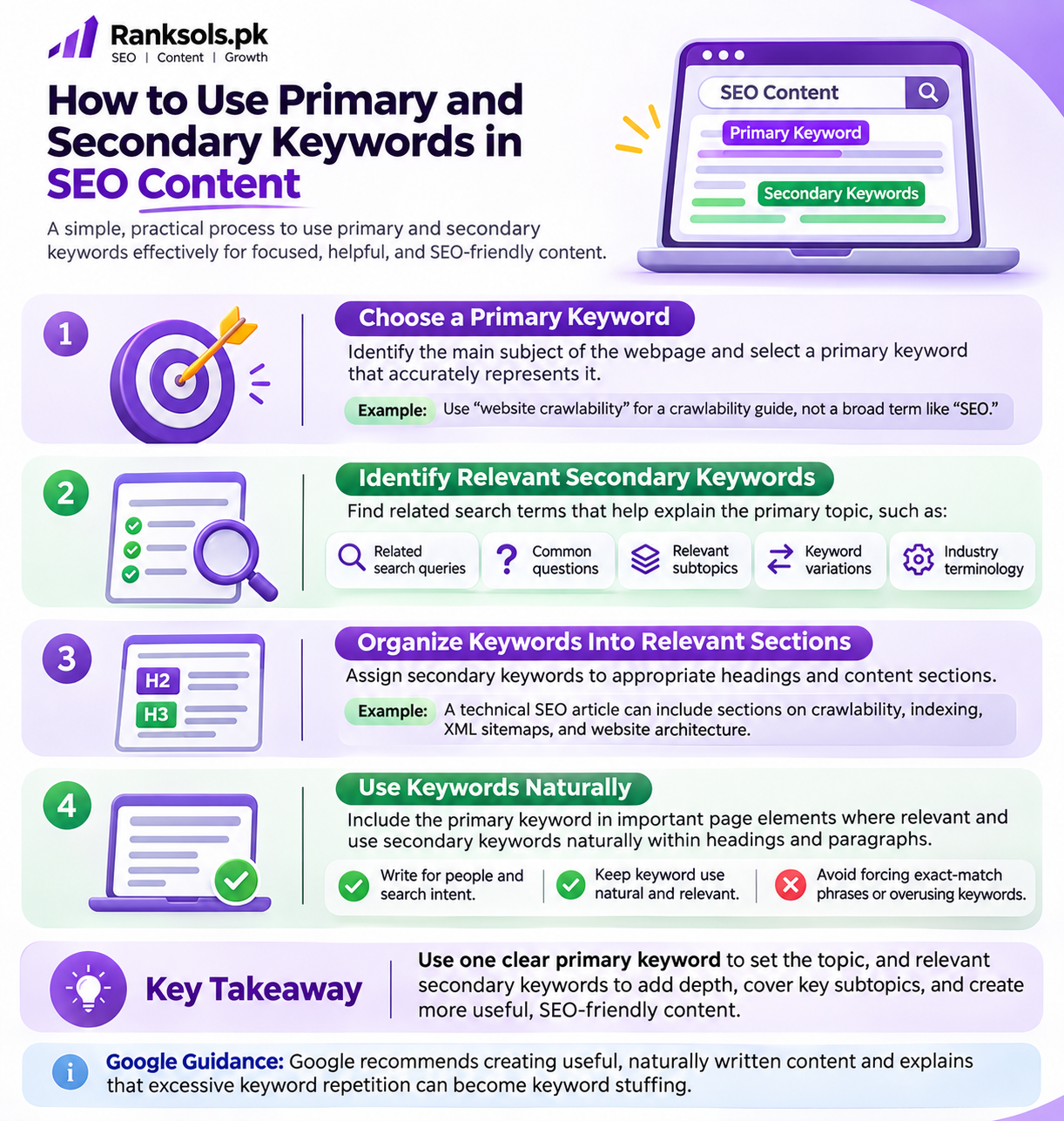
How to Use Primary and Secondary Keywords in SEO Content
Using primary and secondary keywords effectively requires a clear content focus and a logical relationship between related search terms.
Choose a Primary Keyword
Start by identifying the main subject of the webpage and selecting a primary keyword that accurately represents it.
Consider the topic, audience, and search intent before choosing the keyword.
For example, an article explaining website crawlability should focus on a term that reflects that subject rather than targeting a broad keyword such as SEO.
Identify Relevant Secondary Keywords
Find related search terms that help explain the primary topic.
Consider:
Related search queries.
Common questions.
Relevant subtopics.
Keyword variations.
Important industry terminology.
Select terms that genuinely contribute to the article instead of including every keyword suggestion.
Organize Keywords Into Relevant Sections
Assign secondary keywords to appropriate headings and content sections.
For example, an article targeting technical SEO might include sections about website crawlability, indexing, XML sitemaps, and website architecture.
This helps organize information logically and prevents unrelated subjects from weakening the article’s focus.
Use Keywords Naturally
Include the primary keyword in important page elements where relevant. Use secondary keywords naturally within headings and paragraphs that discuss those subjects.
Avoid forcing exact-match phrases into sentences or repeating keywords simply to increase their frequency.
Google recommends creating useful, naturally written content and explains that excessive keyword repetition can become keyword stuffing.
Common Mistakes When Using Primary and Secondary Keywords
Poor keyword targeting can make content less focused and create unnecessary overlap between webpages.
Avoid these common mistakes:
Targeting unrelated primary keywords: Combining different subjects on one page can make its central purpose unclear.
Ignoring search intent: A keyword may be relevant to the subject but unsuitable for the type of content being created.
Keyword stuffing: Repeating primary and secondary keywords unnaturally reduces readability.
Using irrelevant secondary keywords: Supporting terms should have a meaningful connection with the main topic.
Creating unnecessary separate pages: Closely related search terms with the same intent may be better addressed within one useful, comprehensive page.
The objective is to build content around a clear subject and its relevant subtopics, not to create a separate page for every keyword variation.
How Ranksols Can Help With Keyword Optimization
Selecting relevant primary and secondary keywords is an important part of an effective SEO content strategy. Businesses need to align keyword targeting with their website topics, audience needs, and content objectives.
Ranksols provides SEO-focused solutions that help businesses develop structured keyword strategies and improve their website content.
Explore Ranksols SEO services to learn more about developing an organized approach to search engine optimization and content performance.
Frequently Asked Questions
Can a webpage have multiple primary keywords?
A webpage can rank for multiple related search queries. However, establishing one central keyword focus is a useful content-planning approach because it helps maintain a clear subject and search intent.
How many secondary keywords should an article have?
There is no fixed number of secondary keywords required for an article. Their quantity depends on the subject, content structure, and relevant supporting concepts. Include only terms that add meaningful context.
Do secondary keywords help SEO rankings?
Secondary keywords can help content cover related topics and search queries. However, simply adding more keywords does not guarantee higher rankings. Content relevance, usefulness, and overall quality remain important.
Should primary keywords appear more often than secondary keywords?
There is no required keyword-density ratio between primary and secondary keywords. The primary keyword establishes the central subject, while secondary terms provide additional context. Both should be used naturally.