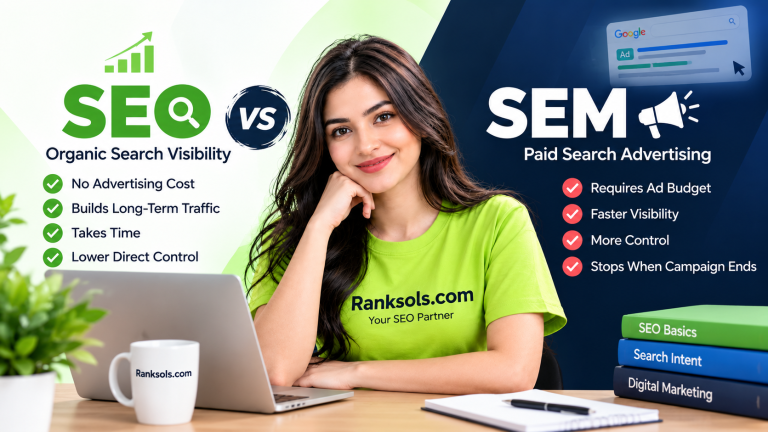
SEO and PPC are two different ways businesses can gain visibility through search. SEO (Search Engine Optimization) focuses on improving a website’s organic visibility, while PPC (Pay-Per-Click) uses paid advertising to reach potential customers.
The key difference is straightforward: SEO works toward organic search visibility, while PPC uses paid advertising to generate targeted exposure. They require different approaches, timelines, and resources, but businesses can also use them together.
What Is SEO?
SEO (Search Engine Optimization) is the practice of improving a website so search engines can discover, understand, and present its content for relevant organic searches.
SEO can involve areas such as:
Helpful and relevant content
On-page optimization
Technical SEO
Internal linking
Website structure
Search appearance
Content quality and usefulness
SEO does not involve paying Google for an organic ranking position. However, SEO should not be considered completely free. Businesses may invest in content, technical improvements, SEO professionals, tools, and ongoing optimization.
For a deeper explanation, readers can explore a dedicated SEO definition and fundamentals resource.
What Is PPC?
PPC (Pay-Per-Click) is a paid advertising model in which advertisers can pay for clicks on ads, depending on the campaign’s bidding and pricing model.
In search advertising, ads can participate in auctions for relevant searches. Factors such as bids, ad and landing-page quality, competition, and search context can influence whether an ad is eligible to appear and where it may be shown.
PPC is broader than Google Search advertising. Paid search refers specifically to advertising within search results, while PPC is commonly used to describe advertising models based on clicks.
This distinction matters because PPC and SEO are not simply two versions of the same search tactic.
SEO vs PPC: Key Differences
| Factor | SEO | PPC |
|---|---|---|
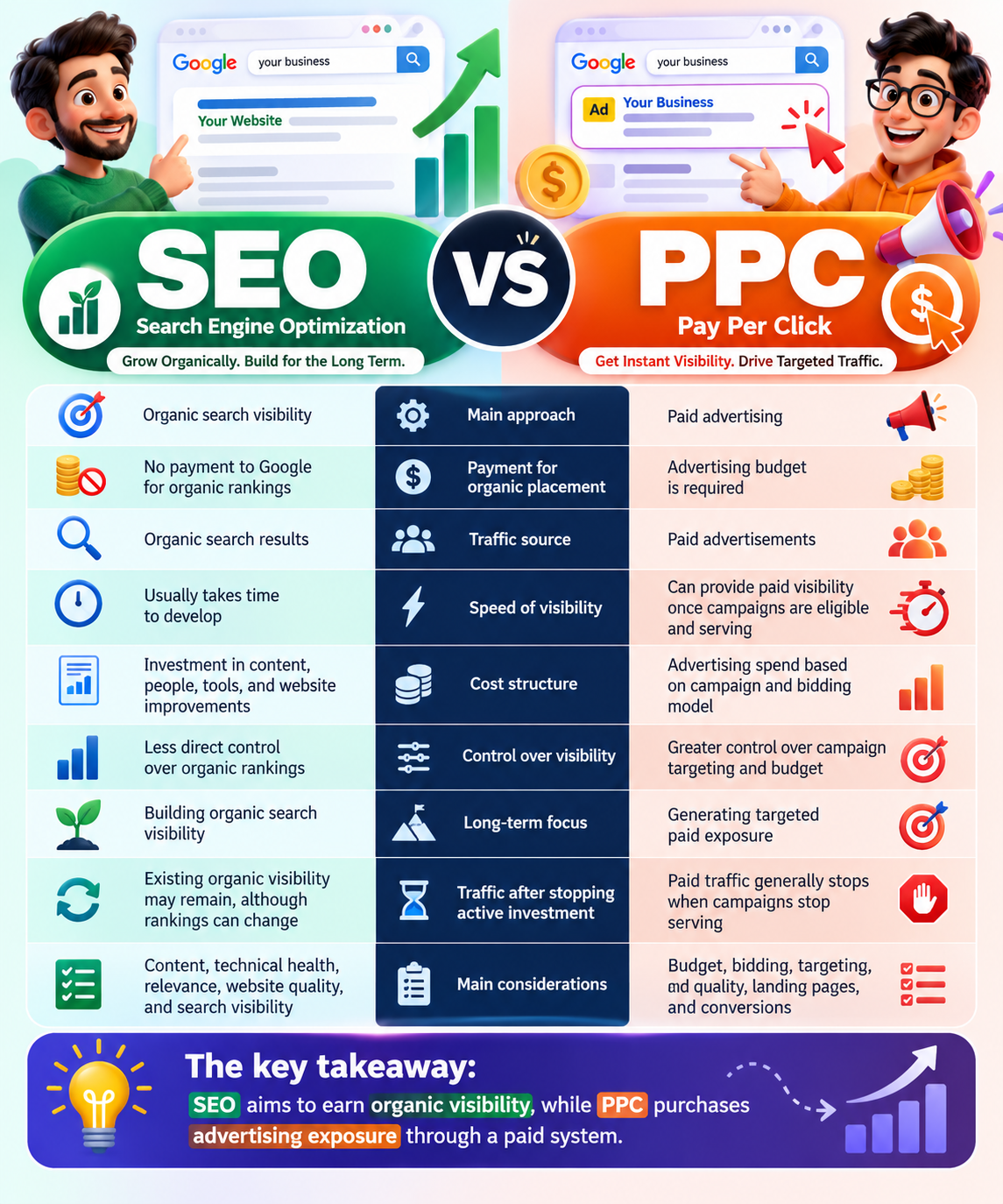
| Main approach | Organic search visibility | Paid advertising |
| Payment for organic placement | No payment to Google for organic rankings | Advertising budget is required |
| Traffic source | Organic search results | Paid advertisements |
| Speed of visibility | Usually takes time to develop | Can provide paid visibility once campaigns are eligible and serving |
| Cost structure | Investment in content, people, tools, and website improvements | Advertising spend based on campaign and bidding model |
| Control over visibility | Less direct control over organic rankings | Greater control over campaign targeting and budget |
| Long-term focus | Building organic search visibility | Generating targeted paid exposure |
| Traffic after stopping active investment | Existing organic visibility may remain, although rankings can change | Paid traffic generally stops when campaigns stop serving |
| Main considerations | Content, technical health, relevance, website quality, and search visibility | Budget, bidding, targeting, ad quality, landing pages, and conversions |
The important point is that SEO aims to earn organic visibility, while PPC purchases advertising exposure through a paid system.
SEO vs PPC: Which Is Faster?
PPC can provide paid search visibility relatively quickly once a campaign is eligible and its ads are serving. However, paying for advertising does not guarantee a particular position, amount of traffic, or number of conversions.
SEO generally requires more time because organic visibility can depend on factors such as website accessibility, content quality, relevance, competition, and how search engines evaluate the site.
This makes the two channels useful for different timelines.
For example, a business launching a new service could use PPC to reach relevant searchers while simultaneously developing SEO content and improving its website for longer-term organic visibility.
Simple rule:
Need targeted paid visibility quickly → PPC
Building organic visibility over time → SEO
Need both short-term and long-term search visibility → SEO + PPC
SEO vs PPC: Which Is More Cost-Effective?
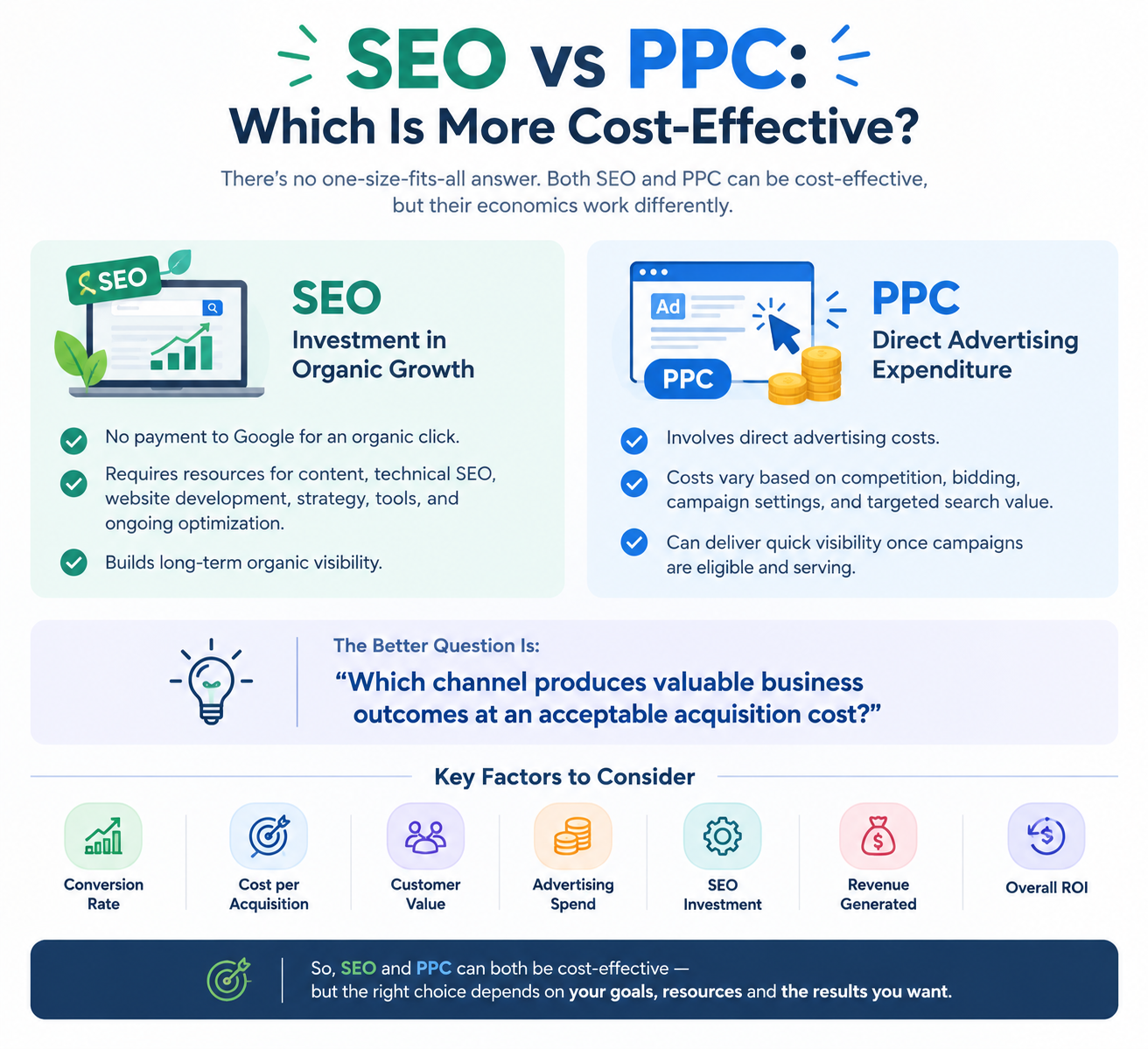
There is no universal answer.
SEO does not charge a fee to Google for an organic click, but building organic visibility requires resources. A business may invest in content production, technical SEO, website development, strategy, tools, and ongoing optimization.
PPC involves direct advertising expenditure. Costs can vary according to factors such as competition, bidding, campaign settings, and the value of the targeted searches.
The better comparison is therefore not simply “Which one is cheaper?”
A more useful question is:
Which channel produces valuable business outcomes at an acceptable acquisition cost?
For example, a lower-cost traffic source is not necessarily better if those visitors rarely become customers. Businesses should consider factors such as:
Conversion rate
Cost per acquisition
Customer value
Advertising spend
SEO investment
Revenue generated
Overall return on investment
SEO and PPC can therefore both be cost-effective, but their economics work differently.
SEO or PPC: Which Should a Business Choose?
The right choice depends on the business, search demand, available resources, and desired timeframe.
Choose SEO When:
SEO may be a strong option when a business:
Wants to build organic visibility over time
Has customers who regularly search for its products or services
Can invest consistently in useful content and website improvements
Wants to build broader organic search coverage
Is focused on a longer-term search strategy
Choose PPC When:
PPC may be useful when a business:
Needs targeted paid visibility quickly
Has a specific product, service, or offer to promote
Wants greater control over advertising budgets
Can measure conversions and customer value
Wants to test advertising messages or commercial offers
Consider Both When:
Using SEO and PPC together may make sense when:
Search is an important customer-acquisition channel
Immediate visibility matters while organic visibility is developing
The business has sufficient resources to manage both
Each channel has a clearly defined role
The goal should not be to use both simply because they are available. Each channel should support a specific business objective.
When SEO and PPC Work Together
SEO and PPC can support different parts of a search strategy.
A simple way to view their roles is:
PPC → targeted paid visibility
SEO → long-term organic visibility
For example, a company could use PPC to promote an important commercial service while developing SEO content around related informational and commercial searches.
PPC campaign data may also help marketers understand which messages, offers, or search themes attract valuable visitors. That information can inform broader marketing decisions, but it should not be interpreted as evidence that running PPC directly improves organic rankings.
Using both channels can be especially useful when a business wants to address immediate search opportunities while continuing to build its organic presence.
Does PPC Improve SEO Rankings?
No. Paying for Google Ads does not directly improve a website’s organic ranking.
Google treats advertising and organic Search as separate systems. Buying advertisements does not give a website a ranking advantage in Google’s organic search results.
This distinction is important because a business can run successful PPC campaigns without improving its organic rankings, just as a website can build organic visibility without running PPC campaigns.
SEO and PPC can support the same marketing strategy, but paid advertising should not be presented as an SEO ranking tactic.
SEO vs PPC: A Simple Example
Consider a Lahore-based business offering SEO services.
With SEO, the business could improve relevant service pages, publish useful SEO resources, strengthen its website structure, and work toward greater organic visibility for relevant searches.
With PPC, the same business could create paid search campaigns for selected commercial queries and allocate an advertising budget to those campaigns.
The SEO approach focuses on building organic visibility.
The PPC approach focuses on buying targeted advertising exposure.
Both can bring qualified visitors, but they use different mechanisms and require different forms of investment.
Common Misconception: SEO Is Free and PPC Is Expensive
This is an oversimplification.
SEO does not require payment to Google for organic rankings, but professional SEO requires resources. Creating useful content, improving technical performance, analyzing search opportunities, and maintaining a website all involve time or money.
PPC, meanwhile, is not automatically expensive or profitable simply because it requires an advertising budget.
A PPC campaign can perform poorly when targeting, ad relevance, landing pages, conversion tracking, or campaign management are weak. Similarly, an SEO strategy can consume resources without creating meaningful business value if it targets irrelevant searches or produces content that does not satisfy users.
Both channels need clear objectives and measurement.
SEO vs PPC: Which Is Better?
Neither SEO nor PPC is universally better.
SEO is generally suited to building organic search visibility over time, while PPC is useful for targeted paid exposure and greater control over advertising campaigns.
The better choice depends on:
Business goals
Search demand
Competition
Available resources
Customer value
Desired timeframe
Conversion opportunities
For many businesses, the strongest approach is not SEO vs PPC, but a deliberate combination of both where each channel has a defined role.
If you’re deciding whether SEO should be part of your acquisition strategy, Ranksols can help you evaluate your website’s organic search visibility and identify practical areas for improvement.
Frequently Asked Questions
Is SEO better than PPC?
Not necessarily. SEO and PPC serve different purposes. SEO focuses on organic search visibility, while PPC uses paid advertising to generate targeted exposure. The right choice depends on the business goal, resources, and timeframe.
Is PPC part of SEO?
No. PPC and SEO are separate approaches. SEO focuses on organic search visibility, while PPC is a paid advertising model.
Is SEO free?
SEO does not require payment to Google for organic ranking positions, but businesses may spend money on content, technical improvements, SEO professionals, tools, and ongoing optimization.
Does PPC guarantee traffic or sales?
No. Paying for advertising does not guarantee conversions or a specific business outcome. Performance depends on factors such as targeting, ad relevance, landing-page experience, competition, bidding, and the offer.
Can SEO and PPC be used together?
Yes. Businesses can use PPC for targeted paid visibility while developing SEO to build organic visibility over time. The two channels can complement each other when their roles are clearly defined.
Does running Google Ads improve organic rankings?
No. Running paid search advertising does not directly improve a website’s organic rankings. Paid advertising and organic Search are separate systems.