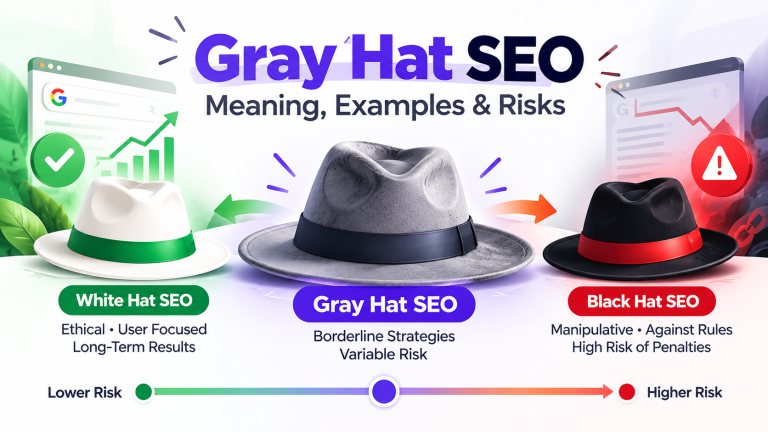
SEO can be approached in very different ways. White Hat SEO focuses on improving a website for users while following search engine guidelines, whereas Black Hat SEO relies on tactics designed primarily to manipulate search rankings.
Understanding the difference helps website owners, marketers, and businesses choose SEO practices that support sustainable organic search visibility rather than creating avoidable search or reputation risks.
What Is White Hat SEO?
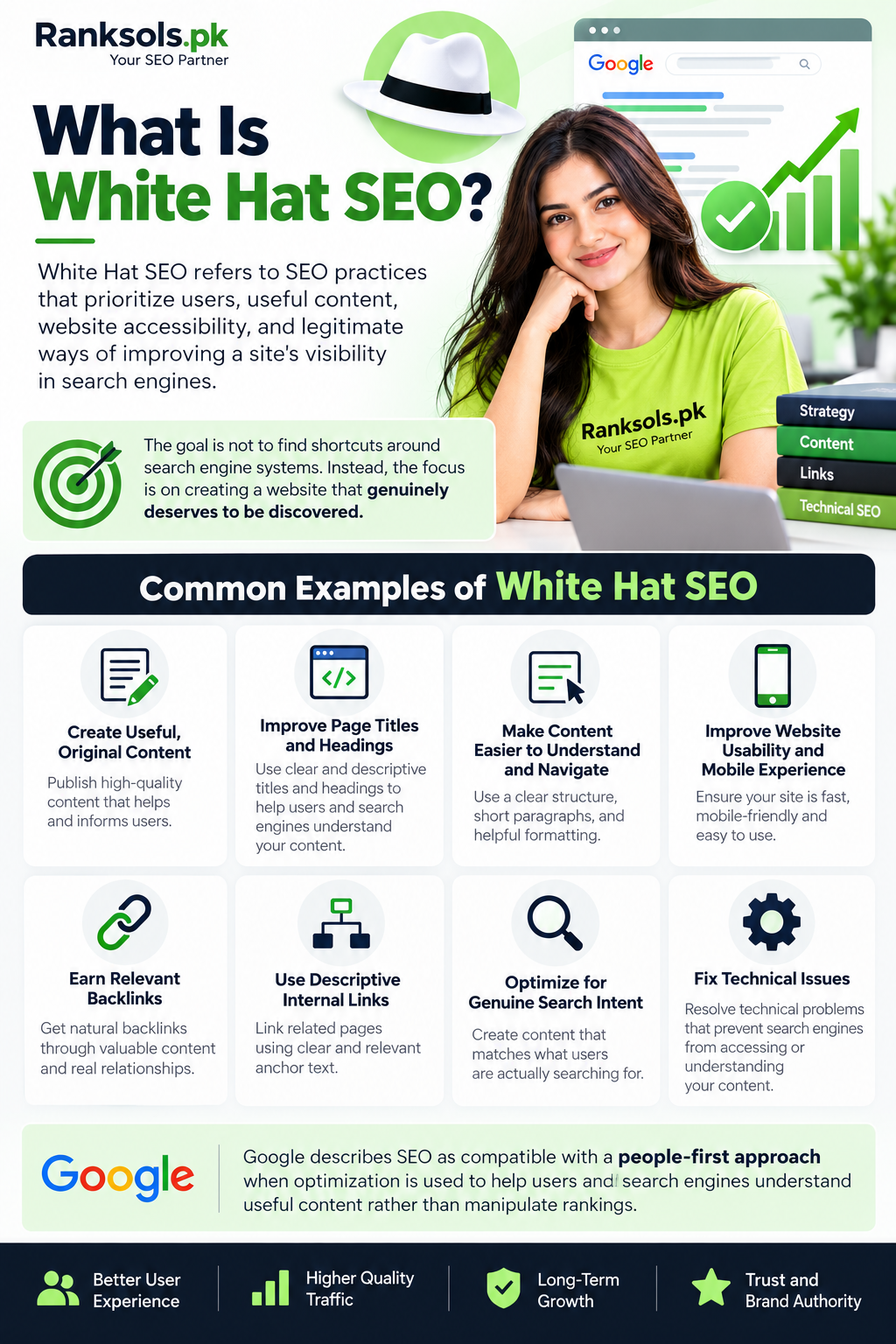
White Hat SEO refers to SEO practices that prioritize users, useful content, website accessibility, and legitimate ways of improving a site’s visibility in search engines.
The goal is not to find shortcuts around search engine systems. Instead, the focus is on creating a website that genuinely deserves to be discovered.
Common examples include:
Creating useful, original content
Improving page titles and headings
Making content easier to understand and navigate
Improving website usability and mobile experience
Earning relevant backlinks through valuable content and relationships
Using descriptive internal links
Optimizing pages around genuine search intent
Fixing technical issues that prevent search engines from accessing or understanding content
Google describes SEO as compatible with a people-first approach when optimization is used to help users and search engines understand useful content rather than manipulate rankings.
Example of White Hat SEO
Suppose a company publishes a detailed guide explaining how businesses can improve their local online presence. The company researches the subject, provides original explanations, uses clear headings, answers relevant questions, and maintains accurate information.
That is consistent with a people-first SEO approach because the content is created to provide value rather than simply generate search-engine traffic.
What Is Black Hat SEO?
Black Hat SEO describes practices that attempt to manipulate search rankings by exploiting search-engine systems rather than improving the experience or value provided to users.
Some tactics historically associated with Black Hat SEO include:
Hidden text or hidden links
Manipulative link schemes
Automatically generated pages created primarily to manipulate rankings
Cloaking
Low-quality doorway pages
Buying or exchanging links specifically to influence ranking signals
Publishing large amounts of low-value content for search traffic
Google’s current spam policies identify practices such as link spam, hidden text and links, and scaled content abuse among practices that can violate its search policies.
The important distinction is intent and implementation. Not every activity that involves automation, advertising, or links is automatically Black Hat. The way a tactic is used and whether it is intended to manipulate search systems matters.
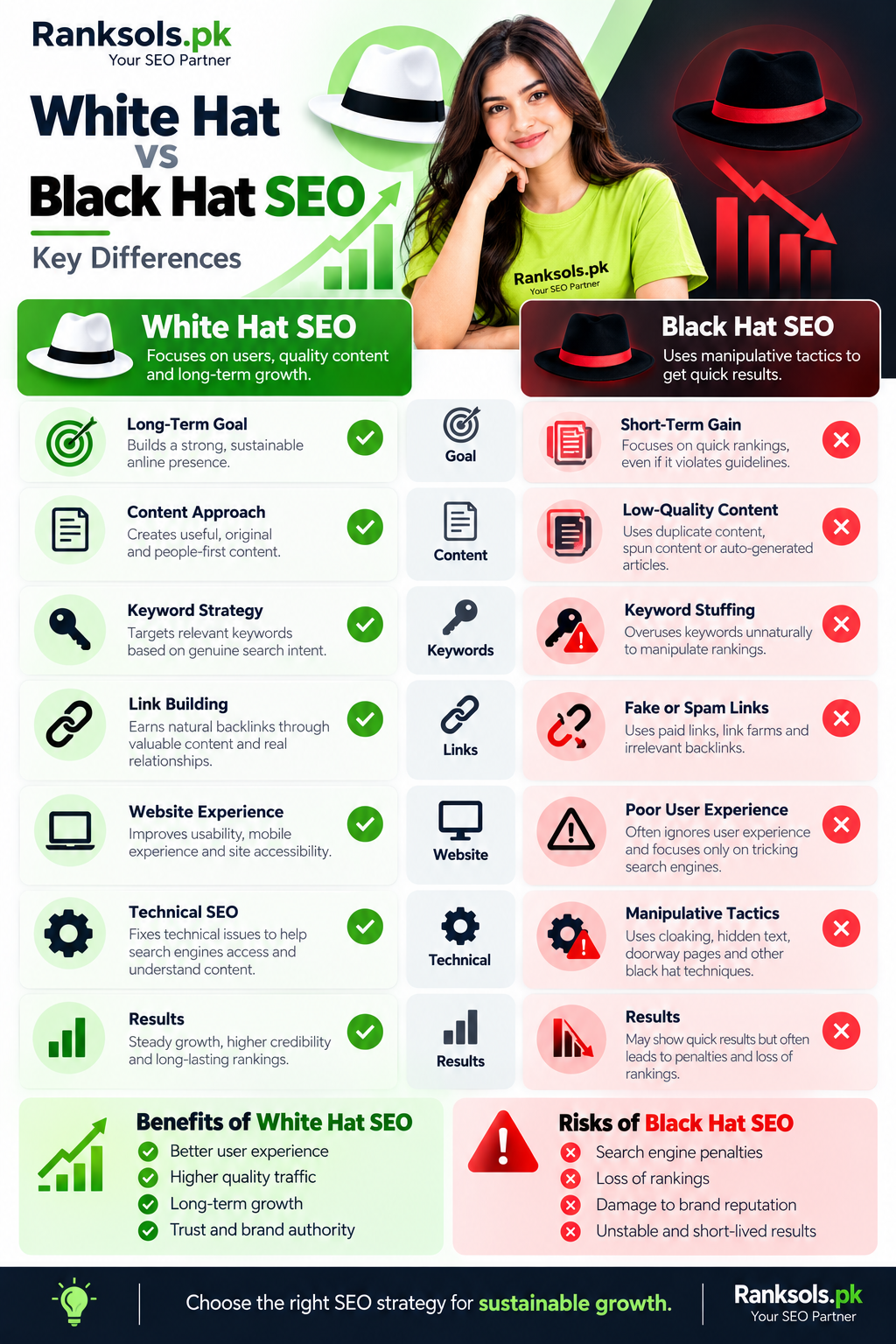
White Hat vs Black Hat SEO: Key Differences
| Factor | White Hat SEO | Black Hat SEO |
|---|---|---|
| Primary focus | Users and sustainable visibility | Manipulating search rankings |
| Content | Useful and original | Often created or modified primarily for rankings |
| Links | Relevant and naturally earned | Manipulative or created to pass ranking signals |
| Keywords | Used naturally | May be excessively repeated or hidden |
| Search guidelines | Designed to follow them | May attempt to bypass or violate them |
| Long-term approach | Builds a website’s value | Often depends on shortcuts or exploits |
| Risk | Generally lower when practices follow guidelines | Greater risk of search-related action |
The distinction is not simply about whether a technique is “old” or “new.” Search engines continually update their systems and policies, so SEO practices should be evaluated against current guidance.
Why Black Hat SEO Can Be Risky
Black Hat SEO can produce short-term changes in visibility in some situations, but manipulative tactics can also expose a website to search-related consequences.
Google states that sites violating its spam policies may experience lower rankings or may not appear in search results.
For example, Google’s link-spam guidance identifies buying or selling links for ranking purposes, excessive link exchanges, and automated link creation as examples of link spam.
There is also a broader risk: tactics designed around manipulating search systems can become ineffective when search algorithms or policies change.
For a business that depends on organic search, this can make aggressive shortcuts difficult to manage over time.
Is White Hat SEO Always Slow?
White Hat SEO is sometimes described as a slow approach because it generally involves building useful content, improving the website, earning relevant references, and establishing credibility over time.
However, SEO should not be judged simply by how quickly a tactic produces a ranking change.
A sustainable SEO process can include technical improvements, content optimization, better internal linking, improved search intent alignment, and other legitimate changes that may improve how a site is discovered and understood.
Google explicitly states that there is no preferred word count for content and recommends focusing on helpful, people-first content rather than creating content simply to attract search-engine visits.
What About Gray Hat SEO?
Gray Hat SEO is commonly used as an informal term for tactics that sit somewhere between conventional best practices and clearly manipulative techniques.
The term does not represent a formal Google classification.
A tactic described as “gray hat” should therefore be evaluated individually. Ask:
Does it provide genuine value to users?
Is the primary purpose improving the website or manipulating rankings?
Does it conflict with current search-engine policies?
Would the tactic still make sense if search engines did not exist?
That last question can be particularly useful. If a practice has little value outside of influencing rankings, it deserves closer scrutiny.
How to Keep Your SEO Strategy on the White Hat Side
A practical approach is to focus on improvements that would still benefit visitors even without search engines.
Create content for people first
Answer the reader’s actual question clearly. Avoid producing pages simply because a keyword has search volume.
Earn links instead of manufacturing them
Useful resources, original research, tools, and genuinely valuable content can create legitimate opportunities for references and links.
Avoid manipulative optimization
Do not hide keywords, create doorway pages, stuff keywords into content, or use other techniques primarily intended to influence rankings.
Review automated content carefully
Automation itself is not the central issue. The problem arises when large amounts of content are produced primarily to manipulate search rankings without providing meaningful value. Google’s spam policies specifically address scaled content abuse in this context.
Follow current search guidance
SEO recommendations change. Google’s Search Essentials and Search Central documentation provide current guidance on technical requirements, spam policies, and SEO practices.
White Hat vs Black Hat SEO: The Practical Takeaway
The simplest distinction is this:
White Hat SEO improves a website for people and uses search optimization to help that value be discovered. Black Hat SEO primarily attempts to manipulate search systems to gain visibility.
For businesses building long-term organic search visibility, this distinction matters because SEO is not only about rankings. It also involves the quality of the website, the usefulness of its content, user experience, and the trustworthiness of the methods used to promote it.
If your business needs help developing an SEO strategy based on sustainable content, technical optimization, and search best practices, Ranksols can help you evaluate your website and identify areas for improvement without relying on manipulative shortcuts.
Frequently Asked Questions
Is Black Hat SEO illegal?
Black Hat SEO is not necessarily a criminal or illegal activity simply because it violates a search engine’s guidelines. However, some tactics can involve deceptive, fraudulent, or otherwise unlawful conduct depending on how they are carried out. From an SEO perspective, the important issue is whether the practice violates applicable search-engine policies.
Is White Hat SEO safer?
White Hat SEO generally avoids tactics specifically intended to manipulate search systems and is therefore aligned more closely with search-engine guidelines. However, following SEO best practices does not guarantee rankings or protect a site from every possible search-related change.
Can Black Hat SEO permanently damage a website?
Manipulative SEO can create significant search visibility problems if a site is affected by spam-related systems or manual actions. The impact depends on the tactic, its scale, and the circumstances of the site.
Is buying backlinks Black Hat SEO?
Buying links specifically to manipulate search rankings can fall under Google’s link-spam policies. Google distinguishes ordinary advertising and sponsorship from links intended to pass ranking credit; qualifying paid links appropriately is important.
Should businesses avoid Black Hat SEO?
Businesses should evaluate SEO tactics against their purpose, implementation, and current search-engine policies. Practices designed primarily to manipulate rankings can introduce risks that are unnecessary when legitimate SEO methods are available.