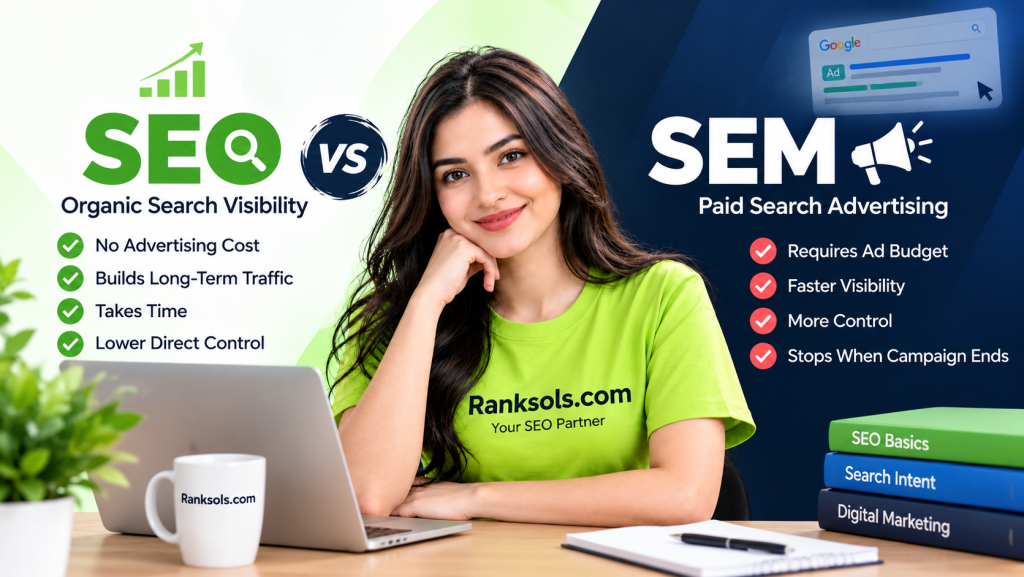
SEO and SEM both relate to gaining visibility through search engines, but they use different approaches. SEO (Search Engine Optimization) focuses on improving organic search visibility, while SEM (Search Engine Marketing) is commonly used today to refer to paid search advertising.
The terminology around SEM can vary between sources. In this article, SEM refers primarily to paid search advertising, including search campaigns such as Google Ads. Understanding this distinction helps businesses decide which approach better fits their goals, budget, and timeline.
What Is SEO?
SEO, or Search Engine Optimization, is the process of improving a website and its content so that search engines can better understand it and users can discover it through organic search results.
SEO can involve:
Creating useful and relevant content
Improving page titles, headings, and other on-page elements
Making pages easier for search engines to crawl and understand
Improving website structure and internal linking
Addressing technical SEO issues
Building a useful and trustworthy website presence
Google describes SEO as helping search engines understand content and helping users find websites through search. Google also recommends creating helpful, reliable, people-first content rather than content designed primarily to manipulate search rankings.
How SEO Works
SEO does not involve paying Google for a position in the organic search results. Organic listings are generated independently of Google’s advertising programs.
Instead, SEO focuses on improving a website’s relevance, accessibility, content, and overall search presence.
For example, a Lahore-based SEO agency could create a useful page explaining its SEO services in Lahore. The company can then work to improve that page’s organic visibility for relevant searches.
SEO generally takes time to develop. Organic visibility can also change as search systems, competitors, websites, content, and user behavior change.
What Is SEM?
SEM, or Search Engine Marketing, is a term that can have different meanings across the digital marketing industry. Historically, it has sometimes been used as an umbrella term for search marketing, including both organic and paid activities.
Today, however, SEM is often used to describe paid search advertising.
In this article, SEM is used in that narrower sense.
Paid search allows businesses to create advertisements that may appear when people conduct relevant searches. Google Ads is one example of a paid search advertising platform.
Google distinguishes paid advertisements from organic search results. Ads are labeled as advertisements, while organic search results are separate from Google’s advertising programs.
How SEM Works
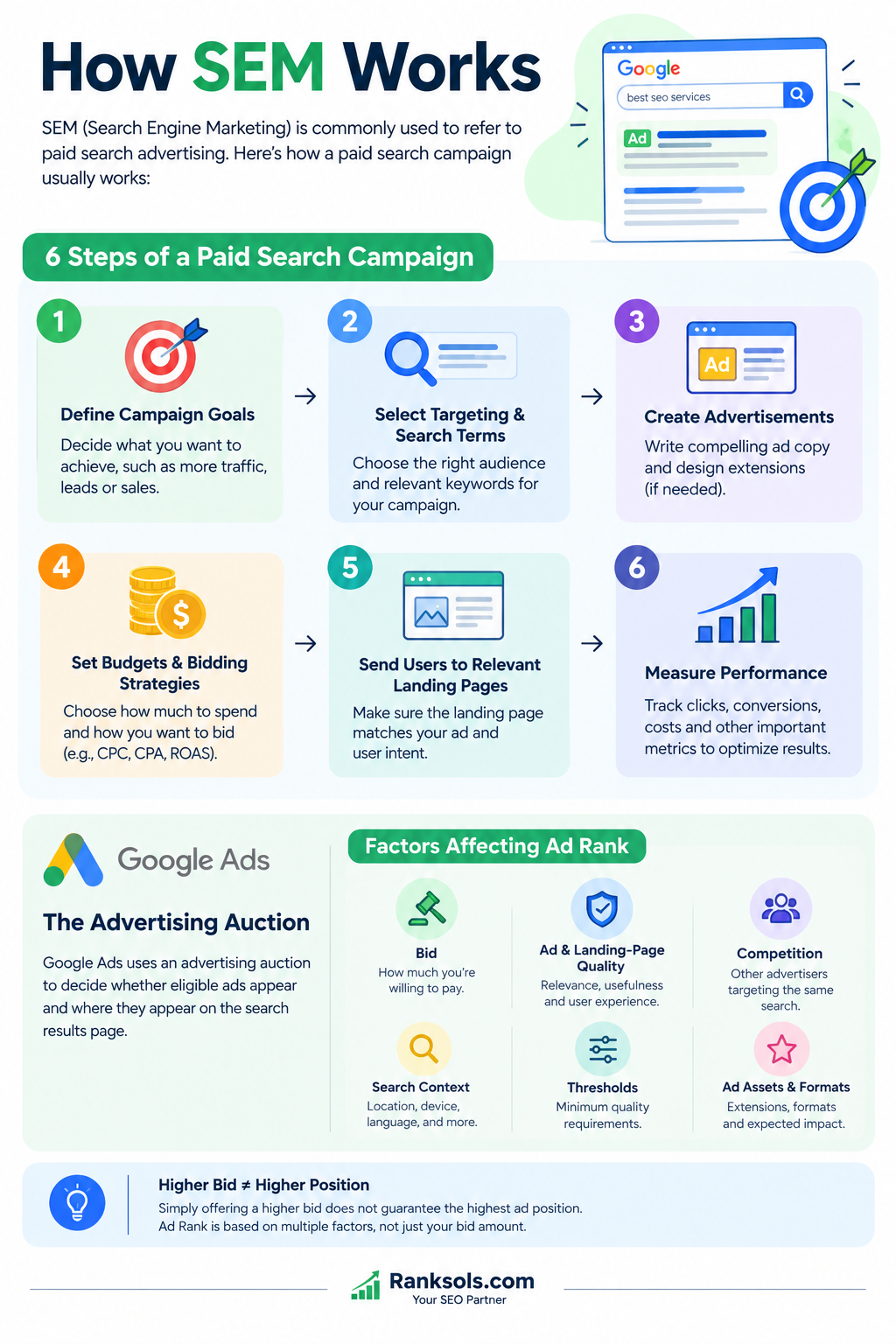
A paid search campaign typically involves:
Defining campaign goals
Selecting relevant targeting and search terms
Creating advertisements
Setting budgets and bidding strategies
Sending users to relevant landing pages
Measuring clicks, conversions, costs, and other performance metrics
Google Ads uses an advertising auction to determine whether eligible ads appear and where they appear. Factors affecting Ad Rank include the bid, ad and landing-page quality, competition, search context, thresholds, and the expected impact of ad assets and formats.
This means that simply offering a higher bid does not guarantee the highest ad position.
SEM vs PPC: Are They the Same?
SEM and PPC are related terms, but they are not necessarily identical.
Paid search describes advertising through search-engine results, while PPC (pay-per-click) describes a pricing model in which advertisers commonly pay when someone clicks an advertisement.
SEM is often used as a broader label for paid search marketing, while PPC can describe the way that advertising is charged.
For this article, the simplest distinction is:
SEO → organic search visibility
SEM → paid search advertising
PPC → a common paid-advertising pricing model
The exact terminology can vary between marketers and platforms, so context matters.
SEO vs SEM: Key Differences
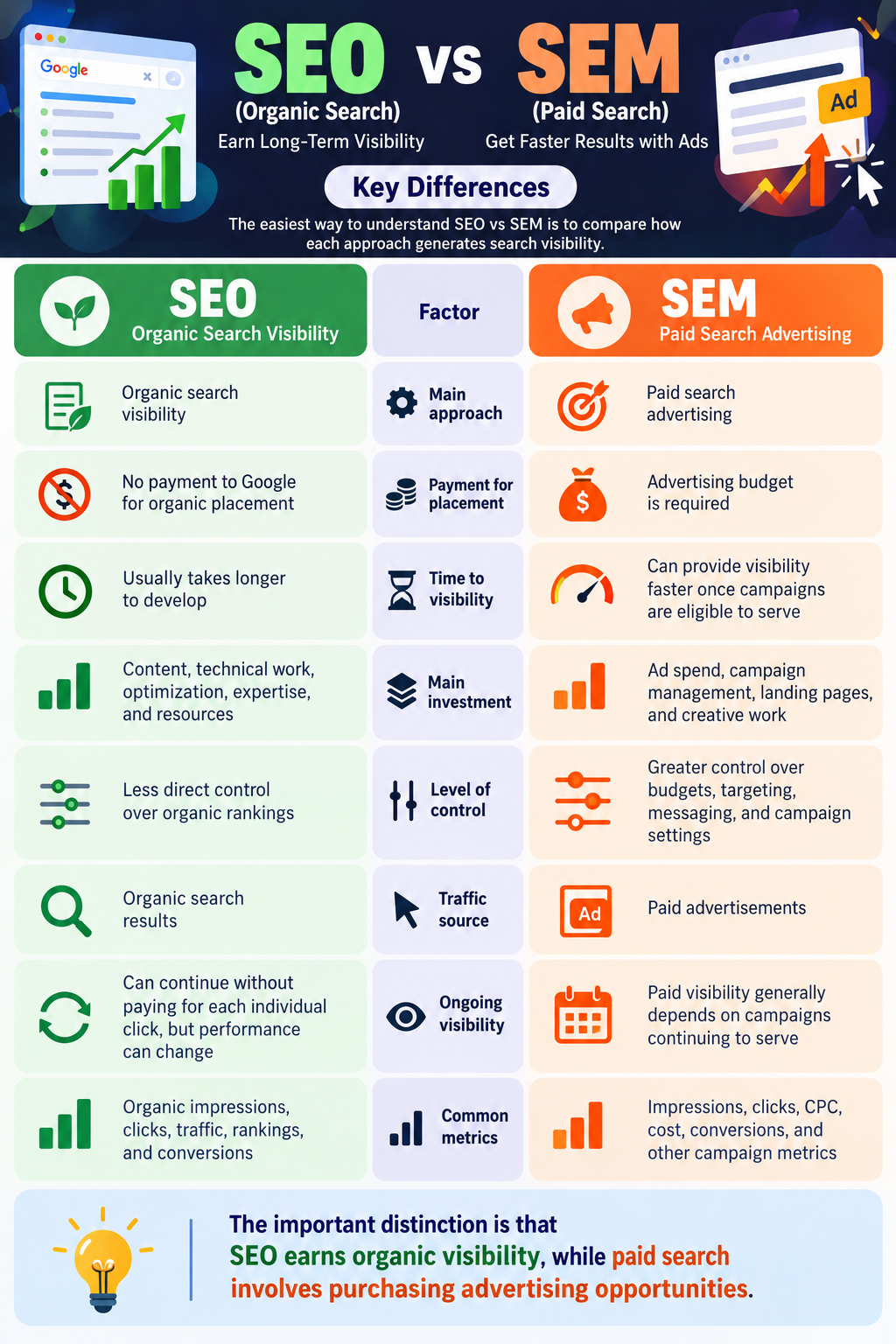
The easiest way to understand SEO vs SEM is to compare how each approach generates search visibility.
| Factor | SEO | SEM / Paid Search |
|---|---|---|
| Main approach | Organic search visibility | Paid search advertising |
| Payment for placement | No payment to Google for organic placement | Advertising budget is required |
| Time to visibility | Usually takes longer to develop | Can provide visibility faster once campaigns are eligible to serve |
| Main investment | Content, technical work, optimization, expertise, and resources | Ad spend, campaign management, landing pages, and creative work |
| Level of control | Less direct control over organic rankings | Greater control over budgets, targeting, messaging, and campaign settings |
| Traffic source | Organic search results | Paid advertisements |
| Ongoing visibility | Can continue without paying for each individual click, but performance can change | Paid visibility generally depends on campaigns continuing to serve |
| Common metrics | Organic impressions, clicks, traffic, rankings, and conversions | Impressions, clicks, CPC, cost, conversions, and other campaign metrics |
The important distinction is that SEO earns organic visibility, while paid search involves purchasing advertising opportunities.
SEO vs SEM: Which Is Faster?
Paid search can generate search visibility faster than SEO, provided campaigns are approved, eligible, properly configured, and able to compete in the relevant auctions.
However, faster visibility does not mean guaranteed placement or performance. Ad visibility depends on factors such as campaign settings, competition, budget, ad quality, search context, and Ad Rank.
SEO usually takes longer because a website must build and maintain organic search visibility over time.
This makes paid search useful for businesses that need to promote a product, service, or offer relatively quickly, while SEO is often more suitable for developing a longer-term organic search presence.
SEO vs SEM: Which Costs More?
The two approaches have different cost structures.
With SEO, businesses invest in activities such as:
Content creation
Technical improvements
Keyword and search-intent research
Website optimization
Internal linking
SEO expertise and tools
There is no advertising charge simply because a page appears in Google’s organic results. However, that does not mean SEO is free.
With paid search, businesses allocate an advertising budget and may pay for clicks or use other bidding and charging models depending on the campaign.
For example, Google Ads supports different bidding approaches, while CPC bidding is based around the cost associated with clicks. Actual costs can vary according to the auction, competition, and other factors.
So it is more accurate to think of the distinction as:
SEO = investment in organic visibility
SEM = investment in paid search visibility
Rather than simply:
SEO = free
SEM = paid
SEO vs SEM: Which Should a Business Choose?
The right choice depends on the business objective rather than one channel being universally better.
Choose SEO when:
You want to build long-term organic search visibility.
You can invest in useful content and website improvements.
Your audience regularly searches for information related to your products or services.
You want to develop an organic search presence over time.
You want to strengthen your website’s overall search visibility.
Consider SEM when:
You need paid search visibility relatively quickly.
You want to promote a specific product, service, or offer.
You have a defined advertising budget.
You want greater control over paid campaigns and targeting.
You want to test specific search opportunities through advertising.
For many businesses, the decision does not have to be SEO vs SEM. The two approaches can serve different purposes within a broader search strategy.
Can SEO and SEM Be Used Together?
Yes. SEO and paid search can complement one another when each channel has a clear purpose.
For example, a business could use:
SEO to build organic visibility around valuable topics and search queries.
SEM to promote specific commercial searches or time-sensitive offers.
Organic search data to identify queries that may also have paid-search opportunities.
Paid search data to understand which messages, offers, or landing pages generate meaningful engagement.
Google provides tools for comparing paid and organic search performance, including reports that allow advertisers to examine organic search data alongside paid search performance.
The goal should not be to duplicate the same work across both channels. Instead, businesses can use each channel where it provides the most appropriate type of search visibility.
A Simple Example of SEO vs SEM
Imagine a company that provides web design services in Lahore.
With SEO, the company might create and optimize a useful page about its web design services and work to earn organic visibility for relevant searches.
With SEM, the same company could create a paid search campaign targeting relevant searches and compete for advertising placements.
The difference can be summarized simply:
SEO → Work to earn organic visibility
SEM → Pay for eligible search advertising opportunities
Both can bring visitors from search, but they do so through different systems.
Common Misunderstandings About SEO vs SEM
“SEO is free.”
SEO does not require payment to Google for organic placement, but SEO still requires resources. Content, technical improvements, research, expertise, tools, and ongoing optimization can all involve costs.
“SEM guarantees the top position.”
Paid advertising does not guarantee a particular position simply because an advertiser has a large budget.
Google’s Ad Rank system considers multiple factors, including bid, ad and landing-page quality, competition, search context, thresholds, and ad assets.
“Paid ads improve organic rankings.”
They do not.
Google states that organic search results are independent of its advertising programs. Paying for advertisements does not purchase better organic rankings.
“SEO and SEM are completely separate.”
They are different approaches, but they can complement one another.
Organic search data can help identify potential paid-search opportunities, while paid campaigns can provide additional visibility for relevant searches.
“SEM always means paid search.”
Not necessarily.
SEM has been used differently across the industry. Some sources use it broadly for search-engine marketing, while others use it primarily for paid search.
That is why it is useful to define the terminology being used. In this article, SEM refers primarily to paid search advertising.
Which Is Better: SEO or SEM?
There is no universal winner.
SEO is generally suited to building organic search visibility over time, while SEM can provide paid search visibility when a business is prepared to invest in advertising.
The better approach depends on:
Business goals
Budget
Time horizon
Search demand
Competition
Products or services
Conversion objectives
A business focused on long-term organic visibility may prioritize SEO. A business seeking faster paid exposure for a particular offer may use paid search. In some cases, using both can make sense.
Final Takeaway
The key difference between SEO vs SEM is how search visibility is obtained.
SEO focuses on earning visibility through organic search. SEM is often used to describe paid search advertising, although the term can have broader meanings depending on the source.
SEO generally requires more time to build organic visibility, while paid search can provide faster advertising exposure once campaigns are eligible to serve. Neither approach is automatically better for every business.
For a sustainable search strategy, businesses should consider their goals, resources, timeline, and audience before deciding how much emphasis to place on organic SEO or paid search.
Need Help Choosing the Right Search Strategy?
If your business is unsure whether to prioritize organic SEO, paid search, or a combination of both, Ranksols can help you evaluate your search visibility opportunities and identify practical areas for improvement.
The right strategy should be based on your business goals and search behavior—not on the assumption that one channel is always better than the other.