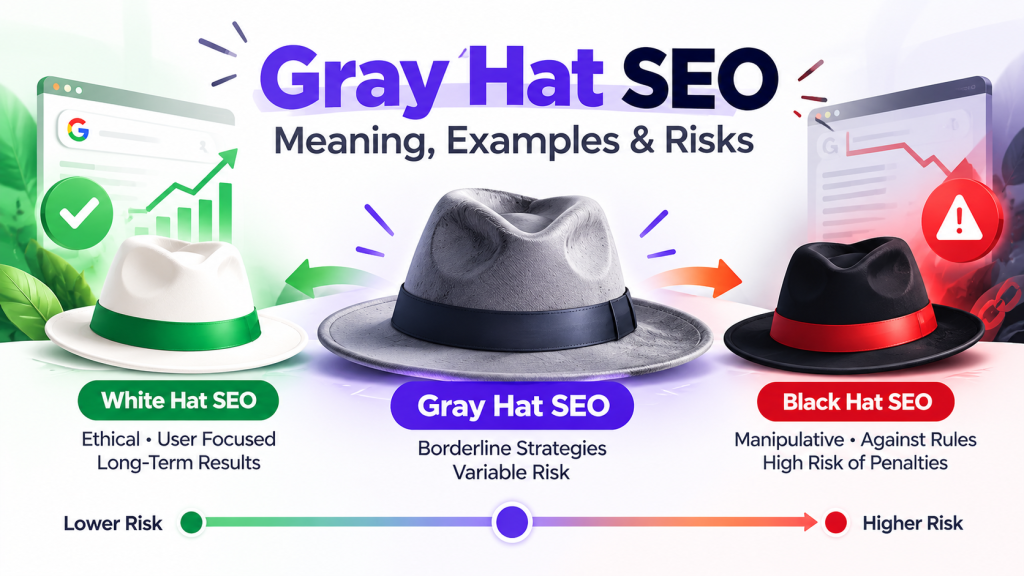
Gray Hat SEO refers to SEO practices that fall somewhere between commonly accepted White Hat SEO techniques and clearly manipulative Black Hat SEO tactics.
However, “Gray Hat SEO” is an informal industry term, not an official Google classification. Google evaluates individual SEO practices through its Search Essentials, spam policies, and people-first content guidance rather than placing techniques into official white, gray, or black hat categories.
The term is therefore best used to describe SEO strategies that may be considered aggressive, questionable, or borderline depending on how they are implemented, why they are used, and the value they provide to users.
What Is Gray Hat SEO?
Gray Hat SEO describes optimization techniques that may go beyond conventional SEO practices without necessarily being clearly deceptive or directly prohibited.
For example, an SEO practitioner may use an aggressive link-building approach, acquire an expired domain, or scale content production. These activities are not automatically problematic. The risk depends on the purpose and implementation.
A useful way to think about Gray Hat SEO is:
The tactic itself matters less than how and why it is used.
A strategy that improves a website and provides genuine value may be legitimate. The same general activity can become risky when its primary purpose is to manipulate search rankings rather than help users.
This distinction is important because being called “gray hat” does not mean a technique is safe or approved by Google.
Google’s guidance emphasizes creating helpful, reliable, people-first content rather than content or practices primarily designed to manipulate search rankings.
Is Gray Hat SEO an Official Google Category?
No.
Google does not officially classify SEO practices as White Hat, Gray Hat, or Black Hat.
These terms are commonly used within the SEO industry to describe different approaches to search optimization. Google’s documentation instead focuses on search fundamentals, technical requirements, spam policies, and creating useful content.
This means an SEO tactic should not be considered acceptable simply because someone describes it as “gray hat.”
The better approach is to evaluate the actual practice and ask whether it provides genuine value, uses deceptive methods, manipulates search signals, or conflicts with Google’s current policies.
Gray Hat SEO vs. White Hat and Black Hat SEO
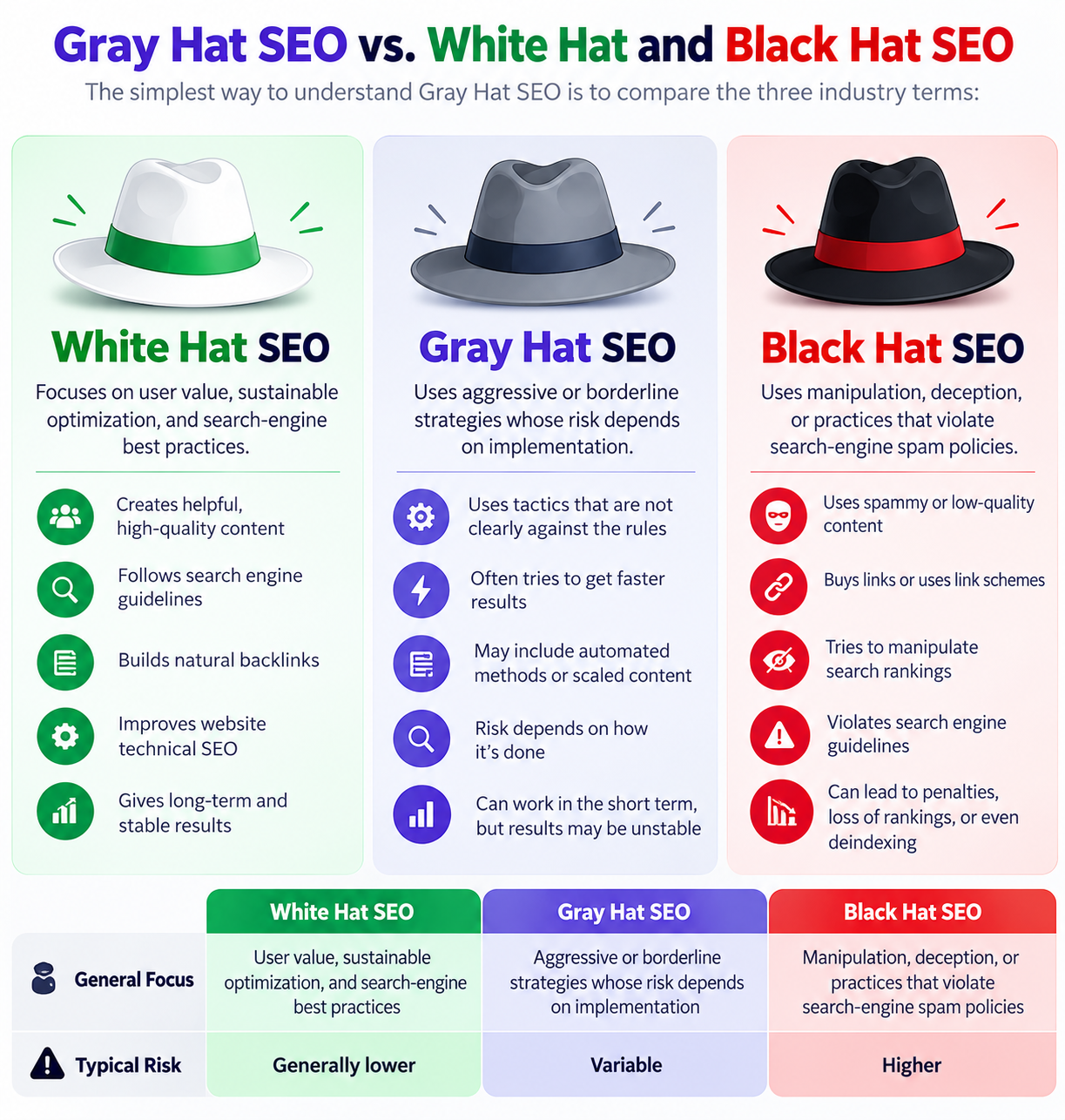
The simplest way to understand Gray Hat SEO is to compare the three industry terms:
| SEO Approach | General Focus | Typical Risk |
|---|---|---|
| White Hat SEO | User value, sustainable optimization, and search-engine best practices | Generally lower |
| Gray Hat SEO | Aggressive or borderline strategies whose risk depends on implementation | Variable |
| Black Hat SEO | Manipulation, deception, or practices that violate search-engine spam policies | Higher |
These labels are useful for discussing SEO strategies, but they should not be treated as official Google categories.
There can also be a significant difference between an aggressive SEO strategy and a policy violation. Not every unconventional tactic is automatically Black Hat, and not every tactic described as Gray Hat is necessarily safe.
Common Examples of Gray Hat SEO
There is no official Google list of “Gray Hat SEO techniques.” However, SEO professionals may use the term when discussing practices such as aggressive link acquisition, expired-domain strategies, or scaled content production.
Aggressive Link Building
Some link-building methods may be described as Gray Hat when they focus heavily on acquiring links for ranking purposes rather than earning genuine editorial references.
For example, extensive outreach, reciprocal linking, or other forms of deliberate link acquisition may become risky when the primary objective is manipulating ranking signals.
There is an important distinction here:
Legitimate:
Creating useful resources that other websites naturally want to reference.
Aggressive or questionable:
Using large-scale link acquisition primarily to influence search rankings.
Clearly against Google’s policies:
Buying or selling links for ranking purposes, automated link creation, or other manipulative link schemes.
Google identifies links created primarily to manipulate rankings as link spam and provides several examples of practices that violate its spam policies.
Therefore, the issue is not simply whether a website is actively building links. The more important question is how those links are obtained and what purpose they serve.
Expired Domain Strategies
Buying or acquiring an expired domain is not automatically a Gray Hat or spam practice.
For example, a business could acquire a relevant expired domain and rebuild it into a useful website that serves a legitimate audience.
The risk appears when an expired domain is used primarily to exploit its previous authority and publish unrelated or low-value content for search visibility.
Google specifically identifies expired domain abuse as a spam practice when an expired domain is repurposed mainly to manipulate search rankings with content that provides little or no value to users.
This makes the distinction between legitimate reuse and manipulative reuse particularly important.
Scaled or Low-Value Content
Producing content at scale is not automatically a problem.
A website may legitimately use templates, automation, editorial workflows, or AI-assisted processes to produce useful information.
The concern arises when content is produced at scale with little original value and primarily for the purpose of gaining search traffic.
Google’s guidance identifies scaled content abuse as a spam practice when large amounts of content are generated primarily to manipulate search rankings rather than provide value to users.
Therefore, the important question is not simply:
“Was this content produced at scale?”
Instead, ask:
“Does this content provide meaningful value that users would find useful?”
That distinction makes the concept more practical and avoids treating legitimate content production methods as inherently risky.
When Does a Gray Hat Tactic Become Risky?
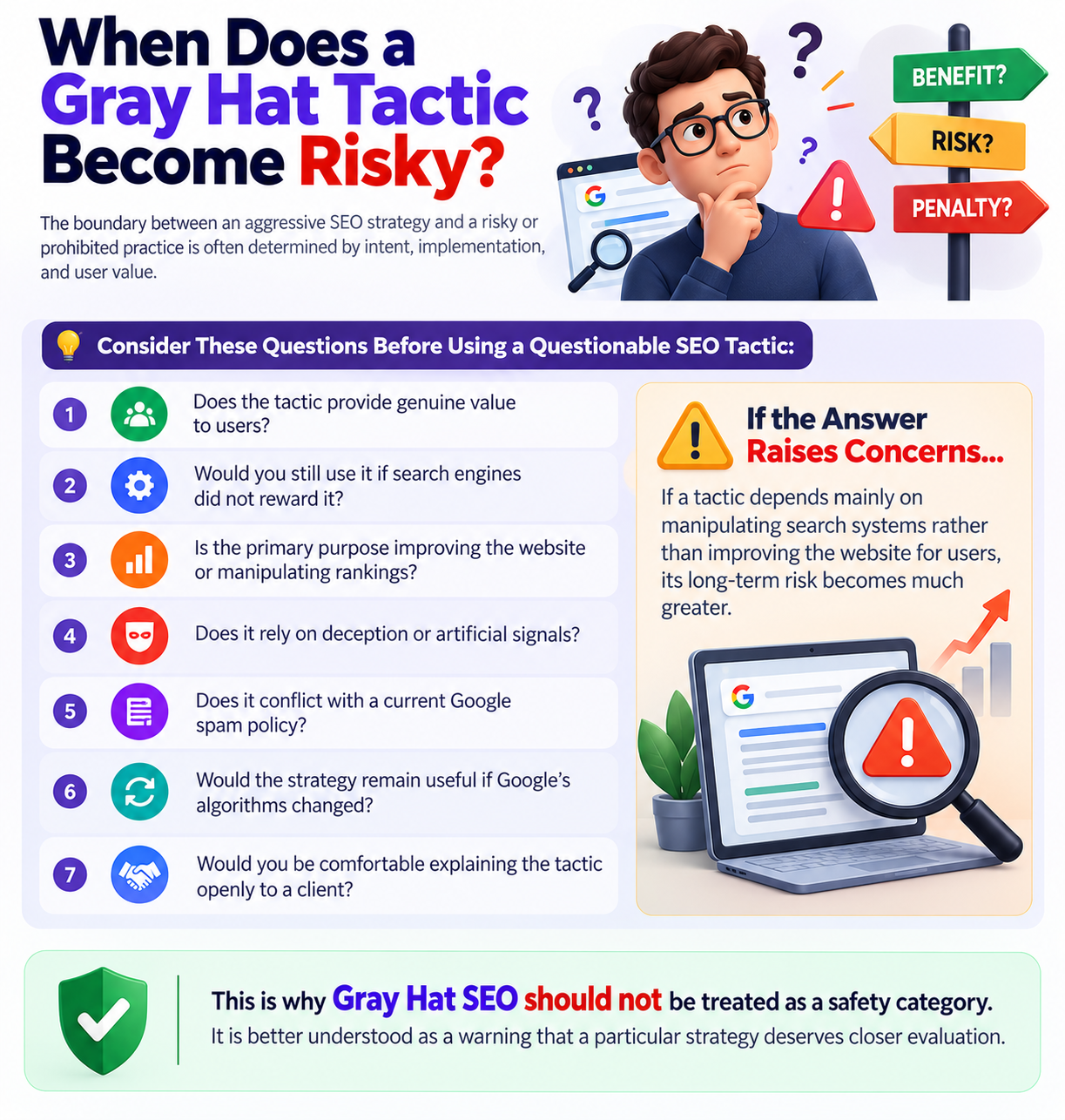
The boundary between an aggressive SEO strategy and a risky or prohibited practice is often determined by intent, implementation, and user value.
Consider these questions before using a questionable SEO tactic:
Does the tactic provide genuine value to users?
Would you still use it if search engines did not reward it?
Is the primary purpose improving the website or manipulating rankings?
Does it rely on deception or artificial signals?
Does it conflict with a current Google spam policy?
Would the strategy remain useful if Google’s algorithms changed?
Would you be comfortable explaining the tactic openly to a client?
If a tactic depends mainly on manipulating search systems rather than improving the website for users, its long-term risk becomes much greater.
This is why the term Gray Hat SEO should not be treated as a safety category. It is better understood as a warning that a particular strategy deserves closer evaluation.
Is Gray Hat SEO Safe?
There is no universal answer.
Calling a tactic “gray hat” does not make it safe. The actual risk depends on the specific method and how it is implemented.
A tactic may be relatively harmless in one context but become problematic when it is scaled aggressively, used deceptively, or designed primarily to manipulate search rankings.
For businesses building a long-term organic search presence, the safer approach is to prioritize strategies that provide lasting value regardless of algorithm changes.
These include:
Useful and original content
Strong technical foundations
Relevant internal linking
Clear alignment with search intent
Legitimate authority and reputation
Helpful user experiences
Natural and editorially appropriate links
Continuous content improvement
This does not mean SEO needs to be passive or overly conservative. Competitive SEO can still be strategic and ambitious without depending on tactics designed primarily to manipulate search systems.
Can Gray Hat SEO Hurt Search Visibility?
It can, depending on the tactic.
Not every practice commonly described as Gray Hat will result in a Google penalty. Some tactics may simply become ineffective, while others may cause manipulated signals to be ignored or may conflict with Google’s spam policies.
Google’s spam policies cover practices such as link spam, expired domain abuse, scaled content abuse, cloaking, hidden text and links, scraping, and other forms of search manipulation.
In applicable cases, violations can lead to actions that affect a website’s visibility in Google Search.
For this reason, businesses should not evaluate an SEO tactic only by asking whether it can produce rankings.
A better question is:
Can this strategy continue to provide value if search engines change how they evaluate it?
If the answer is no, the tactic may not be a strong foundation for long-term SEO.
Why Do Some SEOs Use Gray Hat Techniques?
The main attraction is usually speed, competition, or the possibility of gaining an advantage over competitors.
A website operating in a competitive search market may look for strategies that produce results faster than conventional content development, technical optimization, or naturally earned authority.
However, short-term effectiveness does not necessarily make a strategy sustainable.
Search engines continually improve their systems and update their policies. A technique that appears effective today may become less effective or create greater risk later.
For that reason, SEO decisions should be evaluated based on:
Long-term value
Sustainability
User benefit
Policy risk
Resource requirements
Dependence on search-engine behavior
Ranking improvements alone are not enough to determine whether an SEO strategy is worthwhile.
Should You Use Gray Hat SEO?
For businesses building a long-term organic search presence, the safest approach is to prioritize sustainable SEO practices.
That does not mean every strategy must be slow, conservative, or completely conventional. It means the strategy should have a legitimate purpose beyond manipulating search rankings.
Before adopting a questionable tactic, consider whether it improves the website, helps users, and remains valuable even if search-engine algorithms change.
If a strategy only works because a search engine has not yet detected or neutralized a particular manipulation, it is a weak foundation for a long-term SEO campaign.
For businesses that need a structured and sustainable SEO strategy, Ranksols can help evaluate current optimization opportunities while keeping the focus on useful content, technical quality, and long-term organic visibility.
Gray Hat SEO: Key Takeaway
Gray Hat SEO is best understood as an informal industry term for SEO practices that may sit between conventional optimization and clearly manipulative techniques.
It is not an official Google SEO category, and a tactic should not be considered safe simply because someone calls it Gray Hat.
The more useful approach is to evaluate each strategy based on its purpose, implementation, user value, sustainability, and relationship to current search-engine policies.
For a long-term SEO strategy, the goal should not be to find the closest possible line to a search-engine violation. The goal should be to build a website that deserves visibility because it provides useful information and a strong experience for its audience.
Related Ranksols Topics
Readers exploring this subject may also benefit from dedicated resources covering White Hat SEO, Black Hat SEO, SEO techniques, link building, and Google Search spam policies. These topics can provide deeper context without expanding this supporting article beyond its primary focus.