People Also Ask (PAA) is a Google Search feature that displays related questions users can expand to view answers from webpages. It helps searchers explore a topic and gives SEO professionals useful insights into related queries, audience questions, and potential content opportunities.
Understanding People Also Ask can help website owners identify relevant questions, improve existing content, and build more useful resources without creating unnecessary pages or repeating information.
What Is People Also Ask in SEO?
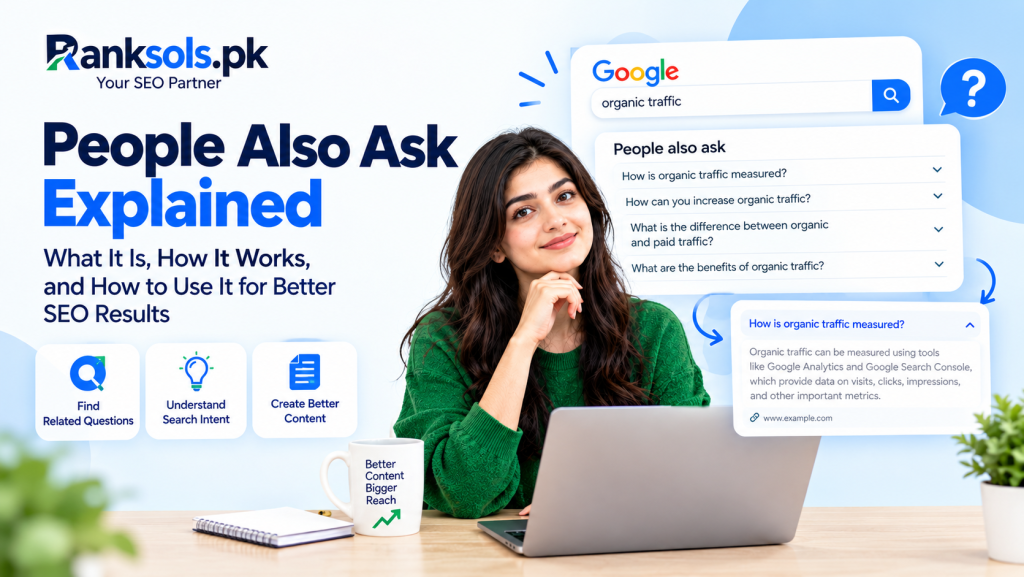
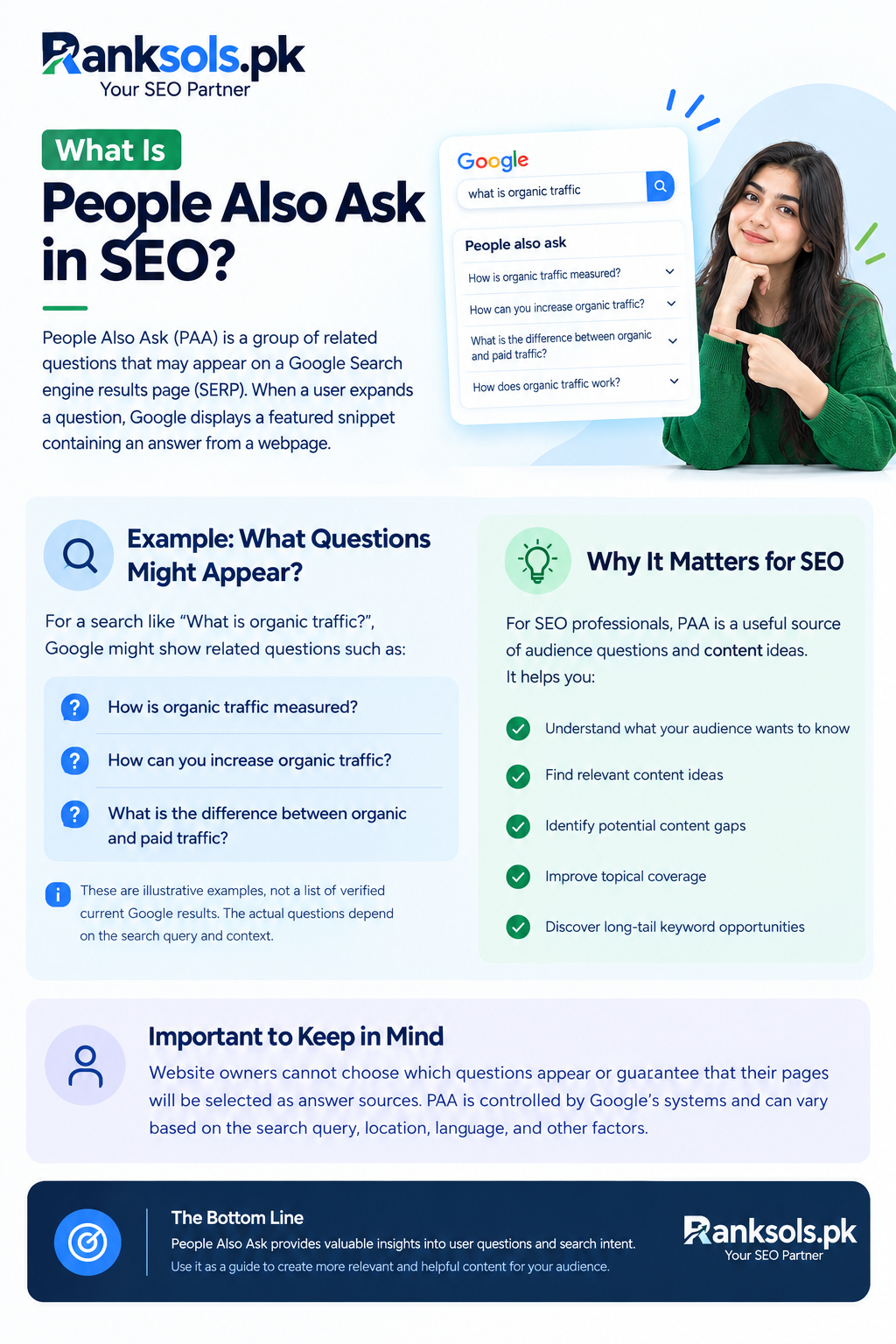
People Also Ask is a group of related questions that may appear on a Google Search engine results page (SERP). When a user expands a question, Google displays a featured snippet containing an answer from a webpage.
For example, a search for “What is organic traffic?” might display related questions such as:
How is organic traffic measured?
How can you increase organic traffic?
What is the difference between organic and paid traffic?
These are illustrative examples, not a list of verified current Google results. The actual questions depend on the search query and context.
For SEO professionals, PAA is a useful source of audience questions and content ideas. However, website owners cannot choose which questions appear or guarantee that their pages will be selected as answer sources.
How Does People Also Ask Work?
Google generates related-question groups to help users explore topics connected to their original searches. According to Google’s documentation, expanding a question in a People Also Ask group displays a featured snippet. Google’s featured snippet documentation explains how these answer formats work.
The process can be understood in four steps:
A user searches for a topic. Google processes the query and displays relevant search results.
Related questions appear. A People Also Ask group may show questions associated with the original search.
The user expands a question. Google displays an answer from a webpage in a featured snippet.
The user explores further. Additional questions may appear, allowing the user to investigate related aspects of the topic.
The questions and answers can change across queries and search contexts. Google does not provide website owners with a fixed list of PAA questions or a direct method to control their appearance.
Why Is People Also Ask Useful for SEO?
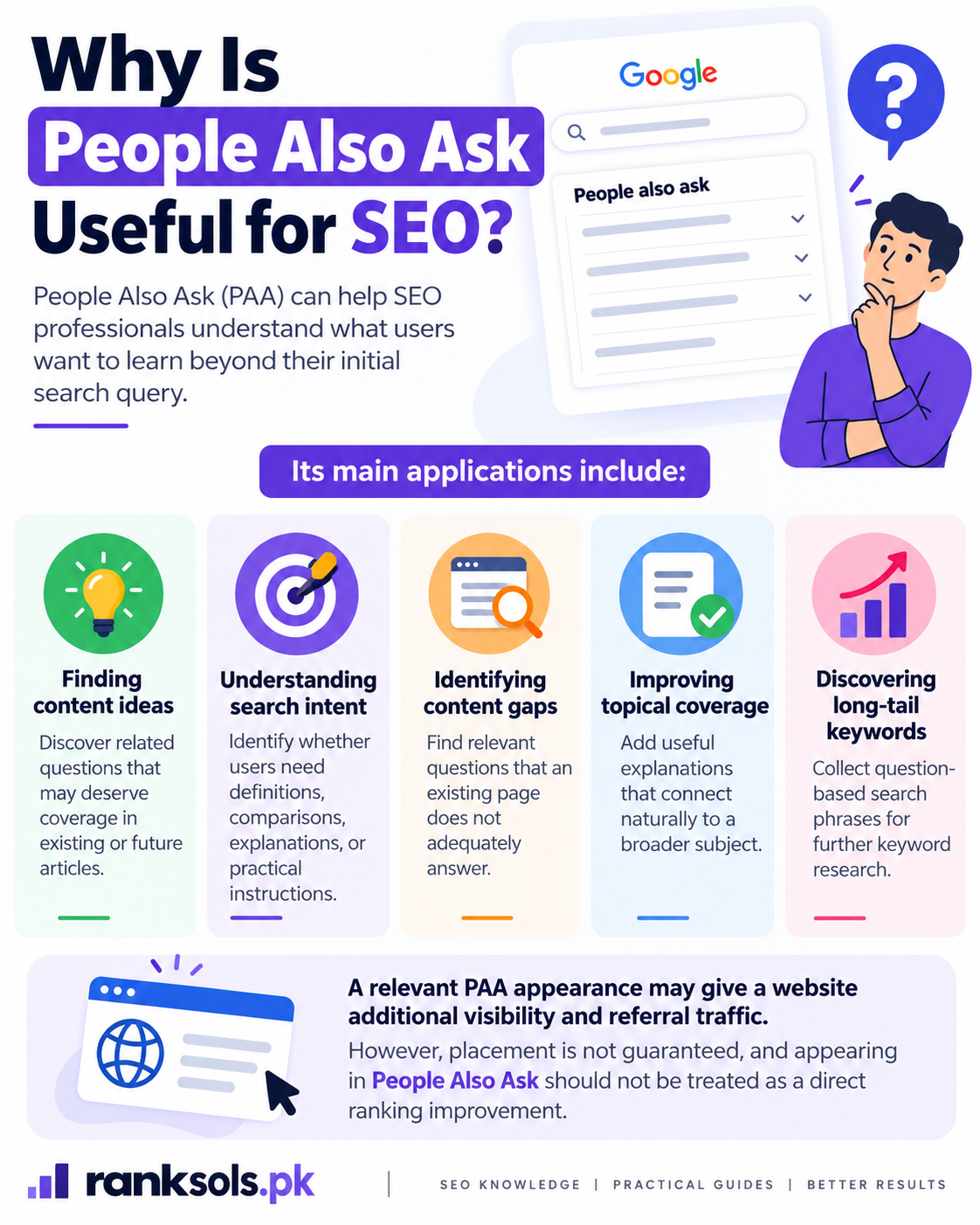
People Also Ask can help SEO professionals understand what users want to learn beyond their initial search query.
Its main applications include:
Finding content ideas: Discover related questions that may deserve coverage in existing or future articles.
Understanding search intent: Identify whether users need definitions, comparisons, explanations, or practical instructions.
Identifying content gaps: Find relevant questions that an existing page does not adequately answer.
Improving topical coverage: Add useful explanations that connect naturally to a broader subject.
Discovering long-tail keywords: Collect question-based search phrases for further keyword research.
A relevant PAA appearance may give a website additional visibility and referral traffic. However, placement is not guaranteed, and appearing in People Also Ask should not be treated as a direct ranking improvement.
How to Find and Evaluate People Also Ask Questions
Google Search is a practical starting point for discovering related questions. The important step is to evaluate those questions before deciding how to use them.
1. Search for Your Primary Keyword
Enter your target keyword into Google and examine the search results page for a People Also Ask section.
For example, if you are researching organic traffic, note the related questions that appear and explore questions relevant to your website’s audience.
PAA results can vary, so record the search query and relevant context when conducting research. Treat the results as research observations rather than a permanent list of questions.
2. Expand Relevant Questions
Click questions related to your topic to reveal their answers and explore additional questions that may appear.
Record useful questions in a spreadsheet or content-planning document. Group similar questions together to identify recurring themes and avoid collecting several variations of the same idea.
3. Evaluate Search Intent and Relevance
Not every PAA question belongs in the same article. Determine whether each question supports the page’s primary purpose.
For example, a question about measuring organic traffic may fit naturally within a guide about organic traffic measurement. A question about the difference between organic and paid traffic may be better answered in a dedicated comparison article.
Consider these points before using a question:
Is it closely related to the page’s main topic?
Does the existing content already answer it?
Would answering it improve the reader’s understanding?
Does it require a separate resource with a distinct search intent?
Can the answer be supported with accurate information?
4. Decide Whether to Update or Create Content
Use the collected questions to make a content decision rather than automatically creating a new page for each query.
| Finding | Recommended action |
|---|---|
| The question is relevant and already answered well | Keep the existing section and avoid unnecessary repetition |
| The question reveals a meaningful content gap | Add a focused explanation to the existing article |
| The question requires a distinct, substantial answer | Consider a separate supporting article |
| The question overlaps with another published page | Improve internal linking or clarify each page’s purpose |
| The question is unrelated to the target topic | Exclude it from the article |
This approach helps maintain a clear content structure and reduces the risk of keyword cannibalization.
How to Optimize Content for People Also Ask
There is no guaranteed method for securing a PAA placement. The practical objective is to create clear, accurate content that answers relevant questions effectively.
1. Answer Questions Directly
When a question deserves its own section, use a descriptive heading and answer it in the opening sentence. Add supporting details afterward when they help the reader.
For example:
What is organic traffic?
Organic traffic consists of visits a website receives through unpaid search engine results. Website owners can use analytics and search performance tools to understand different aspects of this traffic.
The answer defines the term directly before introducing additional context. This structure also helps readers find information quickly.
2. Match the Answer to Search Intent
A definition question needs a clear explanation. A question beginning with “how” may need a sequence of steps, while a comparison question may benefit from a table.
Choose the format that best addresses the question instead of using the same structure for every answer.
3. Use Clear Headings and Readable Formatting
Organize information with descriptive H2 and H3 headings, concise paragraphs, and lists where appropriate. Keep each section focused on one subject and avoid repeating answers in multiple sections.
Good structure improves usability, but headings alone do not guarantee that Google will select a page for People Also Ask.
4. Provide Accurate and Helpful Information
Support factual claims with reliable sources, explain important limitations, and avoid presenting assumptions about Google’s systems as established facts.
Answer questions because they are useful to readers, not simply because they contain keywords. A short, complete answer is preferable to a longer section filled with repetition.
5. Keep Information Current
Review question-based content when facts, tools, processes, or recommendations change. Update sections when there is a meaningful improvement to make rather than changing publication dates without improving the content.
People Also Ask vs. Featured Snippets
People Also Ask and featured snippets are related Google Search features, but they serve different purposes.
| Feature | People Also Ask | Featured Snippet |
|---|---|---|
| Purpose | Helps users explore related questions | Highlights an answer to a search query |
| Presentation | A group of expandable related questions | An answer excerpt from a webpage |
| Interaction | Users expand a question to see its answer | Users can view the answer directly |
| Relationship | Expanding a question displays a featured snippet | Featured snippets can appear within PAA groups and in other search-result locations |
The distinction matters because People Also Ask is the related-question group, while a featured snippet is the answer format that may appear when a question is expanded.
Content optimization practices that help make answers clear and useful may be relevant to both features, but optimizing for one does not guarantee placement in the other.
For a broader overview of search-result elements, see Organic Search Results Explained.
Common People Also Ask SEO Mistakes
Avoid these mistakes when using PAA in your content strategy:
Adding irrelevant questions: Include only questions that support the page’s topic and search intent.
Creating unnecessary pages: Do not publish separate articles for minor question variations that can be answered adequately in an existing resource.
Repeating the same information: Keep answers concise and avoid duplicating explanations across sections.
Assuming every question is a keyword opportunity: Some questions are useful context but do not justify a new page.
Treating PAA placement as guaranteed: Google determines which questions and sources appear.
Confusing FAQ schema with PAA optimization: FAQ structured data is not a requirement for appearing in People Also Ask.
Writing for search features instead of readers: Prioritize accurate, useful answers rather than attempting to manipulate search results.
Frequently Asked Questions About People Also Ask
Is People Also Ask a Google ranking factor?
People Also Ask is a search-result feature, not a standalone ranking factor that website owners can directly optimize for. Appearing in PAA may provide additional visibility, but it does not guarantee improved organic rankings.
Can a new website appear in People Also Ask?
A new website may be selected as a source if Google considers its content suitable for a particular question. However, there is no guaranteed placement method, and following SEO best practices does not ensure inclusion.
Does People Also Ask help with keyword research?
Yes. PAA questions can reveal related queries and potential long-tail keyword ideas. Evaluate them alongside search intent, audience needs, existing content, and available keyword data before deciding what to publish.
Does FAQ schema guarantee People Also Ask visibility?
No. FAQ structured data does not guarantee PAA visibility and is not a prerequisite for appearing in the feature. Google selects the questions and answer sources algorithmically.
Google discontinued FAQ rich results in Search in May 2026. FAQ sections can still be useful when they answer genuine reader questions, but they should not be added solely to obtain the former FAQ rich-result display.
For technical details about structured data, consult Google’s official Q&A structured data documentation. The Q&A markup described there is intended for eligible pages centered on a question and its answers, not ordinary FAQ sections containing multiple questions.
Conclusion
People Also Ask is a useful source of related search questions and content ideas. By researching relevant queries, evaluating content gaps, and providing clear answers, website owners can improve the usefulness of their SEO resources without creating unnecessary pages or repeating existing information.
For businesses seeking a more structured approach to organic search, Ranksols can help identify content opportunities and improve website content through a focused SEO strategy. The priority should remain accurate, relevant information that meets users’ needs rather than chasing a particular search-result feature.