SEO helps businesses become discoverable when potential customers search for information, products, or services they offer. Its value goes beyond appearing higher in search results: a well-planned SEO strategy can help attract relevant visitors, support customer research, strengthen online visibility, and create organic search opportunities over time.
For businesses, the purpose of SEO is not simply to gain rankings. It is to make the website more useful and discoverable for the people who are relevant to the business.
1. Increases Organic Search Visibility
One of the main benefits of SEO is improving a business’s visibility in organic search results.
When a website has clear, useful, and accessible content, search engines can better understand its pages and determine when they may be relevant to users’ searches. Google describes SEO as helping search engines understand content and helping users find websites through search. Google Search Central: SEO Starter Guide
For example, a business that provides commercial accounting services may create useful pages addressing business accounting, bookkeeping, tax services, and related questions. Each page can target a specific user need without requiring the business to cover unrelated SEO topics.
The objective is not to appear for every possible keyword. It is to gain visibility for searches that are genuinely relevant to the business.
2. Attracts Relevant Organic Traffic
SEO can help businesses attract visitors through searches that relate to their products, services, expertise, or solutions.
The quality of that traffic matters more than traffic volume alone. A website may receive thousands of visitors without generating meaningful business results if those visitors have little connection to what the company offers.
This is where search intent becomes important.
Someone searching for “commercial solar installation” has a different need from someone searching for “how does solar energy work?” A company that installs commercial solar systems needs content that addresses the searches and questions relevant to its potential customers.
Understanding search intent helps businesses create pages that are useful for the audience they actually want to reach.
For a deeper understanding of this process, see the related guide on search intent.
3. Helps Customers Research Products and Services
Customers often research a problem before contacting a business or making a purchase.
SEO gives businesses an opportunity to provide useful information during this research process. Depending on the industry, this may include:
Explanations of products or services
Answers to common questions
Buying considerations
Comparisons between relevant options
Information about problems and possible solutions
Guidance about when a particular service may be appropriate
This allows a website to support customers before they reach the decision stage.
For example, a software company might publish an explanation of a particular business problem before introducing its product as one possible solution. The content serves the user’s information need first while creating a natural connection to the company’s offering.
SEO therefore can support multiple stages of the customer journey without turning every page into sales copy.
4. Supports Brand Discovery
SEO can also contribute to brand discovery.
When a business consistently appears for relevant searches, users may encounter the brand while researching topics, products, or services related to their needs. This can introduce the business to people who were not previously familiar with it.
However, search visibility should not automatically be treated as brand awareness or customer acquisition. The impact depends on factors such as relevance, visibility, the quality of the page, the user’s intent, and what happens after the visit.
A useful SEO strategy therefore focuses on being visible for meaningful searches, rather than simply maximizing impressions.
5. Creates Long-Term Organic Search Opportunities
Unlike paid advertising, where visibility is directly connected to an advertising campaign and its budget, SEO focuses on earning organic visibility through useful content, technical accessibility, relevance, and website quality.
A useful page can continue receiving organic visibility after publication. However, this should not be interpreted as a guarantee of permanent rankings or traffic.
Search results change, competitors publish new content, user behavior evolves, and search engines continuously update their systems.
Businesses can therefore treat well-developed content as a long-term digital asset while continuing to review and improve it when necessary.
The goal is to build a useful collection of pages that can continue serving users and supporting organic search visibility over time.
6. Improves Website Content and User Experience
SEO can encourage businesses to improve how information is organized and presented on their websites.
This may include:
Clear page titles and headings
Logical content structure
Easily accessible important information
Mobile-friendly presentation
Fast and usable pages
Secure website connections
Clear navigation
Content that directly addresses user needs
These improvements can benefit visitors as well as search engines.
Google’s guidance on page experience considers factors such as Core Web Vitals, mobile usability, HTTPS, and intrusive elements, while also emphasizing that page experience is only one part of providing a useful result and does not guarantee top rankings. Google Search Central: Understanding Page Experience
SEO should therefore not be treated as a checklist where completing technical tasks automatically produces higher rankings. Relevance and helpful content remain central.
For more detail, technical improvements can be covered separately in a dedicated technical SEO resource.
7. Provides Useful Search and Customer Insights
Search data can provide useful signals about the questions, topics, and needs people use when discovering a business.
Google Search Console provides information such as clicks, impressions, click-through rate, average position, queries, and pages. This data can help website owners understand how their content performs in Google Search. Google Search Console Performance Report
For example, a business may discover that a page receives impressions for searches it did not specifically target. That information can help the business identify content opportunities or determine whether an existing page should be improved.
Search data should be treated as a useful signal rather than a complete representation of customer demand. It can inform content decisions, but it does not replace direct customer research or other business data.
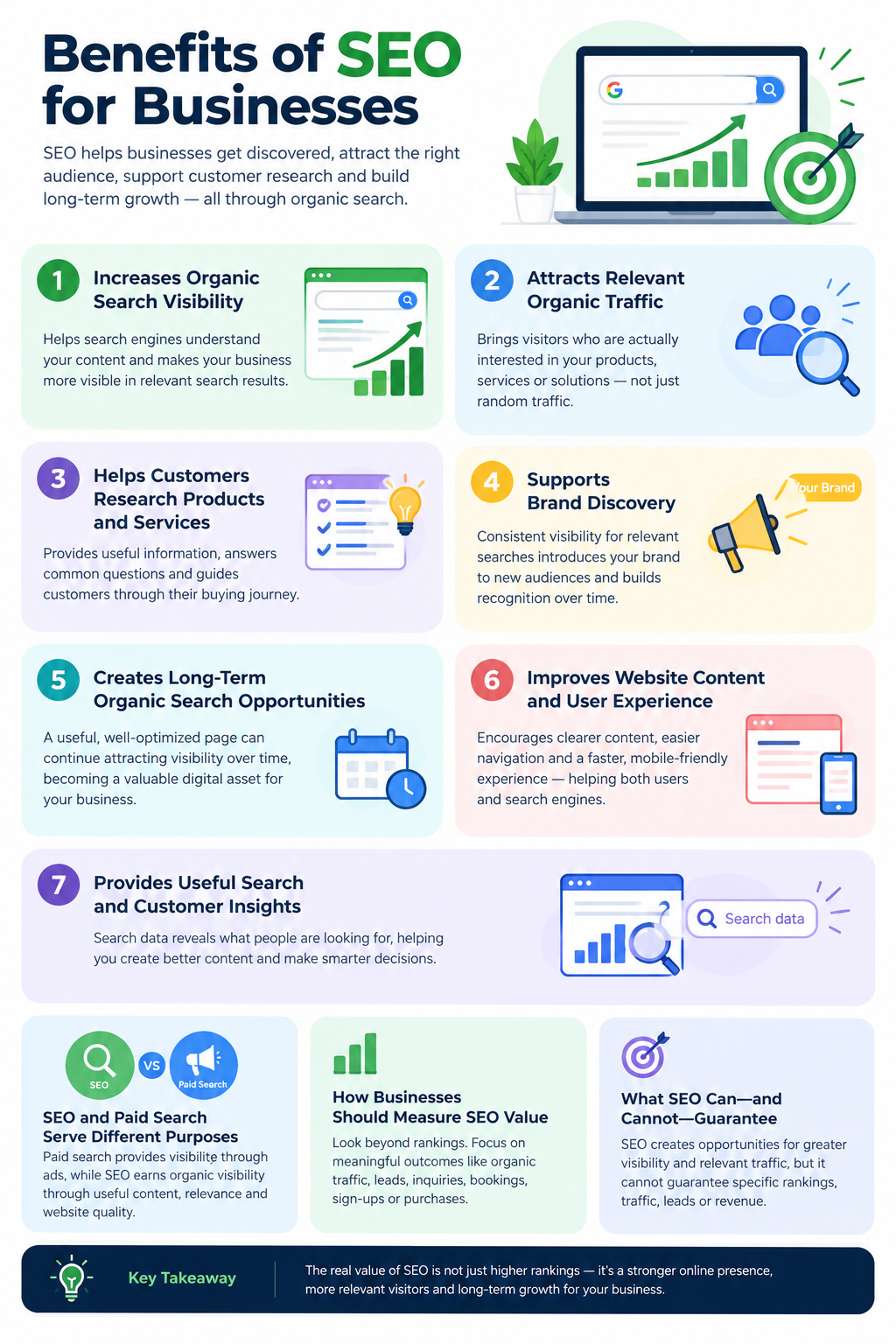
SEO and Paid Search Serve Different Purposes
SEO and paid search can both help businesses gain visibility in search, but they operate differently.
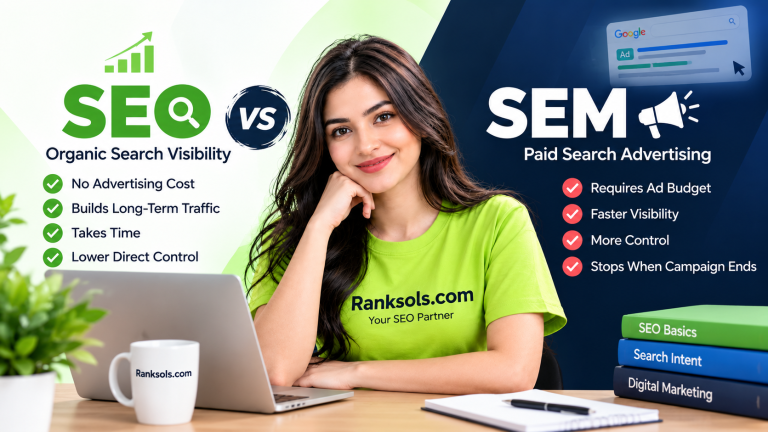
Paid search generally provides visibility through advertising placements in exchange for advertising spend. SEO focuses on earning organic visibility by improving the usefulness, relevance, accessibility, and overall quality of website content.
Businesses may use either approach or combine them depending on their goals, market, budget, and customer acquisition strategy.
The purpose of SEO is therefore not to replace every other marketing channel. It is to develop a sustainable organic search presence that supports the business’s broader objectives.
How Businesses Should Measure SEO Value
Rankings alone do not fully explain whether SEO is helping a business.
Depending on the business model, useful measures may include:
Relevant organic traffic
Organic impressions and clicks
Qualified leads
Contact inquiries
Product or service discovery
Bookings
Sign-ups
Purchases
Engagement with important pages
The appropriate measurement depends on what the business is trying to achieve.
For example, an online store may focus heavily on organic product discovery and purchases, while a professional services firm may place greater importance on qualified inquiries and leads.
This is why SEO should be connected to meaningful business objectives rather than treated as a ranking exercise.
What SEO Can—and Cannot—Guarantee
SEO can create opportunities for greater organic visibility and relevant website traffic, but it cannot guarantee a particular ranking position, amount of traffic, number of leads, or revenue outcome.
Search results depend on many factors, including the relevance and quality of content, competition, technical accessibility, user needs, and changes in search systems.
Businesses should therefore approach SEO as an ongoing process of creating useful resources, improving the website, understanding search demand, and measuring meaningful outcomes.
Key Takeaway
The benefits of SEO for businesses extend beyond rankings. A well-planned SEO strategy can help a business become easier to discover, attract relevant organic visitors, support customer research, improve its website, and develop useful search visibility over time.
The most effective approach is to focus on the audience first: create information that genuinely helps people, make it accessible, and connect it naturally with the products or services the business provides.