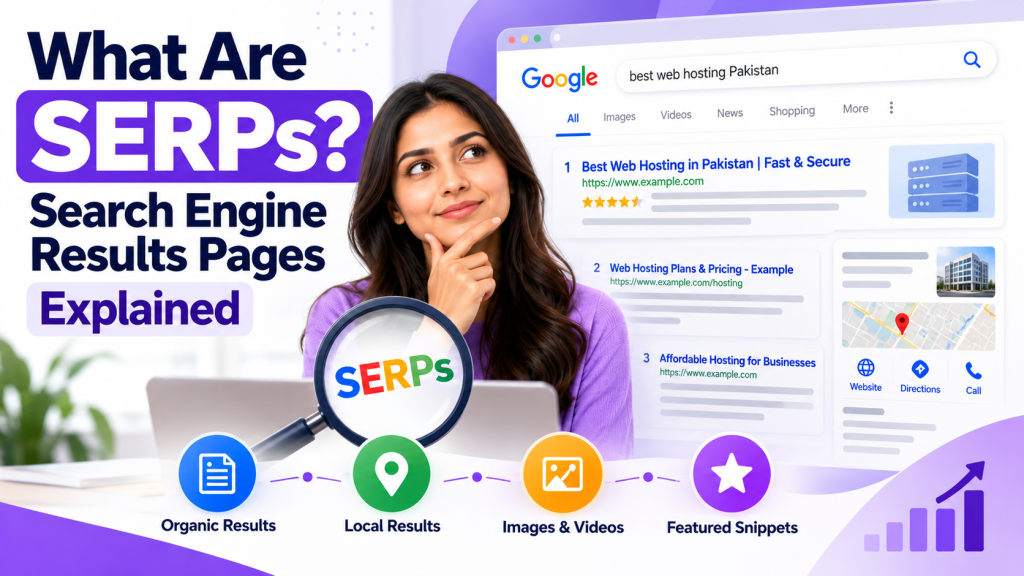
SERPs stands for Search Engine Results Pages. These are the pages search engines such as Google and Bing display in response to a user’s search query. A SERP can include organic search results, paid advertisements, featured snippets, image and video results, local listings, and other search features.
Understanding SERPs helps website owners and SEO professionals evaluate how content appears in search results, understand search intent, and identify opportunities to improve organic visibility.
What Appears on a SERP?
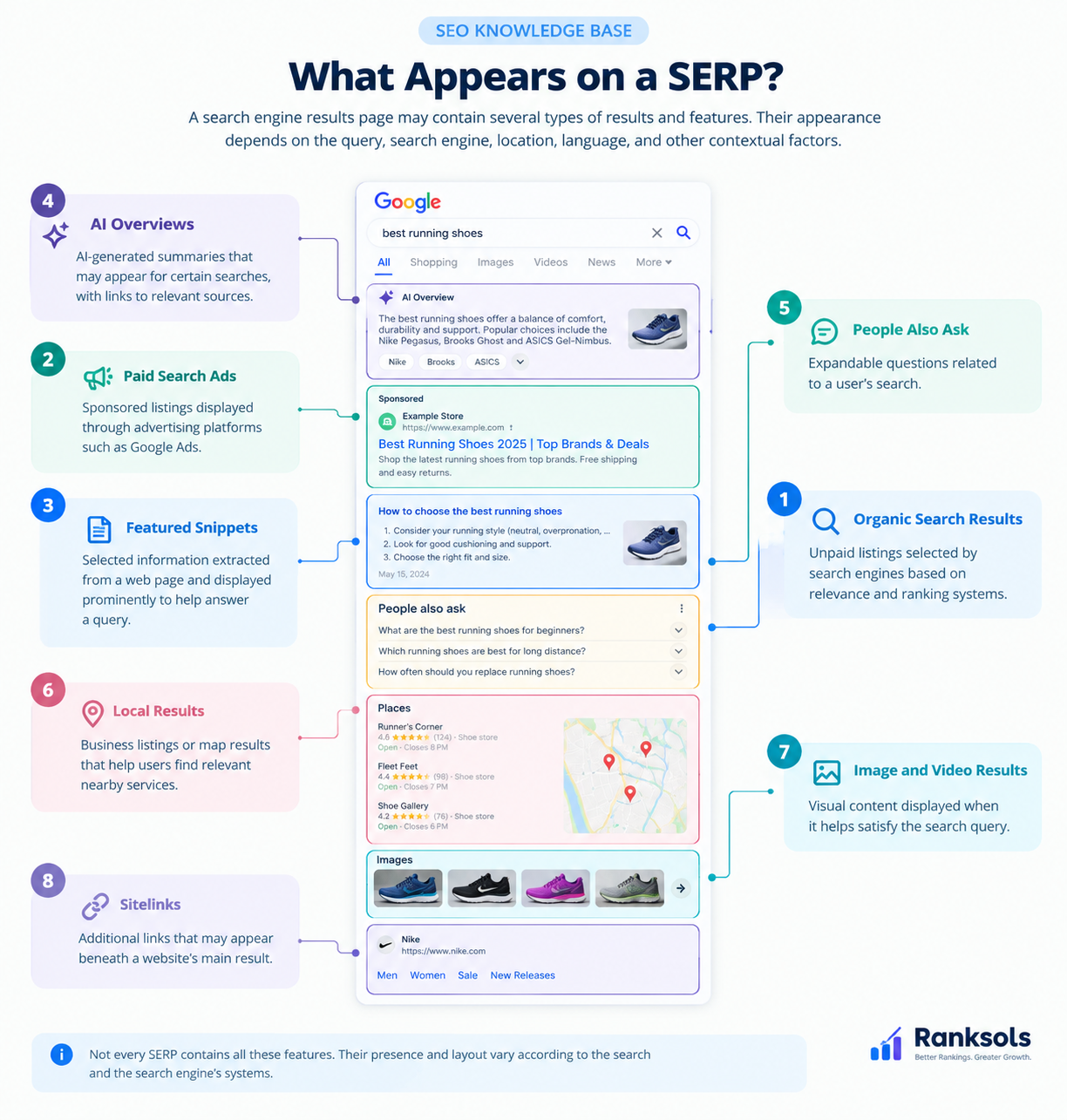
A search engine results page may contain several types of results and features. Their appearance depends on the query, search engine, location, language, and other contextual factors.
Common SERP elements include:
Organic search results: Unpaid listings selected by search engines based on relevance and ranking systems.
Paid search ads: Sponsored listings displayed through advertising platforms such as Google Ads.
Featured snippets: Selected information extracted from a web page and displayed prominently to help answer a query.
AI Overviews: AI-generated summaries that may appear for certain searches, with links to relevant sources.
People Also Ask: Expandable questions related to a user’s search.
Local results: Business listings or map results that help users find relevant nearby services.
Image and video results: Visual content displayed when it helps satisfy the search query.
Sitelinks: Additional links that may appear beneath a website’s main search result.
Not every SERP contains all these features. Their presence and layout vary according to the search and the search engine’s systems.
How Do SERPs Work?
When someone enters a search query, a search engine uses its index and ranking systems to identify relevant content and present results. The exact process and presentation can vary between search engines.
The general process involves three stages:
Query interpretation: The search engine analyzes the query to understand what the user is looking for.
Result selection and ranking: Its systems identify relevant content and determine how results should be ordered.
SERP presentation: The search engine displays selected results and any relevant search features.
For example, a search for “what is technical SEO” may return educational articles, while “SEO agency near me” may display local business listings and a map.
These differences show why understanding a query’s purpose is useful when planning content.
Why Are SERPs Important for SEO?
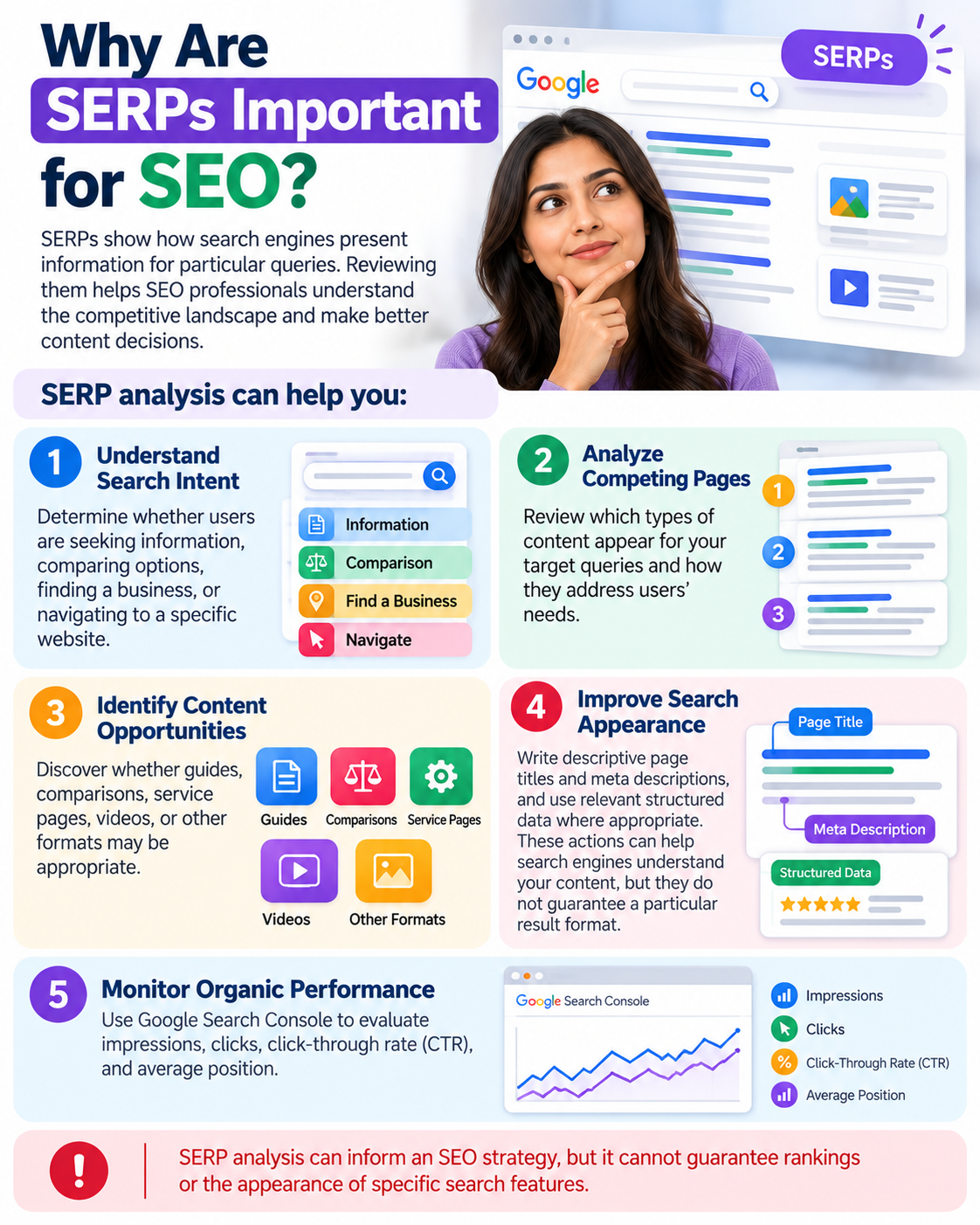
SERPs reveal how search engines present information for particular queries. Reviewing them helps SEO professionals understand the competitive landscape and make better content decisions.
SERP analysis can help you:
Understand search intent: Determine whether users are seeking information, comparing options, finding a business, or navigating to a specific website.
Analyze competing pages: Review which types of content appear for your target queries and how they address users’ needs.
Identify content opportunities: Discover whether guides, comparisons, service pages, videos, or other formats may be appropriate.
Improve search appearance: Write descriptive page titles and meta descriptions, and use relevant structured data where appropriate. These actions can help search engines understand your content, but they do not guarantee a particular result format.
Monitor organic performance: Use Google Search Console to evaluate impressions, clicks, click-through rate (CTR), and average position.
SERP analysis can inform an SEO strategy, but it cannot guarantee rankings or the appearance of specific search features.
What Is the Difference Between Organic and Paid SERP Results?
Organic and paid results can appear on the same search engine results page, but they are generated differently.
| Organic search results | Paid search results |
|---|---|
| Unpaid listings selected by search engine ranking systems | Sponsored placements purchased through advertising campaigns |
| Visibility is developed through relevance, content quality, and other ranking considerations | Visibility depends on advertising factors such as bids, ad quality, competition, and campaign settings |
| Traffic does not require paying for each organic click | Costs depend on the advertising model and campaign |
| Performance can be monitored through tools such as Google Search Console | Campaign performance can be monitored through advertising platforms |
A website can appear in both organic and paid results for the same query. However, paying for search advertisements does not directly purchase a higher organic ranking.
How to Analyze SERPs for SEO
A basic SERP analysis helps you understand what users expect to find and how your page could meet those needs.
Search for your target query. Review results for the relevant country, language, and device.
Identify the dominant content types. Determine whether the results mainly contain educational guides, comparison articles, product pages, service pages, or local listings.
Review visible SERP features. Look for featured snippets, People Also Ask questions, image results, AI Overviews, and other relevant elements.
Evaluate competing pages. Compare their relevance, information, structure, and usefulness rather than simply counting keywords.
Choose an appropriate content format. Create a page that satisfies the query and provides clear value to readers.
Example: Analyzing “Best SEO Tools”
Suppose you want to create content targeting “best SEO tools.”
If the results mainly contain comparison articles, readers are likely looking to evaluate different tools rather than learn only what SEO tools are.
Review whether competing pages compare features, pricing, use cases, and limitations. You can then develop a useful comparison that helps readers make an informed decision.
This is an illustrative example, not a claim about the current live search results for that query.
SERPs can change over time, so review them periodically rather than treating one analysis as a permanent blueprint.
How to Measure SERP Performance
Google Search Console’s Performance report provides data about how your website appears and performs in Google Search.
Key metrics include:
Impressions: How often your site’s results were shown in Google Search, according to Google’s reporting rules.
Clicks: How often users clicked through from Google Search to your website.
Click-through rate (CTR): The percentage of recorded impressions that resulted in clicks.
Average position: The average position of your site’s topmost result across the impressions included in the report.
Average position is an aggregate metric, not a guarantee of the exact position someone will see during an individual search. Results can vary across queries and search contexts.
You can use these metrics to identify queries that generate impressions but relatively few clicks, monitor performance changes, and decide which pages may need further review.
Frequently Asked Questions
What does SERP stand for in SEO?
SERP stands for Search Engine Results Page. It refers to the page a search engine displays in response to a user’s query.
Are SERPs the same for everyone?
No. Search results and their features may vary according to factors such as location, language, device, query context, and the search engine being used.
How can I check my website’s SERP performance?
Use Google Search Console’s Performance report to review search queries, impressions, clicks, CTR, and average position. These metrics help you understand your website’s visibility and performance in Google Search.
Conclusion
SERPs are the pages where search engines present organic listings, paid advertisements, and other search features in response to users’ queries. Understanding their structure helps website owners analyze search intent, evaluate competing content, and make informed SEO decisions.
For guidance on improving your website’s organic search visibility, explore the SEO resources available at Ranksols.pk.