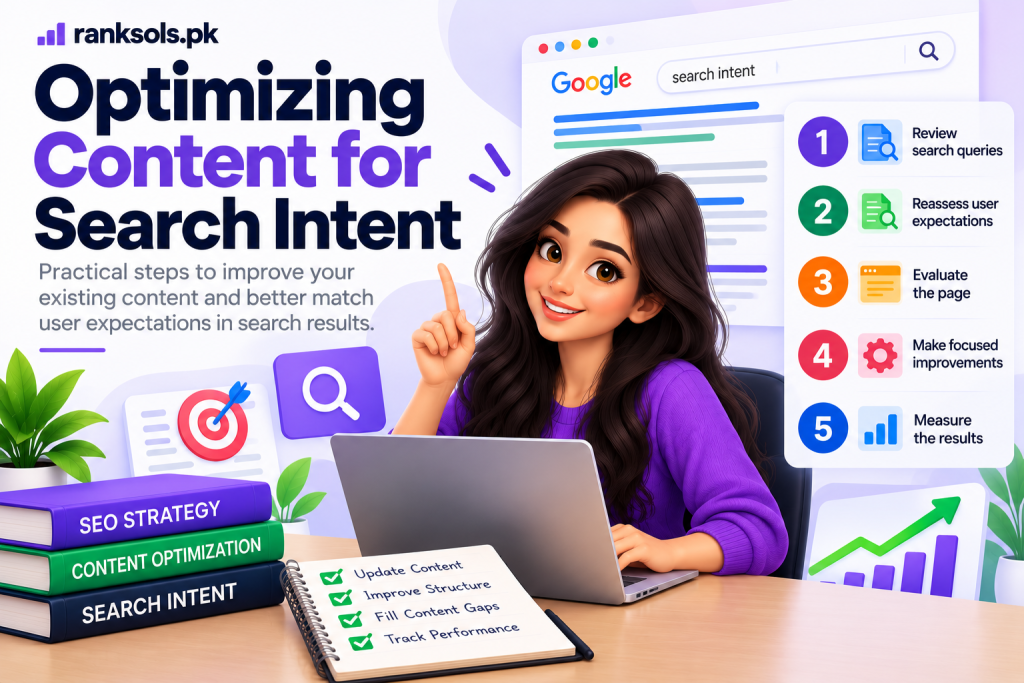
Optimizing content for search intent means aligning a webpage with what users want to accomplish when they enter a query into a search engine. It involves choosing the right content format, answering relevant questions, and making information easy to find.
Understanding search intent helps SEO professionals create useful, focused content that meets user expectations and supports organic search visibility.
How to Optimize Content for Search Intent
1. Identify the Purpose Behind the Search Query
Start by determining what users are likely trying to achieve with their target keyword. Search intent is not always obvious from the wording alone, so consider the query’s context and the results currently displayed by Google.
Common search-intent categories include:
Informational: Users want to learn something, such as “What is technical SEO?”
Navigational: Users want to reach a particular destination, such as “Google Search Console login.”
Commercial investigation: Users want to compare options, such as “Best SEO agency in Pakistan.”
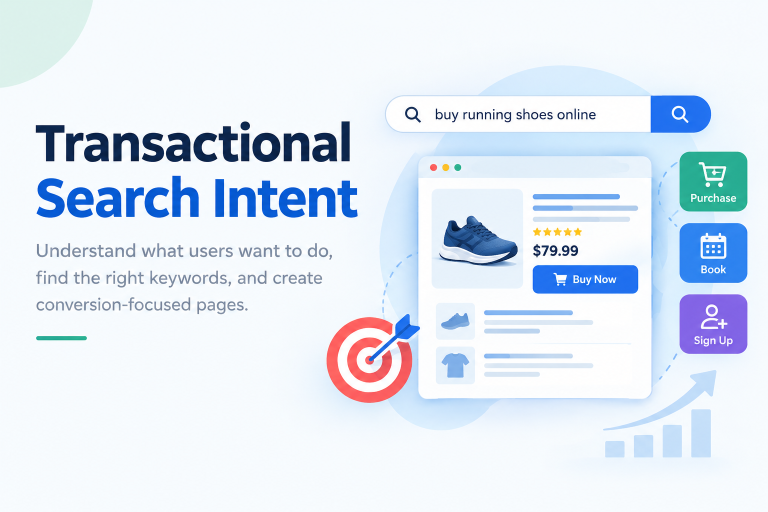
Transactional: Users want to take an action, such as “Hire an SEO agency in Pakistan.”
These categories form a widely used industry framework, not an official four-part classification published by Google. Some queries can have overlapping intentions.
2. Analyze the Search Engine Results Page (SERP)
Review the current search results for your target query to understand what information and formats users may expect.
Pay attention to:
Content format: Are the results guides, comparison articles, product pages, or service pages?
Content type: Do they provide tutorials, definitions, reviews, or actionable solutions?
Common subtopics: What questions or related issues appear across relevant results?
Search features: Are featured snippets, videos, images, or other search features present?
For example, someone searching for “how to improve website speed” will generally need practical guidance, whereas someone searching for “SEO services in Lahore” may be looking for service details and ways to contact a provider.
Use SERP analysis to identify likely expectations, not to copy competing pages. Your content should provide independent value and address the user’s needs effectively.
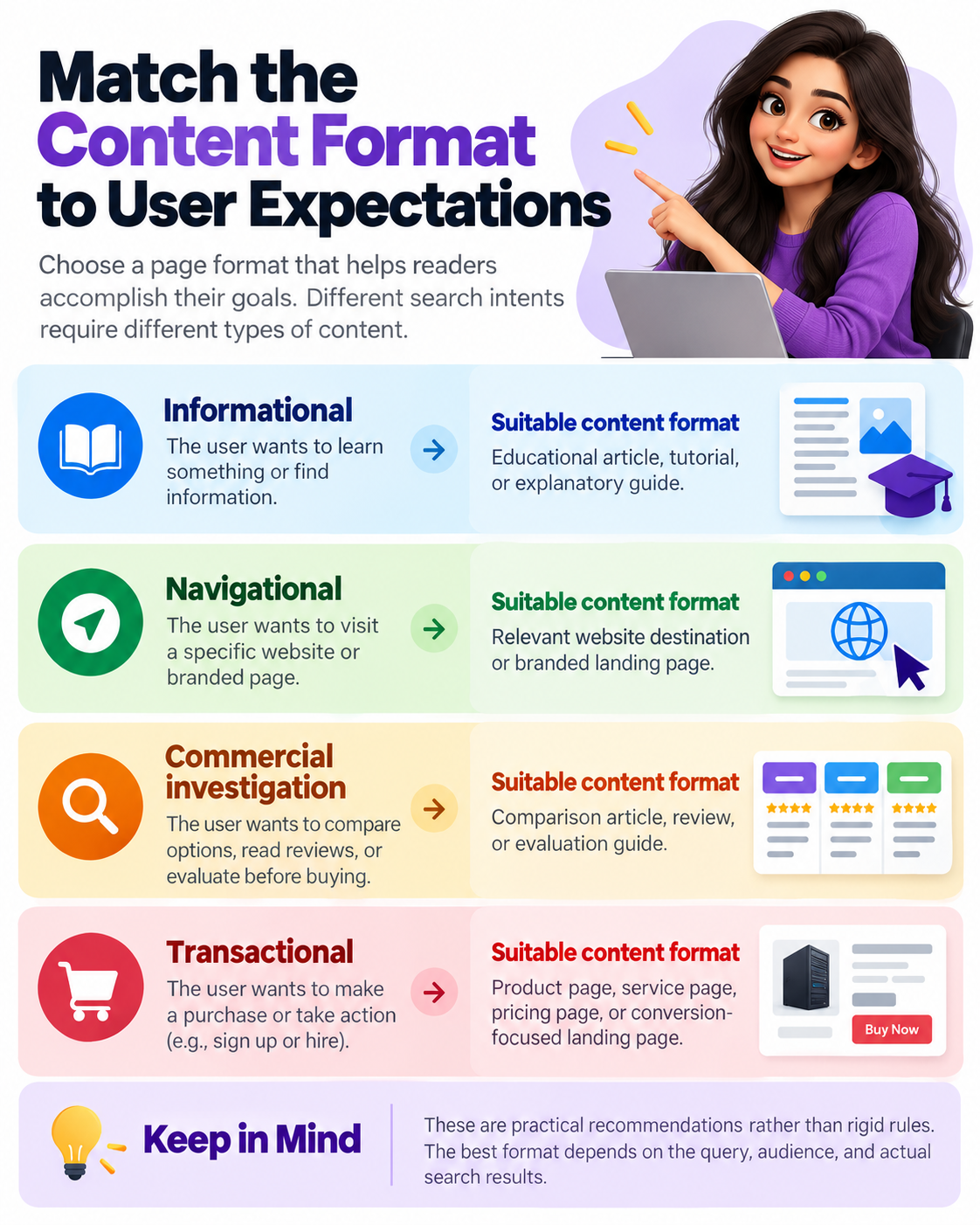
3. Match the Content Format to User Expectations
Choose a page format that helps readers accomplish their goals.
| Search intent | Suitable content format |
|---|---|
| Informational | Educational article, tutorial, or explanatory guide |
| Navigational | Relevant website destination or branded landing page |
| Commercial investigation | Comparison article, review, or evaluation guide |
| Transactional | Product page, service page, pricing page, or conversion-focused landing page |
These are practical recommendations rather than rigid rules. The best format depends on the query, audience, and actual search results.
A service page, for example, may be appropriate for users looking to hire an SEO agency. A detailed educational article is generally more suitable for readers who want to understand how SEO works.
4. Cover the Questions That Matter to the Reader
Once you understand the likely search intent, organize your content around the information users need.
For an informational article, this may include a definition, explanation, relevant examples, and practical steps. For a commercial investigation page, users may need comparisons, limitations, pricing considerations, and decision-making criteria.
Use relevant search queries, SERP observations, customer questions, and subject knowledge to identify useful subtopics.
Avoid adding sections simply to increase word count or include more keywords. Every section should help satisfy the page’s primary purpose.
5. Optimize Headings, Keywords, and Content Structure
Use the primary keyword naturally in relevant locations, such as the page title, main heading, introduction, and appropriate subheadings.
Include semantically related terms when they improve clarity and context. For an article about content optimization for search intent, relevant concepts might include search queries, SERP analysis, content format, user expectations, and on-page SEO.
Make the content easy to navigate with descriptive headings, short paragraphs, lists, and tables where appropriate. Organize information logically so readers can find answers without unnecessary effort.
Avoid keyword stuffing, repetitive headings, and awkward keyword variations. Clear, useful content should take priority over keyword frequency.
6. Align Calls to Action With Search Intent
Calls to action (CTAs) should reflect the reader’s needs and decision-making stage.
Informational content: Recommend a related guide or educational resource.
Commercial investigation content: Offer relevant comparisons, service details, or a consultation option.
Transactional content: Provide a clear next step, such as requesting a quote or purchasing a service.
For example, readers who need professional help developing an SEO content strategy can explore the relevant services offered by Ranksols.pk.
Keep promotional messages proportionate to the page’s purpose. Educational content should answer the reader’s question before encouraging them to take another step.
How to Optimize an Existing Page for Search Intent
Search-intent optimization is not limited to creating new content. Existing pages may need improvements when they no longer address user expectations or perform as intended.
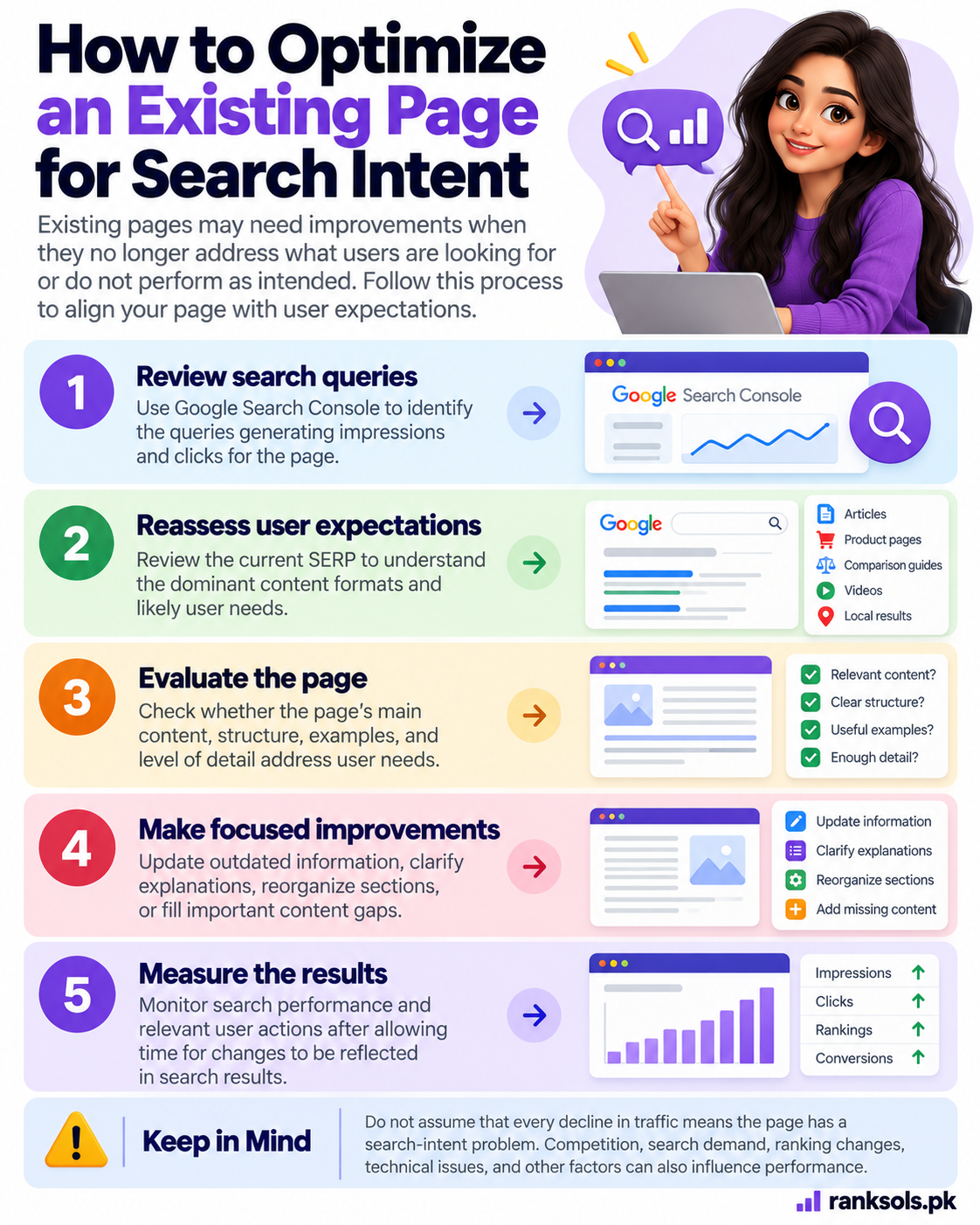
Follow this process:
Review search queries: Use Google Search Console to identify the queries generating impressions and clicks for the page.
Reassess user expectations: Review the current SERP to understand the dominant content formats and likely user needs.
Evaluate the page: Check whether its main content, structure, examples, and level of detail address those needs.
Make focused improvements: Update outdated information, clarify explanations, reorganize sections, or fill important content gaps.
Measure the results: Monitor search performance and relevant user actions after allowing time for changes to be reflected in search results.
Do not assume that every decline in traffic means the page has a search-intent problem. Competition, search demand, ranking changes, technical issues, and other factors can also influence performance.
Common Mistakes When Optimizing Content for Search Intent
Avoid these mistakes when planning or updating SEO content:
Focusing only on keywords: A page can include the target keyword without adequately answering the user’s question.
Choosing the wrong page format: A sales page may not satisfy a query seeking an in-depth tutorial.
Copying competitors: Ranking pages provide useful clues, but your content should offer its own value.
Combining conflicting goals: Mixing a brief definition, a lengthy tutorial, an extensive comparison, and an aggressive sales pitch can make a page less focused.
Adding unnecessary content: Extra sections may distract readers from the main purpose.
Using misleading CTAs: Calls to action should be relevant to what visitors want to accomplish.
Ignoring existing content: Published pages may need periodic review as user expectations and search results change.
Creating overlapping articles: Multiple pages targeting essentially the same search intent can create unnecessary duplication within a website’s content library.
When related topics deserve separate resources, cover each topic at the appropriate depth and connect the pages with relevant internal links.
How to Evaluate Search Intent Optimization
Use performance data and search-result observations together to assess whether your content is meeting its objectives.
| Tool or method | What to examine | Purpose |
|---|---|---|
| Google Search Console | Queries, impressions, clicks, CTR, and average position | Understand search visibility and how users reach the page |
| Google Analytics 4 (GA4) | Engagement and relevant conversions | Understand visitor behavior after arrival |
| Manual SERP review | Current result types and content formats | Reassess likely user expectations |
Interpret these signals in context. For example, a page with impressions but few clicks may benefit from a more descriptive title or meta description, while low conversions may warrant a review of the page’s relevance, offer, or next steps.
Neither pattern proves a search-intent mismatch on its own. Evaluate the page’s purpose, query data, user behavior, and business objectives before deciding what to change.
Frequently Asked Questions
How do I optimize an existing page for search intent?
Review its target queries, compare the page with current search results, identify important information gaps, and update the content to better address user needs. Monitor performance after making focused changes.
What should I do when a keyword has mixed search intent?
Determine which intent is most relevant to your audience and supported by the search results. Prioritize that need, and include secondary information only when it helps readers. Consider a separate page if another intent requires substantially different content.
Can one page satisfy more than one search intent?
Yes. A page can address related needs when they support the same overall purpose. However, if the intents require different formats or goals, separate pages may provide a clearer experience.
How often should I review search intent?
Review important pages periodically and when you notice meaningful changes in search performance, audience needs, or the search results. There is no universal review schedule that suits every website.
Does optimizing for search intent guarantee higher rankings?
No. Search-intent alignment is a useful content practice, but rankings depend on multiple factors. No particular optimization method guarantees a specific position or increase in organic traffic.
Conclusion
Optimizing content for search intent means understanding what users need, choosing an appropriate page format, and providing focused, useful information. Reviewing existing pages and measuring their performance can help identify opportunities for improvement.
For businesses that need support aligning content with search intent and broader SEO objectives, Ranksols.pk can help develop a more structured approach to content optimization.