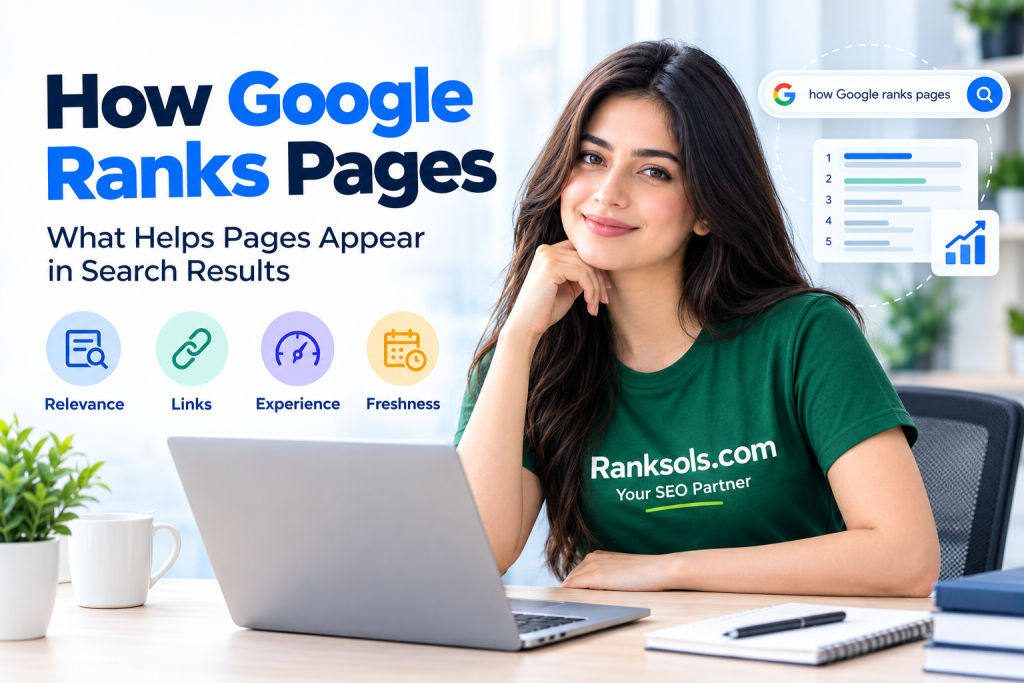
Google ranks pages using multiple automated systems that evaluate relevance, content quality, and other signals to determine which results may best satisfy a user’s search. These systems consider the meaning of a query, the usefulness of a page, and the context of the search.
Understanding how Google ranks pages helps website owners make informed SEO decisions, improve content quality, and avoid outdated ranking myths.
How Does Google Rank Web Pages?
When someone searches on Google, its systems identify relevant information from the Google index and determine which results are most useful for that particular query.
Google does not rely on one universal ranking factor. Instead, multiple ranking systems and signals work together, and their importance can vary depending on the search.
SEO professionals often use the term ranking factors to describe signals that may influence search positions. However, there is no single public checklist that determines every ranking decision.
For example, a search about breaking news may require fresh information, while a search for a basic definition may be better served by a clear, reliable explanation.
Key Factors That Influence Google Rankings
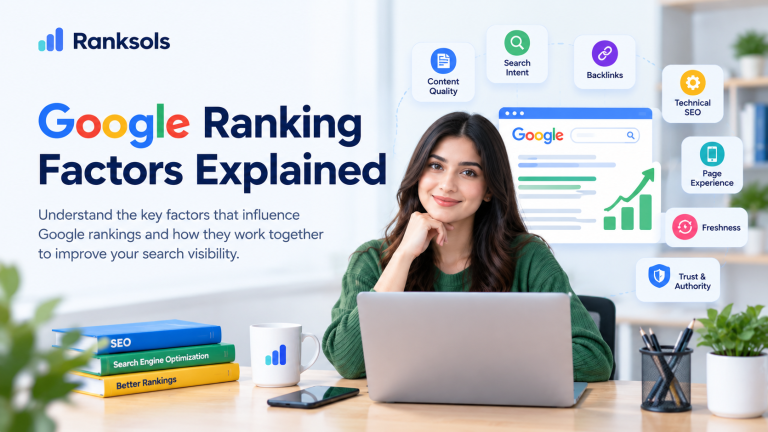
Google uses multiple systems and signals to assess search results. The following areas are particularly useful for understanding how pages can perform in organic search.
1. Content Relevance and Search Intent
Google tries to understand what users mean when they search and how well a page addresses their needs. It considers the query’s wording, context, and related concepts.
For example, a page explaining the meaning of SEO is more relevant to someone searching “What is SEO?” than a page focused entirely on purchasing SEO services.
What to do: Create content that directly answers the target query, addresses the user’s main questions, and provides relevant information without unnecessary explanations.
2. Content Quality and Helpfulness
Google aims to surface helpful, reliable, people-first content. Pages should provide accurate information and meaningful value rather than simply repeating information available elsewhere.
For example, an article explaining Google’s ranking process should clarify how ranking differs from indexing, provide realistic examples, and reference reliable documentation where appropriate.
What to do: Publish well-researched content that demonstrates relevant knowledge, answers the reader’s questions, and provides useful explanations or original insights.
3. Links and PageRank
Google uses link analysis systems, including PageRank, to understand relationships between pages and assess their importance. PageRank remains part of Google’s core ranking systems, although it has evolved significantly.
Links can help Google discover pages and understand how information is connected. However, not all links have the same context or value, and acquiring backlinks does not guarantee higher rankings.
What to do: Create useful resources that people have a genuine reason to reference. Use relevant internal links to connect related pages and help users navigate your website.
4. Page Experience and Usability
A page should be accessible, usable, and provide a satisfactory experience across devices. Loading performance, responsiveness, visual stability, mobile usability, and intrusive page elements are relevant considerations.
Google’s Core Web Vitals measure aspects of loading performance, interactivity, and visual stability. They are useful for evaluating user experience, but passing every metric does not guarantee higher rankings.
What to do: Improve page performance, make content easy to access on mobile devices, and avoid disruptive elements that interfere with reading or navigation.
5. Content Freshness
Freshness matters when a query benefits from recent information. Searches about breaking news, current developments, or recently released products may require up-to-date content.
However, not every page needs frequent updates. An accurate explanation of an established SEO concept may remain useful for years.
What to do: Update content when facts, recommendations, or relevant circumstances change. Do not change publication dates or rewrite useful content without a genuine reason.
6. Search Context and Location
Google may use context such as a user’s location, language, and search settings to provide more relevant results.
For example, someone searching for an SEO agency nearby may receive local business results, while someone searching for the meaning of SEO may see educational resources.
What to do: Understand your intended audience and the context behind your target queries. If your business serves a particular area, create relevant local information where it genuinely helps potential customers.
How Google Ranking Works in Practice
The following example simplifies the process. Google’s actual ranking systems use multiple technologies and signals rather than one fixed sequence of checks.
Suppose someone searches for “best web hosting for small businesses.”
Query interpretation: Google’s systems work to understand the user’s comparison-oriented search.
Relevant page selection: Google identifies indexed pages that may address web hosting options for small businesses.
Signal evaluation: Its ranking systems assess relevance, usefulness, and other signals appropriate to the search.
Result ordering: Google presents the results its systems determine are most useful for that query.
The exact calculations and relative importance of individual signals are not fully public. Search results can also vary according to the query and its context.
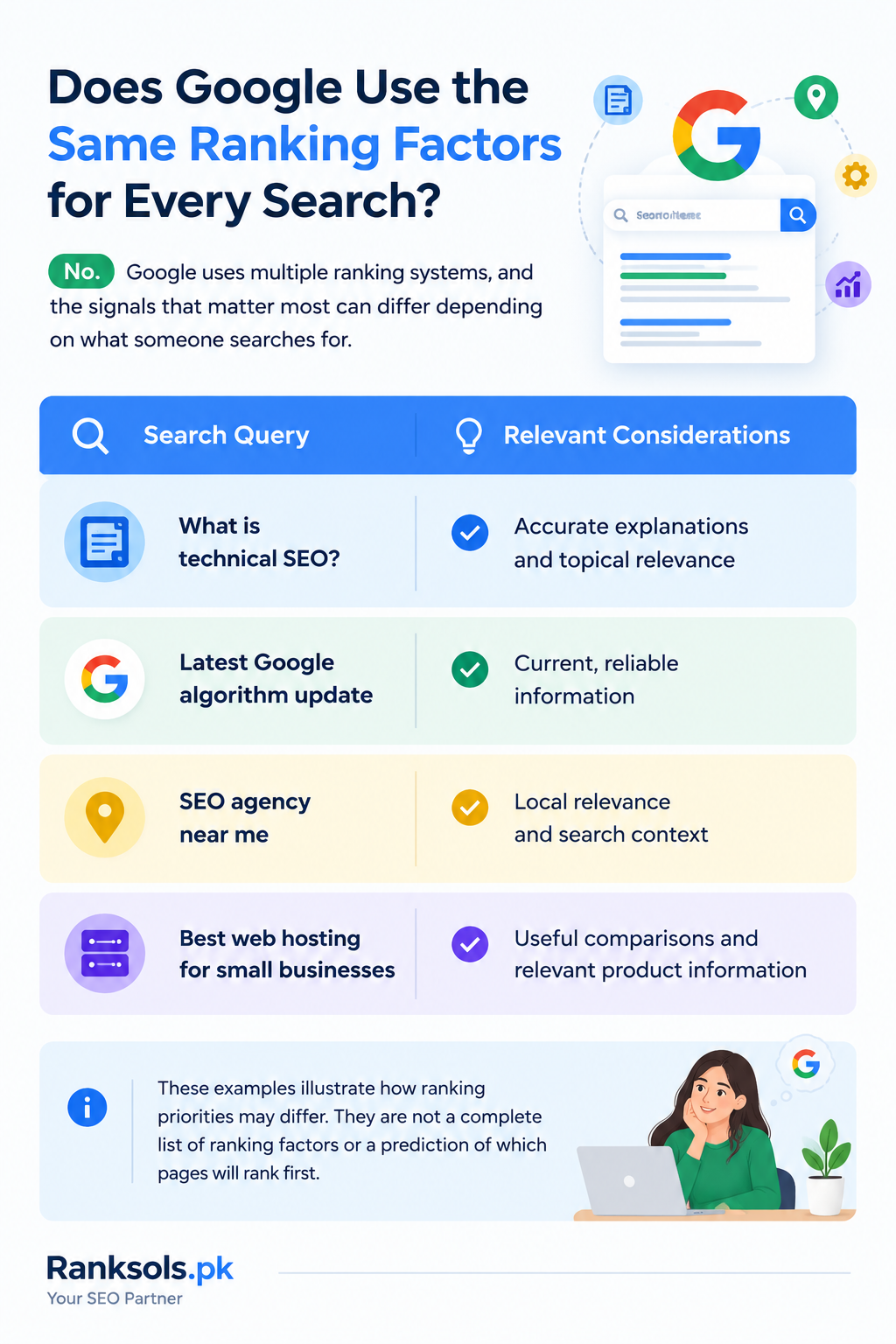
Does Google Use the Same Ranking Factors for Every Search?
No. Google uses multiple ranking systems, and the signals that matter most can differ depending on what someone searches for.
| Search query | Relevant considerations |
|---|---|
| What is technical SEO? | Accurate explanations and topical relevance |
| Latest Google algorithm update | Current, reliable information |
| SEO agency near me | Local relevance and search context |
| Best web hosting for small businesses | Useful comparisons and relevant product information |
These examples illustrate how ranking priorities may differ. They are not a complete list of ranking factors or a prediction of which pages will rank first.
How Can You Improve Your Chances of Ranking on Google?
Website owners can follow practical SEO principles that align with Google’s published guidance:
Match search intent: Understand the user’s goal before creating or optimizing a page.
Improve content quality: Provide accurate, useful information that answers the reader’s questions.
Use descriptive titles and headings: Make the page’s subject clear to users and search engines.
Strengthen internal linking: Connect relevant pages using natural, descriptive anchor text.
Maintain technical accessibility: Ensure important pages can be crawled and are eligible for indexing.
Improve usability: Make the website easy to navigate and use across devices.
Follow Google’s spam policies: Avoid manipulative techniques designed to distort search rankings.
These practices support a sound SEO strategy, but no individual change guarantees a particular ranking position.
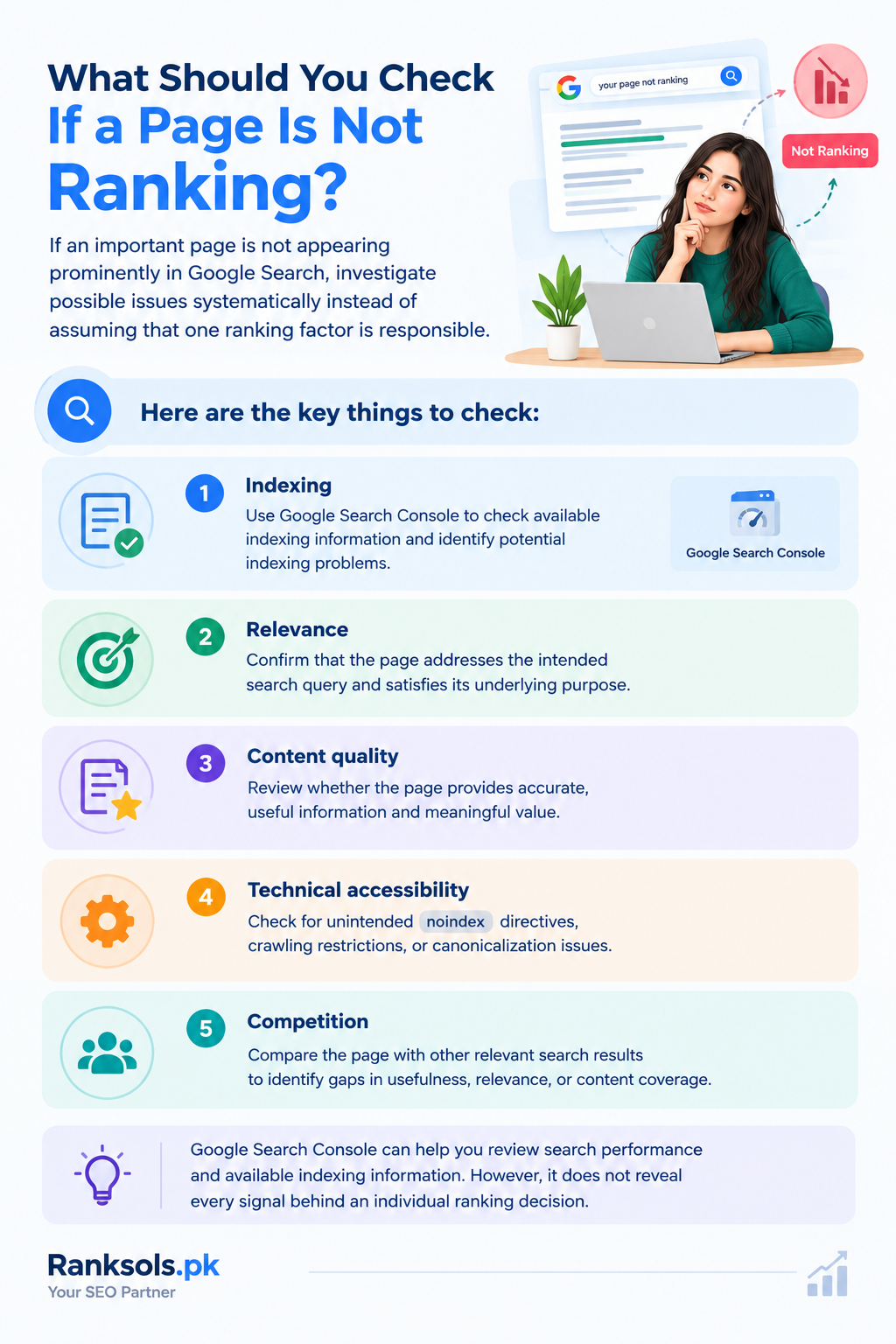
What Should You Check If a Page Is Not Ranking?
If an important page is not appearing prominently in Google Search, investigate possible issues systematically instead of assuming that one ranking factor is responsible.
Indexing: Use Google Search Console to check available indexing information and identify potential indexing problems.
Relevance: Confirm that the page addresses the intended search query and satisfies its underlying purpose.
Content quality: Review whether the page provides accurate, useful information and meaningful value.
Technical accessibility: Check for unintended
noindexdirectives, crawling restrictions, or canonicalization issues.Competition: Compare the page with other relevant search results to identify gaps in usefulness, relevance, or content coverage.
Google Search Console can help you review search performance and available indexing information. However, it does not reveal every signal behind an individual ranking decision.
Does Google Guarantee That Every Indexed Page Will Rank?
No. Being indexed means Google has stored a page in its index, but it does not guarantee that the page will appear prominently—or appear at all—for a particular query.
Google’s systems must still determine whether the page is relevant and useful for the search. Competition, query context, and other signals can influence its visibility.
If a page is indexed but receives little organic traffic, review its relevance, usefulness, and technical accessibility before making changes. Avoid assuming that indexing alone will lead to strong rankings.
Frequently Asked Questions
How many ranking factors does Google use?
Google uses many signals and automated ranking systems. There is no single, complete public checklist that provides a fixed number of ranking factors with universally applicable weights.
Is keyword density a Google ranking factor?
There is no recommended keyword-density percentage that guarantees rankings. Use relevant terms naturally and focus on creating content that clearly addresses the user’s search.
Do backlinks guarantee higher Google rankings?
No. Links are among the signals used by Google’s ranking systems, but their presence does not guarantee a specific position. Focus on relevant, useful content and follow Google’s spam policies.
Can a new website rank on Google?
Yes. A new website can rank if its pages are discovered, indexed, and considered relevant and useful for a search. However, rankings depend on multiple factors, and there is no guaranteed timeframe.
Conclusion
Google ranks pages using multiple automated systems and signals to identify results that best satisfy a user’s search. Relevance, helpful content, links, freshness when appropriate, and usability can all contribute to organic search performance.
For sustainable SEO, focus on creating useful content, maintaining a technically accessible website, and meeting your audience’s needs. Ranksols can help businesses evaluate their website’s SEO and identify practical opportunities to improve search visibility.
For further reading, explore Google’s official guide to Search ranking systems, Google Search Essentials, and How Google Search works.