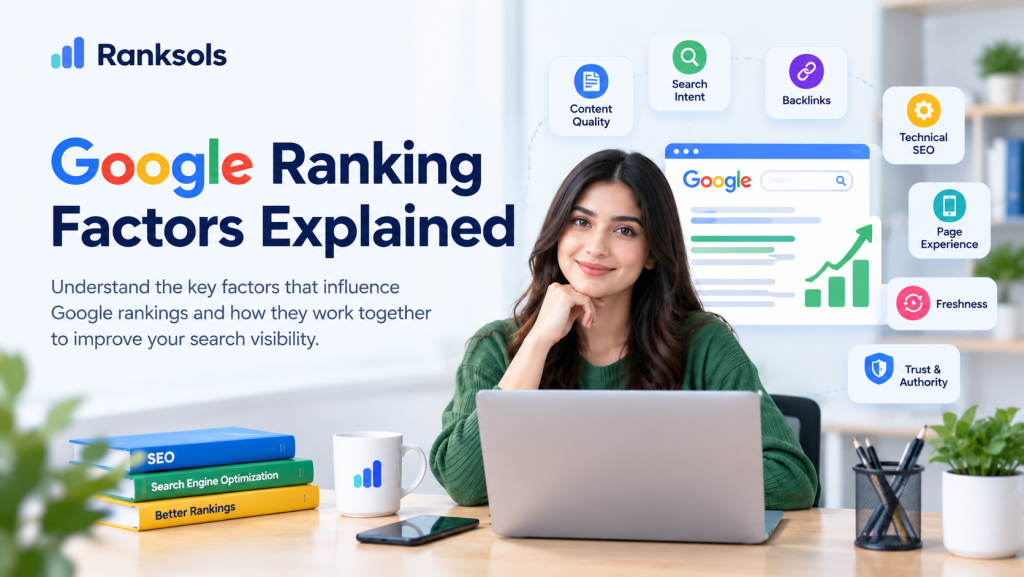
Google ranking factors are signals and systems that help Google determine which pages are most relevant and useful for a search query. Understanding the main areas that influence Google rankings helps website owners prioritize content quality, technical accessibility, and user experience.
Google uses multiple automated ranking systems rather than a single checklist of factors. The importance of different signals can vary depending on the query and the information users need.
What Are the Key Areas That Influence Google Rankings?
Google does not publish a complete, fixed list of ranking factors or assign a universal weight to each one. However, several important areas help explain how websites can improve their search visibility.
1. Content Quality and Relevance
Content quality and relevance are central to successful SEO. Google’s ranking systems aim to surface helpful information that meets users’ needs and relates closely to their search queries.
Useful content should answer relevant questions, explain concepts accurately, and provide meaningful information. It should also reflect the purpose of the search rather than simply repeat keywords.
For example, a page targeting “how to improve website speed” should provide relevant methods and practical explanations instead of discussing website performance without answering the question.
Focus on helpful, reliable, people-first content that demonstrates an appropriate level of knowledge and provides value to readers.
2. Search Intent and Query Understanding
Google’s systems work to understand the meaning and purpose behind a search query. The most useful result depends on what the user is trying to accomplish.
For example, someone searching for “best SEO tools” may want to compare available options, while someone searching for “buy SEO software” may be looking for a purchase option.
Content that matches the likely search intent is better positioned to satisfy the user’s needs. Review the search results for your target queries to understand the types of pages and information that appear relevant.
Search intent is a useful SEO planning concept, not a separate ranking score that website owners can directly optimize.
3. Backlinks and Link Signals
Links from other websites can help Google discover pages and provide signals about their relevance and importance. Google’s ranking systems consider links among many other signals.
However, backlink quantity alone does not determine rankings. The context in which a link appears, its relevance, and whether it was obtained naturally are important considerations when evaluating link-building practices.
Focus on creating useful resources that relevant websites have a genuine reason to reference. Avoid buying links or participating in manipulative link schemes intended to influence search rankings.
4. Technical SEO Foundations
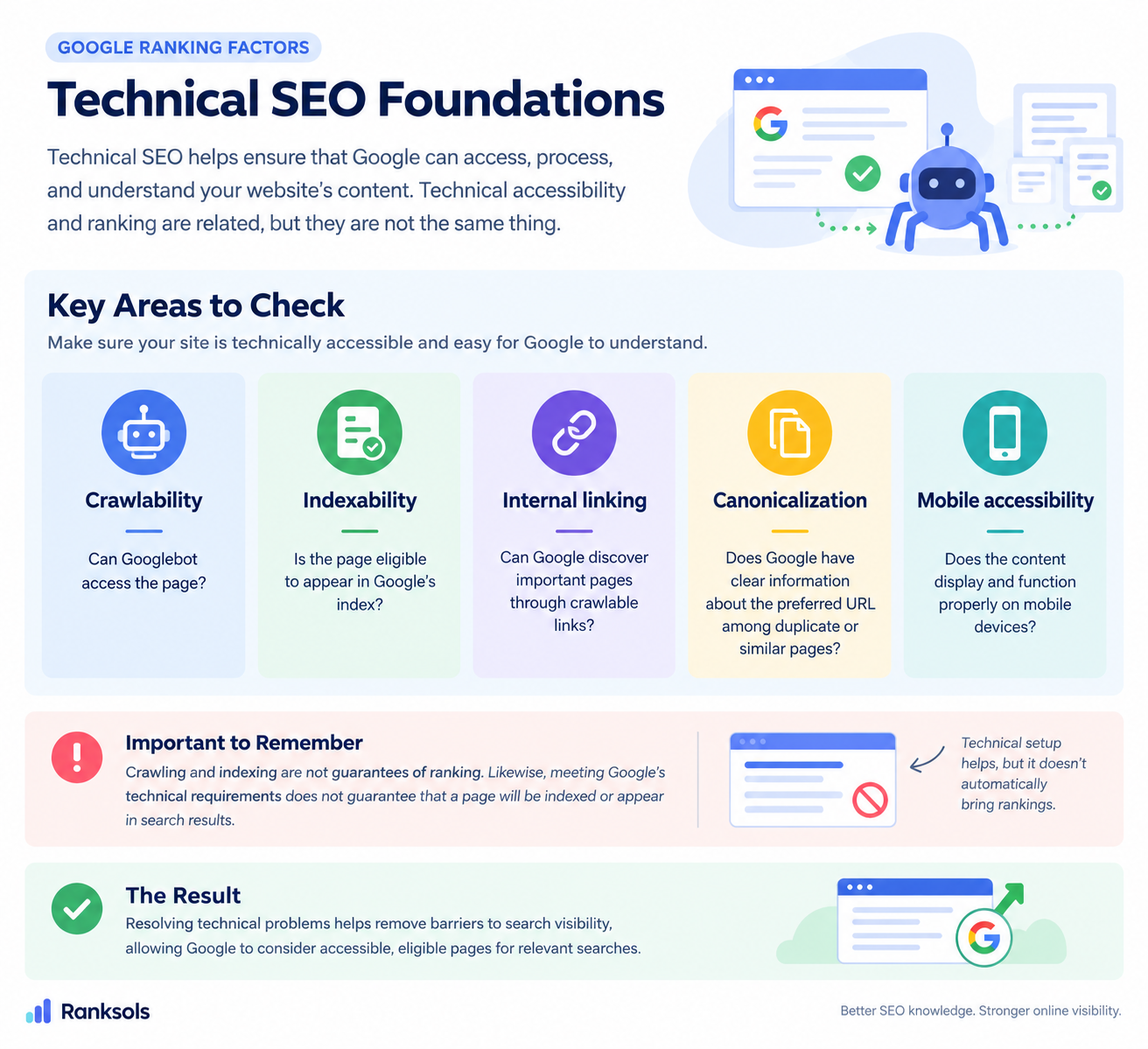
Technical SEO helps ensure that Google can access, process, and understand your website’s content. Technical accessibility and ranking are related, but they are not the same thing.
Important areas to check include:
Crawlability: Can Googlebot access the page?
Indexability: Is the page eligible to appear in Google’s index?
Internal linking: Can Google discover important pages through crawlable links?
Canonicalization: Does Google have clear information about the preferred URL among duplicate or similar pages?
Mobile accessibility: Does the content display and function properly on mobile devices?
Crawling and indexing are not guarantees of ranking. Likewise, meeting Google’s technical requirements does not guarantee that a page will be indexed or appear in search results.
Resolving technical problems helps remove barriers to search visibility, allowing Google to consider accessible, eligible pages for relevant searches.
5. Page Experience and Core Web Vitals
Page experience concerns how easily visitors can access, understand, and interact with a webpage. Google recommends providing a good overall page experience rather than focusing exclusively on individual performance metrics.
Core Web Vitals measure three aspects of real-world user experience:
Largest Contentful Paint (LCP): Measures loading performance.
Interaction to Next Paint (INP): Measures responsiveness to user interactions.
Cumulative Layout Shift (CLS): Measures visual stability.
A good page experience also includes secure connections, mobile-friendly presentation, clear navigation, and avoiding disruptive elements that interfere with the main content.
Good Core Web Vitals can support search performance, but perfect scores do not guarantee top rankings. Relevant, helpful content remains essential, so prioritize improvements that benefit users rather than optimizing metrics for their own sake.
6. Freshness and Content Updates
Freshness can influence which results are most useful for queries that require current information. For example, searches about recent developments, current software features, or changing industry practices may benefit from up-to-date content.
Other topics, such as basic SEO definitions, may remain useful for a long time without frequent updates.
Review important pages when facts, recommendations, examples, or user needs change. Update information meaningfully instead of changing publication dates simply to make content appear fresh.
7. Trust, Experience, and Expertise
Google’s systems use multiple signals to identify helpful and reliable information. Accurate explanations, appropriate sourcing, and clear information about content authorship can help readers assess a page’s credibility.
Google describes qualities associated with experience, expertise, authoritativeness, and trustworthiness through the concept of E-E-A-T. E-E-A-T is not a single, standalone ranking factor. Rather, Google’s systems use a variety of signals to identify qualities associated with trustworthy and helpful content.
To strengthen your content, provide accurate information, support important claims with reliable sources where appropriate, and make it clear who is responsible for the material.
Are All Google Ranking Factors Equally Important?
No. Different signals and ranking systems serve different purposes, and their relevance can vary depending on the search query.
For example, freshness may matter more for a query about a recent industry development than for a query seeking a stable definition. Similarly, content relevance is essential when determining whether a page answers the user’s question, while technical accessibility helps ensure that Google can discover and process the page.
The seven areas discussed in this article are a practical framework for understanding SEO priorities, not an official or exhaustive classification published by Google.
This is why website owners should avoid relying on fixed ranking-factor lists or assumed weighting systems. A better approach is to assess each page’s purpose, content quality, technical condition, and performance in relevant search results.
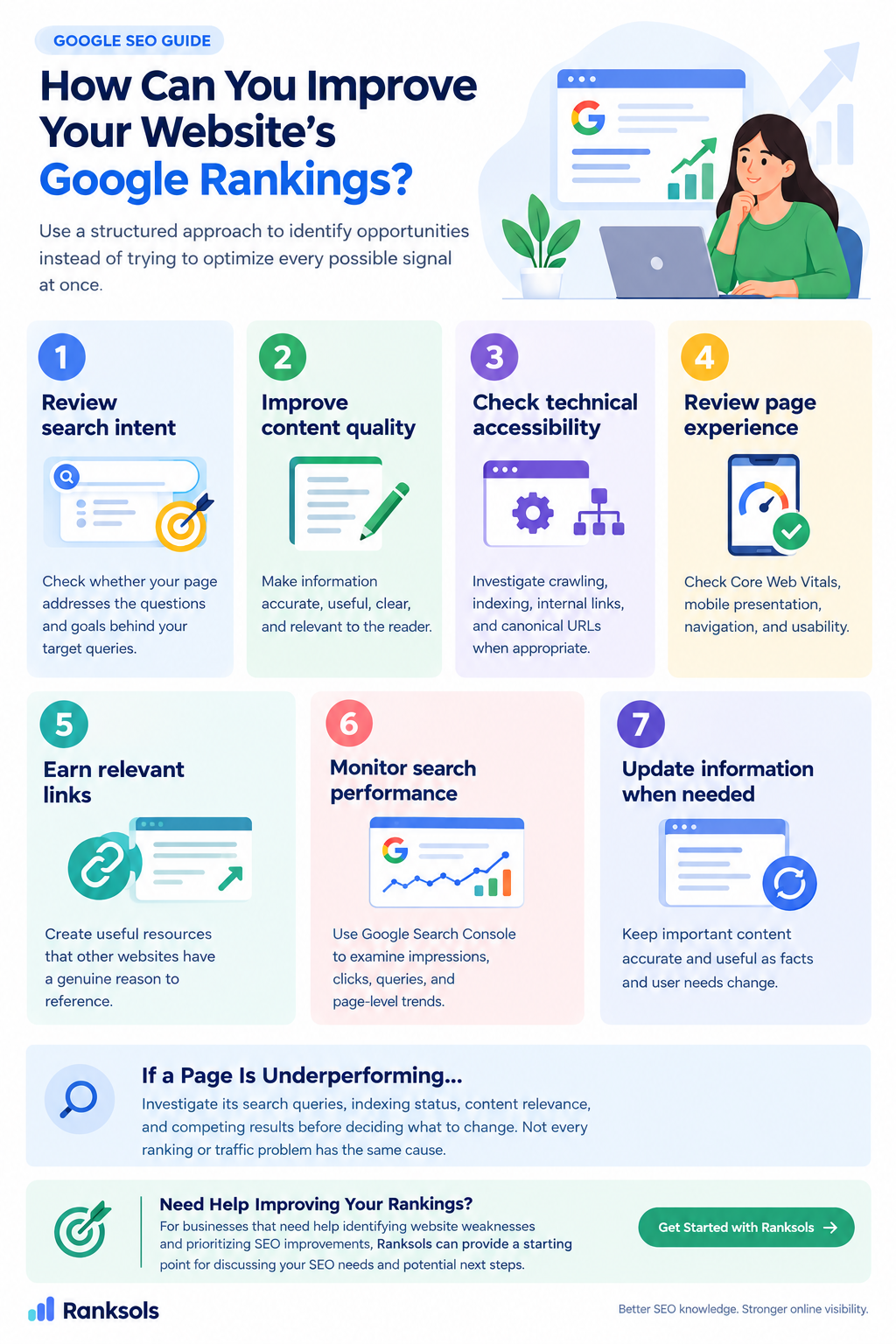
How Can You Improve Your Website’s Google Rankings?
Use a structured approach to identify opportunities instead of trying to optimize every possible signal at once.
Review search intent: Check whether your page addresses the questions and goals behind its target queries.
Improve content quality: Make information accurate, useful, clear, and relevant to the reader.
Check technical accessibility: Investigate crawling, indexing, internal links, and canonical URLs when appropriate.
Review page experience: Check Core Web Vitals, mobile presentation, navigation, and usability.
Earn relevant links: Create useful resources that other websites have a genuine reason to reference.
Monitor search performance: Use Google Search Console to examine impressions, clicks, queries, and page-level trends.
Update information when needed: Keep important content accurate and useful as facts and user needs change.
If an important page is underperforming, investigate its search queries, indexing status, content relevance, and competing results before deciding what to change. Not every ranking or traffic problem has the same cause.
For businesses that need help identifying website weaknesses and prioritizing SEO improvements, Ranksols can provide a starting point for discussing their SEO needs and potential next steps.
Common Misconceptions About Google Ranking Factors
Using a keyword more often guarantees better rankings. Keyword repetition does not guarantee improved visibility. Content should use relevant terminology naturally and address the user’s needs.
Longer content always ranks higher. Google does not prescribe a universal word count for ranking. Content should provide the information necessary to satisfy its purpose.
Perfect Core Web Vitals scores guarantee top rankings. Performance metrics are useful for assessing user experience, but they do not guarantee a particular search position.
E-E-A-T is a single ranking factor. E-E-A-T describes qualities associated with helpful and trustworthy content. It is not one standalone ranking signal.
Following an SEO checklist guarantees rankings. No checklist or SEO provider can guarantee a particular Google position. Search visibility depends on multiple systems, signals, query requirements, and competing results.
Final Thoughts
Google rankings are influenced by multiple systems and signals that help identify relevant, helpful, and reliable results. Website owners should prioritize useful content, technical accessibility, an effective page experience, and credible information rather than chasing supposed ranking shortcuts.
For deeper guidance, explore related Ranksols resources on search intent, technical SEO, search engine crawlers, and indexing. These topics provide practical context for understanding how individual pages can become eligible for search and better serve their intended audience.
Authoritative reference: Google Search ranking systems.