Commercial investigation intent occurs when users research, compare, and evaluate products, services, or providers before deciding which option best meets their needs. They may be considering a purchase, but they still need information to assess the available choices.
In SEO, queries containing terms such as best, review, comparison, alternatives, and vs. often indicate commercial investigation intent. However, the complete search query and its context matter more than any single keyword.
Understanding this intent helps businesses create content that supports users during the evaluation stage of their decision-making process.
How Does Commercial Investigation Intent Work?
Users with commercial investigation intent usually understand what they need but have not yet decided which option to choose. They want information that helps them compare available solutions and make an informed decision.
Their research may involve:
Comparing different products, services, or providers
Reading customer reviews and expert evaluations
Examining features, benefits, and limitations
Comparing pricing and overall value
Exploring alternatives to a particular product or service
For example, someone searching for best SEO agency in Pakistan may want to compare agencies, assess their services, and identify a suitable provider before making contact.
Commercial investigation intent is therefore associated with the consideration stage of the buyer journey, although users may move between research and purchasing decisions in different ways.
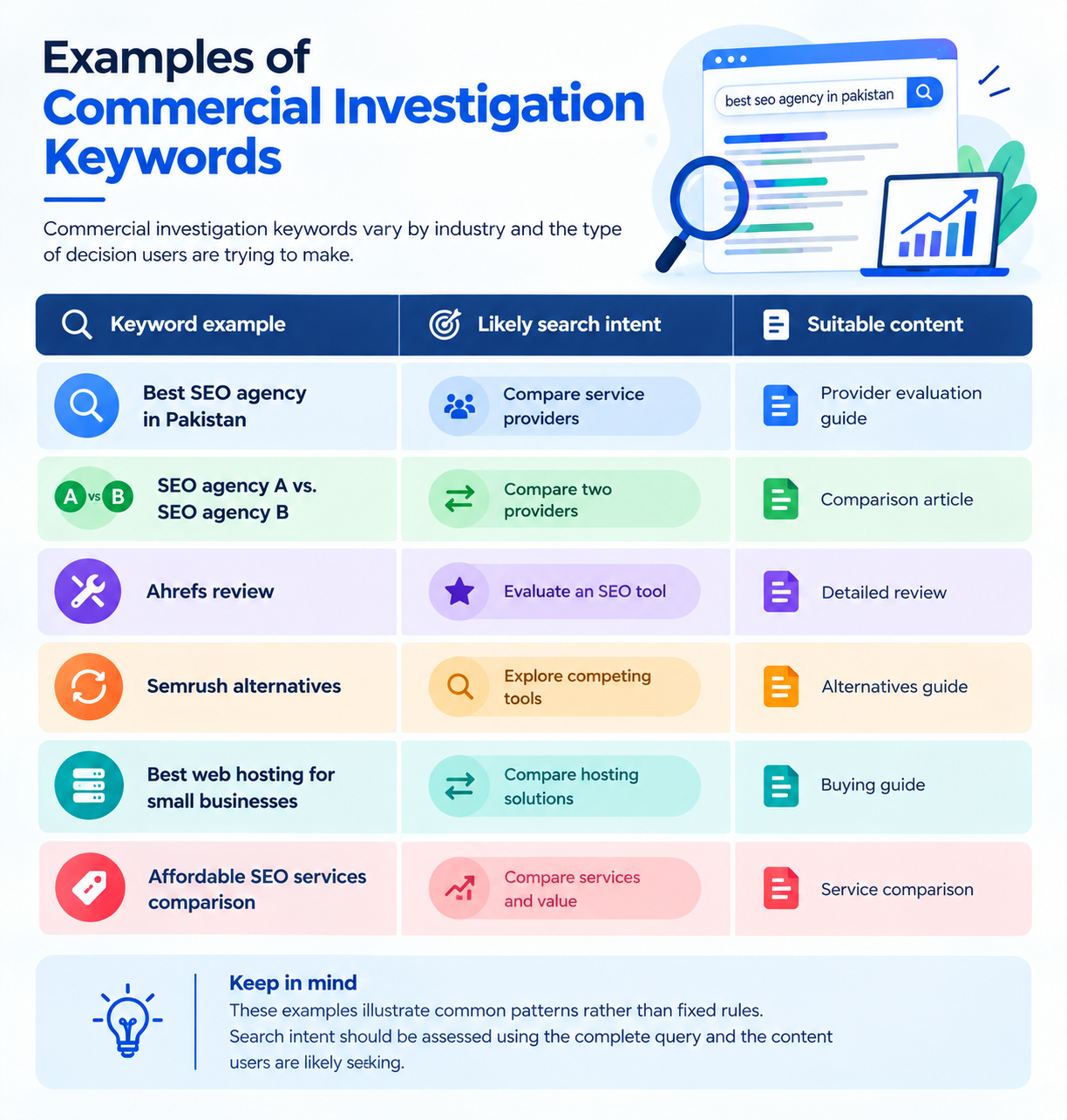
Examples of Commercial Investigation Keywords
Commercial investigation keywords vary by industry and the type of decision users are trying to make.
| Keyword example | Likely search intent | Suitable content |
|---|---|---|
| Best SEO agency in Pakistan | Compare service providers | Provider evaluation guide |
| SEO agency A vs. SEO agency B | Compare two providers | Comparison article |
| Ahrefs review | Evaluate an SEO tool | Detailed review |
| Semrush alternatives | Explore competing tools | Alternatives guide |
| Best web hosting for small businesses | Compare hosting solutions | Buying guide |
| Affordable SEO services comparison | Compare services and value | Service comparison |
These examples illustrate common patterns rather than fixed rules. Search intent should be assessed using the complete query and the content users are likely seeking.
Why Is Commercial Investigation Intent Important for SEO?
Understanding commercial investigation intent helps businesses align their content with the needs of potential customers who are evaluating their options.
Instead of relying only on general informational articles or direct sales pages, websites can publish comparison guides, reviews, alternatives articles, and buying resources that address specific decision-making questions.
This approach can help users understand their choices and discover relevant products or services without requiring every page to function as a sales page.
For example, an SEO agency may publish a guide explaining how to evaluate SEO providers, compare service offerings, and assess suitability for different business needs. Such a resource can support prospective customers while remaining primarily educational.
How to Optimize Content for Commercial Investigation Intent
To target commercial investigation keywords effectively, create content that helps readers evaluate their options and understand the differences between available solutions.
1. Understand What Users Want to Compare
Identify the factors that influence the decision behind the search query. Depending on the subject, users may want to compare pricing, features, service scope, support, experience, or suitability for their needs.
Address the factors that genuinely matter to the intended audience.
2. Choose the Right Content Format
Select a format that matches the searcher’s evaluation needs. Common options include:
Comparison articles: Explain the differences between two or more options.
Product or service reviews: Evaluate a specific offering, including relevant strengths and limitations.
Alternatives guides: Help users explore competing solutions.
Best-of lists: Compare several options against relevant selection criteria.
Buying guides: Explain what to consider before choosing a product or service.
The best format depends on the target query and the information users need to make their decision.
3. Analyze the Search Results
Before creating content, examine the current search results for the target keyword. Look at whether Google primarily displays reviews, comparison articles, list-based guides, product pages, or service pages.
These results can provide clues about the format users expect and the intent Google appears to be serving.
However, search results are not a guarantee of performance. Use them alongside audience needs and subject knowledge to create content that provides genuine value rather than simply copying competing pages.
4. Provide Balanced and Useful Information
Explain relevant differences, benefits, limitations, and use cases. Avoid unsupported claims, exaggerated advantages, or comparisons designed only to promote one option.
Where appropriate, explain which solution may suit a particular type of user and why. Transparent, well-supported information makes the content more useful for decision-making.
5. Use Commercial Keywords Naturally
Include relevant phrases such as best services, product reviews, alternatives, pricing comparison, and service comparisons when they fit the topic.
Avoid forcing these terms into headings or paragraphs. The purpose is to answer the user’s query clearly, not to increase keyword frequency.
6. Provide a Relevant Next Step
When appropriate, guide readers toward a related product page, service page, consultation, or additional resource that helps them continue their evaluation.
For example, readers considering professional SEO support can explore the SEO services offered by Ranksols to understand the types of support available for their search visibility goals.
Keep the call to action relevant to the reader’s needs and secondary to the educational purpose of the article.
Commercial Investigation Intent vs. Other Search Intents
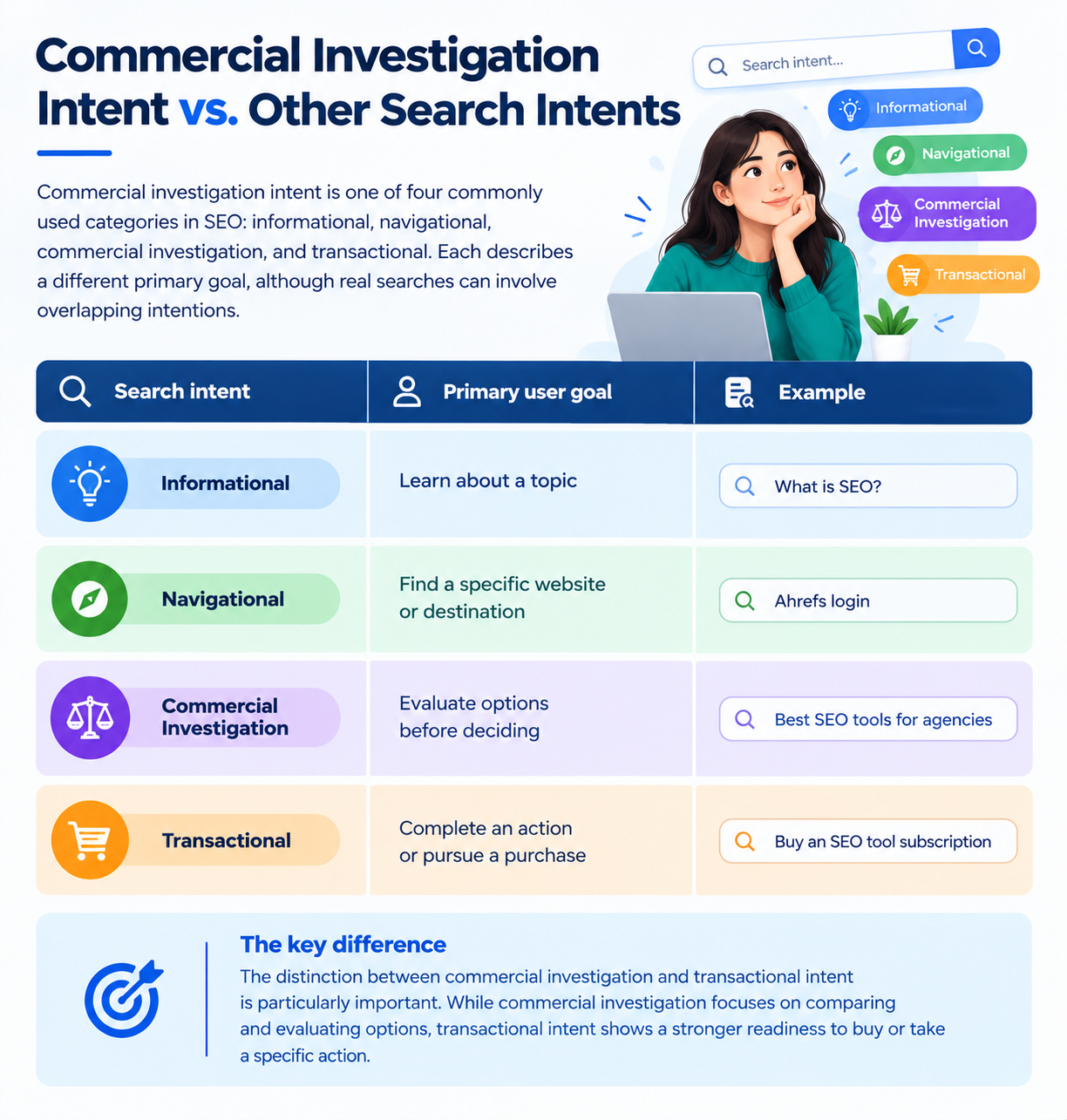
Commercial investigation intent is one of four commonly used categories in SEO: informational, navigational, commercial investigation, and transactional. Each describes a different primary goal, although real searches can involve overlapping intentions.
| Search intent | Primary user goal | Example |
|---|---|---|
| Informational | Learn about a topic | What is SEO? |
| Navigational | Find a specific website or destination | Ahrefs login |
| Commercial investigation | Evaluate options before deciding | Best SEO tools for agencies |
| Transactional | Complete an action or pursue a purchase | Buy an SEO tool subscription |
The distinction between commercial investigation and transactional intent is particularly important.
Someone searching for best SEO agency in Pakistan may want to compare providers, whereas someone searching for hire an SEO agency in Pakistan expresses a more direct intention to engage a provider.
The first query may be better served by an evaluation guide, while the second may be better served by a relevant service page. These are likely interpretations, not guaranteed classifications; the complete query and its context should guide the final decision.
Note: This four-category model is a commonly used SEO industry framework, not an official Google search-intent classification.
For a broader explanation of these categories, read the related Ranksols guide on types of search intent in SEO.
Frequently Asked Questions
Is commercial investigation intent informational or transactional?
Commercial investigation intent has an informational element because users need information to evaluate their options. However, its primary purpose is commercial evaluation rather than simply learning about a subject or completing an immediate purchase.
What are common commercial investigation keywords?
Common examples include best, top, review, comparison, vs., alternatives, and pros and cons. These words can indicate evaluation intent, but the complete query and its context determine the likely goal.
What type of content works best for commercial investigation intent?
Comparison articles, product reviews, alternatives guides, buying guides, and best-of lists are often suitable. Choose the format that best matches the query, the current search results, and the information users need.
Is commercial investigation intent valuable for businesses?
Yes. It can help businesses reach people who are evaluating potential solutions. Useful, trustworthy content can support their decisions and provide a natural path toward relevant products or services.
Conclusion
Commercial investigation intent describes searches made by users who are evaluating products, services, or providers before choosing an option. Understanding this intent helps SEO professionals create relevant comparison guides, reviews, and buying resources that support informed decisions.
The priority is to match content to the searcher’s evaluation needs, provide balanced information, and offer a relevant next step when a suitable product or service is available.