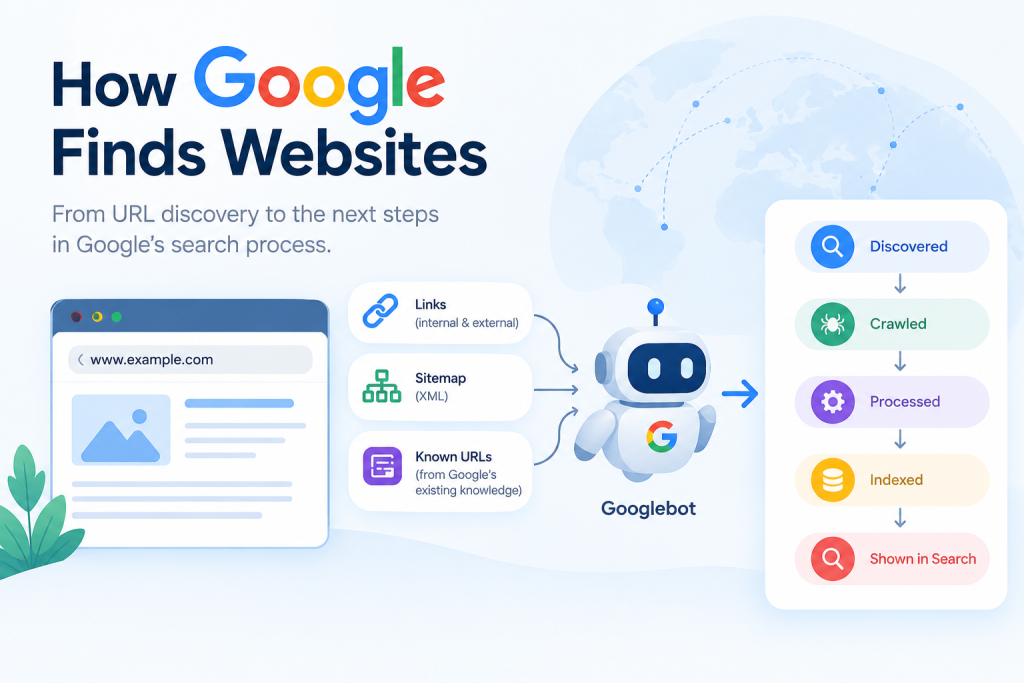
Before Google can crawl a webpage, it first needs to discover its URL. Google can discover websites and individual pages through links, sitemaps, and other URLs it already knows about.
Understanding how Google discovers URLs helps website owners make important pages easier for Google to find without confusing discovery with crawling or indexing.
How Does Google Find a New Website?
Google continuously discovers URLs across the web. When Google finds a URL that it does not already know about, that URL can enter its crawling process.
For example, imagine a new website launches at:
example.com
If another website links to a page on that domain, Google may discover the URL by following that link.
However, an external link is not the only way Google can discover a website. Internal links and XML sitemaps can also provide Google with paths to URLs.
The important concept is:
Google discovers URLs first; crawling and indexing are separate stages.
How Does Google Discover URLs?
There are several ways Google can discover URLs.
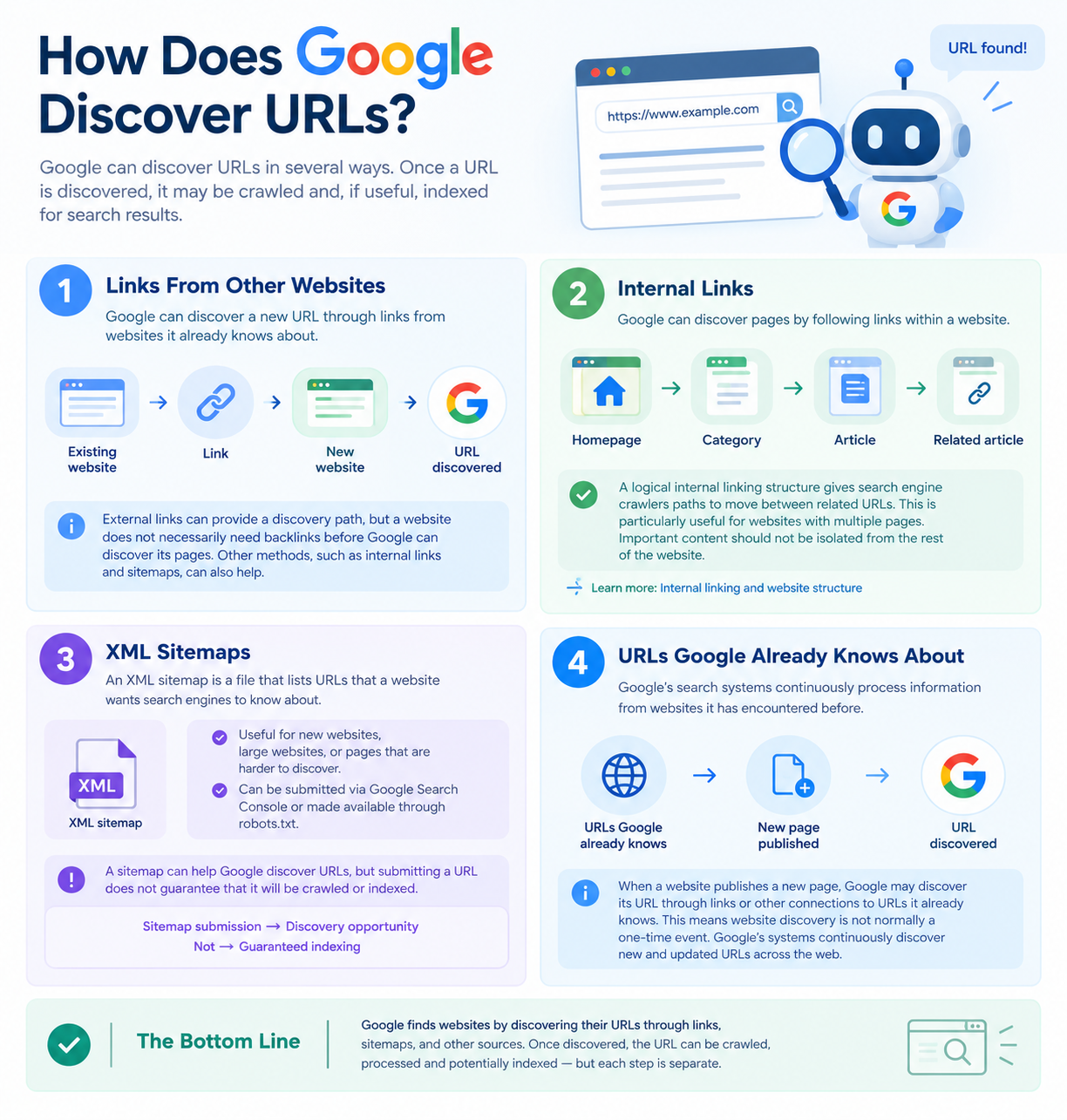
1. Links From Other Websites
Google can discover a new URL through links from websites it already knows about.
For example:
Existing website → Link → New website → URL discovered
External links can therefore provide a discovery path for a new website or webpage.
However, a website does not necessarily need backlinks before Google can discover its pages. Other discovery methods, such as internal links and sitemaps, can also help.
2. Internal Links
Google can discover pages by following links within a website.
For example:
Homepage → Category → Article → Related article
A logical internal linking structure gives search engine crawlers paths to move between related URLs.
This is particularly useful for websites with multiple pages. Important content should not be isolated from the rest of the website without a clear way for Google to discover it.
For a deeper understanding of this subject, see the related guide on internal linking and website structure.
3. XML Sitemaps
An XML sitemap is a file that lists URLs that a website wants search engines to know about.
Sitemaps can be particularly useful for new websites, large websites, or sites with pages that may be harder to discover through normal internal links.
Website owners can submit a sitemap through Google Search Console or make it available through the website’s robots.txt file.
A sitemap can help Google discover URLs, but submitting a URL does not guarantee that Google will crawl or index it.
That distinction is important:
Sitemap submission → Discovery opportunity
Not → Guaranteed indexing
4. URLs Google Already Knows About
Google’s search systems continuously process information from websites it has encountered before.
When a website publishes a new page, Google may discover its URL through links or other connections to URLs it already knows.
This means website discovery is not normally a one-time event. Google’s systems continuously discover new and updated URLs across the web.
Do You Need to Submit Your Website to Google?
Not necessarily.
Google can discover websites and webpages automatically. Website owners do not have to manually submit every URL for Google to know that it exists.
However, submitting an XML sitemap through Google Search Console can provide Google with useful information about the URLs on a website.
Search Console can also help website owners inspect individual URLs and understand whether Google has encountered them.
Neither sitemap submission nor URL inspection guarantees that a page will appear in Google Search.
Can Google Find a Page Without Backlinks?
Yes.
A webpage does not necessarily need a backlink from another website to be discovered.
Google may discover the URL through:
Internal links
XML sitemaps
Other URLs it already knows about
Links from external websites
For example, a new article may have no external backlinks but can still be discoverable if it is properly linked from the website’s homepage, category page, or another relevant article.
This is one reason a clear website structure matters.
What Happens After Google Discovers a URL?
Discovery is only the beginning.
A simplified process is:
URL Discovery → Crawling → Processing → Indexing → Search Results
After discovering a URL, Google may decide to crawl it. Googlebot requests the page and retrieves its content. Google then processes the information and determines whether the page should be included in its search index.
This leads to an important distinction:
Discovered does not mean crawled, and crawled does not automatically mean indexed.
A newly published page can therefore exist on the web without immediately appearing in Google Search.
The separate processes of crawling and indexing deserve their own dedicated resources rather than being covered in detail here.
How Can You Make Important URLs Easier to Discover?
Website owners can support URL discovery by maintaining a clear and accessible website structure.
Practical steps include:
Link important pages from relevant pages on your website.
Maintain an accurate XML sitemap.
Use logical navigation and URL structures.
Avoid leaving important pages isolated from the rest of the site.
Make sure Googlebot can access pages that you want Google to crawl.
Keep important content connected through relevant internal links.
A sitemap helps communicate URLs to search engines, while internal links provide actual paths between pages.
Both can contribute to better URL discovery.
For businesses that depend on organic search visibility, reviewing website structure, internal linking, sitemap configuration, and crawl accessibility can be a useful part of a broader technical SEO assessment.
Ranksols can help businesses evaluate these technical SEO elements as part of an overall website optimization strategy.
Does Robots.txt Help Google Find a Website?
Robots.txt is primarily a crawling-control mechanism, not a discovery method.
A robots.txt file can provide instructions about which areas of a website crawlers are allowed or disallowed from accessing.
Because robots.txt deals mainly with crawling access, it should not be treated as a replacement for internal links or an XML sitemap when thinking about URL discovery.
This distinction is useful when troubleshooting why Google may know about a URL but cannot crawl its content.
Common Misconception: Discovery Means Ranking
Finding a website does not mean Google will rank it.
A simplified sequence is:
Google discovers the URL
↓
Google may crawl the URL
↓
Google processes the page
↓
The page may be indexed
↓
The page may appear in relevant search results
Each stage has different considerations.
Therefore, getting a URL discovered is an important technical step, but it does not guarantee indexing, search visibility, or rankings.
A Simple Example
Suppose a business publishes:
example.com/services/seo-services
The page is linked from the website’s main services page, and the URL is included in the site’s XML sitemap.
Google already knows the website and later encounters the new URL.
The simplified process could look like this:
Existing website knowledge
↓
New URL discovered
↓
Googlebot may crawl the URL
↓
Google processes the page
↓
The URL may be indexed
↓
The page may become eligible to appear in Search
The important point is that discovery creates an opportunity for the next stage; it does not guarantee the outcome of that stage.
Key Takeaway
Google finds websites primarily by discovering their URLs through links, sitemaps, and other URLs it already knows about.
For website owners, the practical goal is simple: make important URLs discoverable, logically connected, and accessible to search engine crawlers.
Remember the distinction:
Discovery → Crawling → Indexing → Search visibility
This article focuses on the first step—how Google discovers websites and their URLs. Crawling, indexing, and ranking are separate topics that can be explored in their respective Ranksols SEO resources.