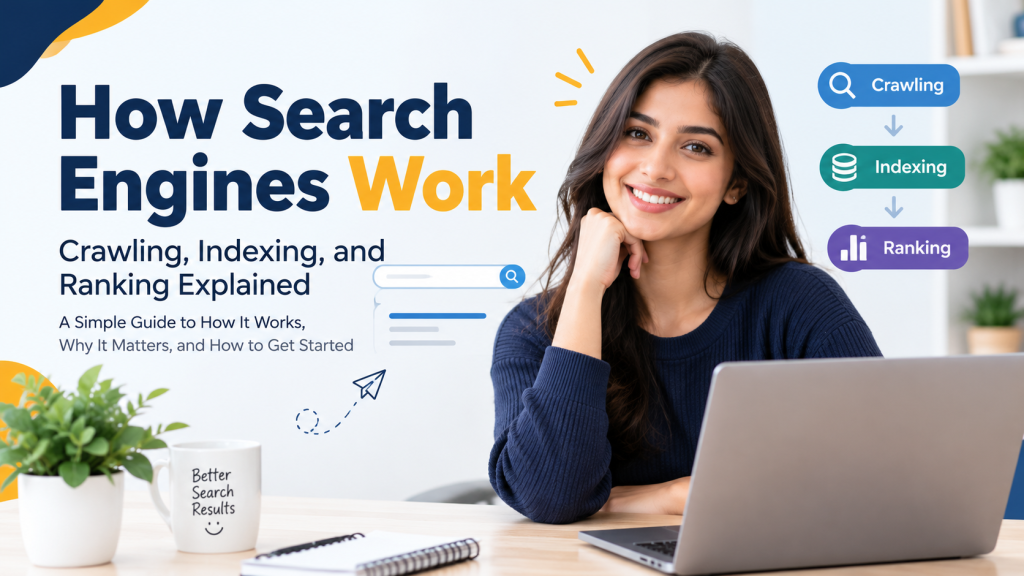
Search engines help people find information from billions of web pages. Before a page can appear in search results, a search engine generally needs to discover the URL, access and process the page, understand its content, and determine whether it is relevant to a user’s search.
The exact systems differ between search engines, but Google Search provides a well-documented example of this process. At a high level, search can be understood through URL discovery, crawling, processing and indexing, and serving relevant search results.
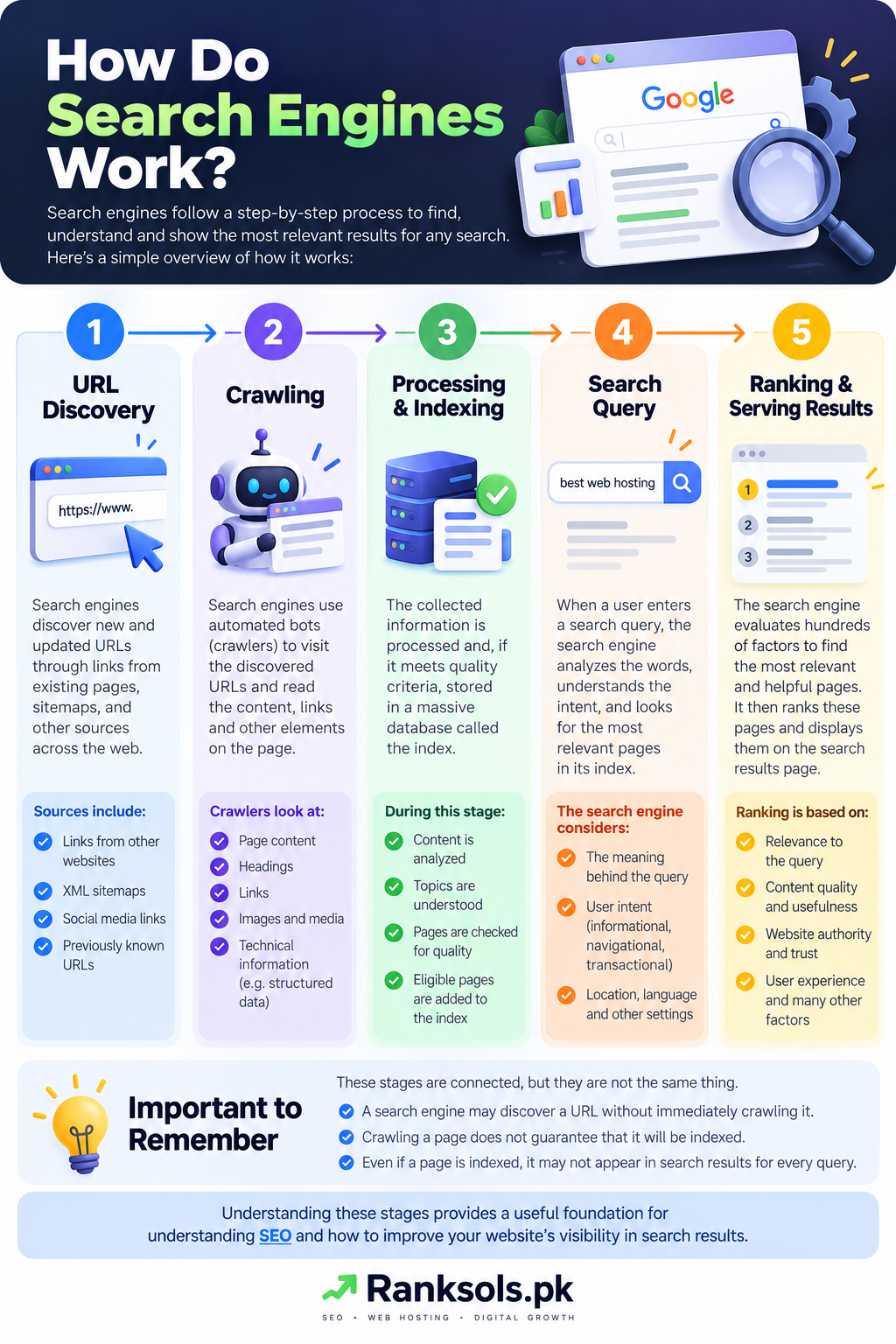
How Do Search Engines Work?
A simplified view of the search process is:
URL Discovery → Crawling → Processing & Indexing → Search Query → Ranking & Serving Results
These stages are connected, but they are not the same thing. A search engine may discover a URL without immediately crawling it, and crawling a page does not guarantee that it will be indexed or shown in search results.
Understanding these stages provides a useful foundation for understanding SEO.
1. URL Discovery: How Search Engines Find Pages
Before a search engine can crawl a page, it needs to know that the URL exists.
Search engines can discover URLs through several sources, including:
Links from other pages
Internal links
XML sitemaps
Previously known URLs
Other discovery mechanisms
Links are particularly important because they help search engines discover related pages across a website and throughout the wider web.
For example, when a website publishes a new article and links to it from an existing page, that link can provide a path for a crawler to discover the new URL.
URL discovery and crawling should therefore be viewed as related but separate steps.
2. Crawling: How Search Engines Access Web Pages
Crawling is the process of accessing URLs and retrieving their content.
Google Search uses Googlebot to crawl web pages. Google’s crawling infrastructure also uses different crawlers and fetchers for other Google products and purposes.
During crawling, a search engine attempts to access the page and the resources needed to process it.
Crawling can be affected by factors such as:
Server availability
Network errors
Access restrictions
Robots.txt rules
The website’s technical configuration
A page that cannot be accessed reliably may have difficulty progressing through the search process.
Crawling vs. Rendering
Crawling and rendering are not identical.
Crawling involves fetching the page, while rendering allows Google to process the page as a browser would, including relevant JavaScript-generated content when necessary.
This matters because some websites rely on JavaScript to display or generate important content. Google Search has supported JavaScript rendering for many years, so using JavaScript by itself does not automatically prevent content from being processed.
For this article, the important point is simply that search engines may need to process more than the initial HTML response to understand what a page presents.
3. Indexing: How Search Engines Process and Store Content
After a page has been crawled and processed, the search engine determines what information it can understand and whether the page should be included in its index.
This stage is known as indexing.
During indexing, Google analyzes information such as:
Textual content
Page titles
Images and related information
Videos
Metadata
Other important page attributes
Google may also identify duplicate or substantially similar pages and select a canonical URL to represent a group of similar pages in its index.
The resulting information is stored in the search index so that relevant pages can be retrieved when users perform searches.
Does Crawling Guarantee Indexing?
No.
A page can be crawled without being included in the search index.
Similarly, being indexed does not mean that the page will automatically appear for every search related to its subject. Search engines still need to determine which indexed information is relevant to a particular query.
This distinction is important because crawling, indexing, and ranking are different stages of the search process.
4. Ranking and Serving Search Results
When someone enters a search query, the search engine searches its index for potentially relevant information.
It then uses automated systems to determine which results are appropriate to show and how they should be presented.
For Google Search, ranking systems evaluate information from the Search index to help provide relevant and useful results. Different systems can address different aspects of search, and the results can vary according to the query and context.
For example, these searches have different purposes:
“What is technical SEO?” — primarily informational
“SEO agency in Lahore” — local and commercial
“best SEO tools” — research-oriented
The pages that best satisfy one query may not be the same pages that best satisfy another.
This is why having a page in Google’s index does not guarantee a fixed position or visibility for every related keyword.
5. How Search Engines Understand Content
Search engines do not rely only on exact keyword matches.
Modern search systems use automated technologies and ranking systems to interpret queries and evaluate the relevance of available information.
This involves understanding the words and context associated with a search and comparing the query with information available in the search index.
For website owners, this means content should clearly communicate its subject and satisfy the user’s information need rather than simply repeating a target keyword.
Google’s current guidance also emphasizes creating helpful, reliable, people-first content instead of content produced primarily to manipulate search rankings.
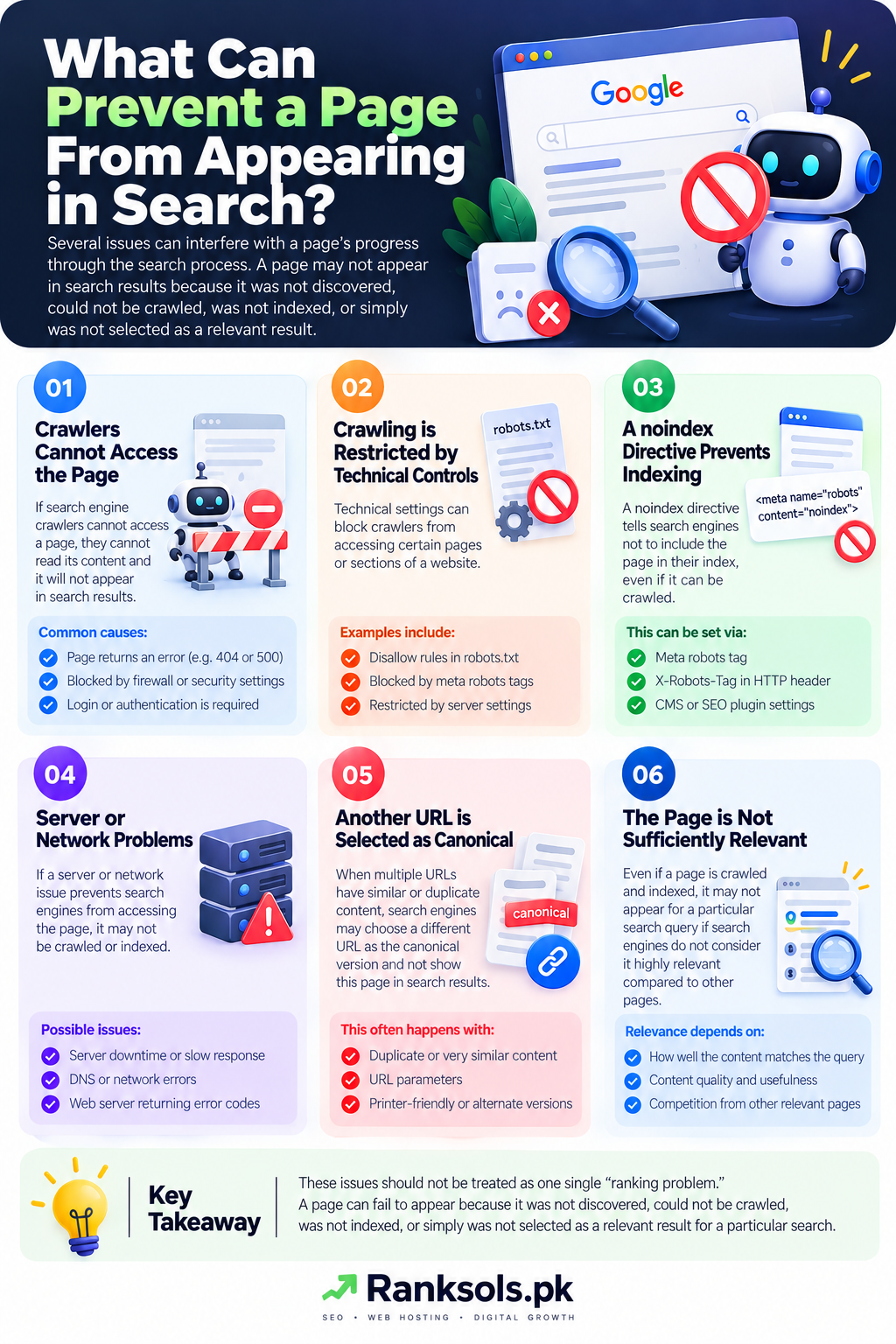
What Can Prevent a Page From Appearing in Search?
Several issues can interfere with a page’s progress through the search process.
Examples include:
Search engine crawlers cannot access the page
Crawling is restricted by technical controls
A
noindexdirective prevents indexingServer or network problems interfere with access
Another URL is selected as canonical for substantially similar content
The page is not considered sufficiently relevant for a particular query
These issues should not be treated as one single “ranking problem.” A page can fail to appear because it was not discovered, could not be crawled, was not indexed, or simply was not selected as a relevant result for a particular search.
Why Understanding Search Engines Matters for SEO
SEO becomes easier to understand when the search process is viewed as a sequence rather than a collection of isolated tactics.
A website needs to be:
Discoverable → Accessible → Understandable → Relevant
This is where SEO can support the search process.
For example:
Internal linking can help search engines discover related URLs.
Technical SEO can help ensure important pages are accessible and crawlable.
Clear content structure can make a page’s subject easier to understand.
Structured data, where appropriate, can provide search engines with additional information about page content.
Search intent research can help align content with what users are actually looking for.
These areas deserve their own dedicated resources, so they should not be treated as separate SEO guides within this article.
A Simple Example of How Search Works
Imagine a website publishes a new article titled:
“What Is Technical SEO?”
The simplified process could look like this:
1. URL Discovery
Google discovers the new URL through an internal link or sitemap.
2. Crawling
Googlebot accesses the URL and retrieves the page.
3. Processing
Google processes the page and, where necessary, renders relevant resources such as JavaScript.
4. Indexing
Google analyzes the page and may add information about it to its Search index.
5. Search Query
A user searches for “what is technical SEO?”
6. Ranking and Serving
Google evaluates potentially relevant indexed information and generates a search results page for that query.
This example shows an important principle: ranking is only one part of the larger search process.
Search Engines vs. Google Search
The general principles discussed in this article apply broadly to modern search engines, but their specific technologies and ranking systems can differ.
When discussing Google-specific details such as Googlebot, Google’s Search index, or Google’s ranking systems, those statements should be understood specifically in the context of Google Search.
This distinction matters because there is no universal search-engine algorithm that works identically across every platform.
Final Takeaway
Search engines work through a continuous process of discovering URLs, crawling pages, processing and indexing information, and serving relevant results for user queries.
The most important distinction is that these stages are not interchangeable:
Discovery does not guarantee crawling.
Crawling does not guarantee indexing.
Indexing does not guarantee ranking.
For SEO, the practical lesson is straightforward: make important pages accessible, help search engines understand what those pages contain, and create useful content that genuinely satisfies relevant searches.
Understanding this foundation makes related topics such as technical SEO, internal linking, search intent, on-page SEO, and structured data easier to understand without requiring this article to cover them in depth.
If your website has challenges with crawling, indexing, or overall search visibility, Ranksols can help assess the underlying SEO issues and identify practical areas for improvement.