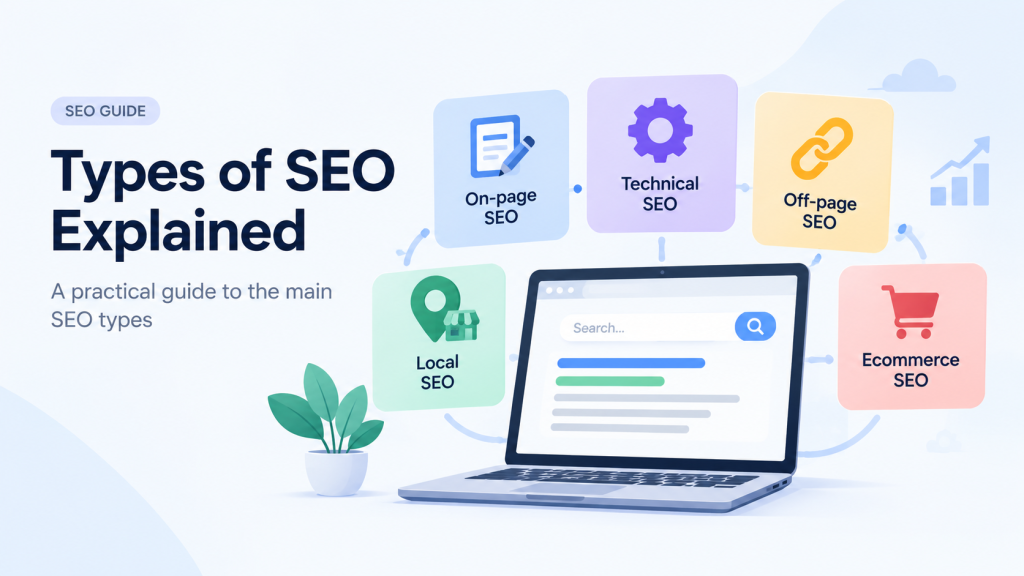
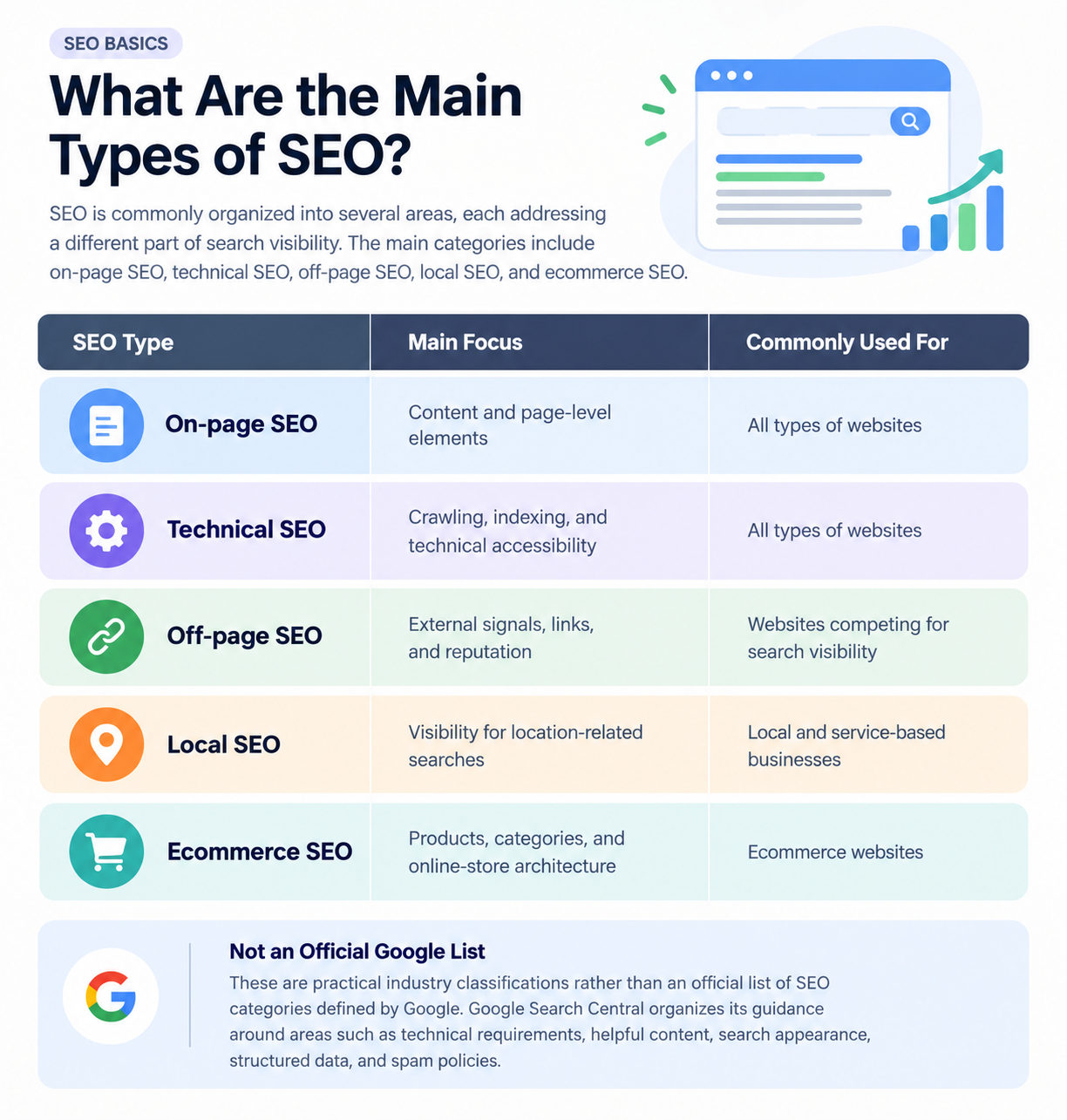
SEO is commonly organized into several areas, each addressing a different part of search visibility. The most widely used categories include on-page SEO, technical SEO, off-page SEO, local SEO, and ecommerce SEO.
These categories are not completely separate. A website may use several types of SEO at the same time, depending on its purpose, audience, structure, and search visibility needs.
What Are the Main Types of SEO?
The main SEO categories covered in this guide are:
| SEO Type | Main Focus | Commonly Used For |
|---|---|---|
| On-page SEO | Content and page-level elements | All types of websites |
| Technical SEO | Crawling, indexing, and technical accessibility | All types of websites |
| Off-page SEO | External signals, links, and reputation | Websites competing for search visibility |
| Local SEO | Visibility for location-related searches | Local and service-based businesses |
| Ecommerce SEO | Products, categories, and online-store architecture | Ecommerce websites |
These are practical industry classifications rather than an official list of SEO categories defined by Google. Google Search Central organizes its guidance around areas such as technical requirements, helpful content, search appearance, structured data, and spam policies.
1. On-Page SEO
On-page SEO focuses on the content and elements of individual webpages that help users and search engines understand what a page is about.
Common areas include:
Page titles
Headings
Main content
Internal links
Image alt text
Descriptive URLs
Content organization
Relevant terminology
Search intent alignment
For example, a page about technical SEO should clearly communicate that subject through its title, headings, content, and related links.
On-page SEO is not simply about adding keywords. The content should be useful, understandable, and created primarily to serve the reader. Google’s guidance emphasizes helpful, reliable, people-first content rather than content created mainly to manipulate search rankings.
Related Ranksols topic: On-Page SEO
2. Technical SEO
Technical SEO covers the technical foundation that helps search engines access, crawl, process, and understand a website.
It can include areas such as:
Crawlability
Indexability
Site architecture
XML sitemaps
Robots.txt
Canonical URLs
Mobile accessibility
HTTPS
Page experience
Structured data
Redirect management
Not every technical SEO practice serves the same purpose. Some help search engines access or index content, while others help them understand pages or support eligible search appearances.
Google’s technical requirements focus on whether Googlebot can access a page, whether the page works correctly, and whether its content is available for indexing. Technical SEO extends beyond those minimum requirements into broader site architecture and implementation practices.
Structured data is another technical SEO practice. Google uses supported structured data to better understand page content and, where eligible, may use it for richer search appearances. Structured data does not guarantee that a rich result will appear.
Related Ranksols topic: Technical SEO
3. Off-Page SEO
Off-page SEO refers to activities and signals outside a website that can contribute to its reputation, discovery, and search visibility.
A major component is earning relevant links from other websites. Off-page SEO can also involve:
Digital PR
Industry relationships
Content promotion
Brand mentions
Relevant backlinks
Reputation-building activities
Effective off-page SEO focuses on earning legitimate recognition rather than manipulating links or pursuing links solely for quantity.
Off-page SEO should therefore not be reduced to “getting backlinks.” The wider goal is to establish genuine external references and relationships around a website and its content.
Related Ranksols topic: Link Building
4. Local SEO
Local SEO focuses on improving visibility for searches connected to a specific geographic area or local business.
It is particularly relevant to businesses such as:
Restaurants
Clinics
Law firms
Agencies
Retail stores
Home-service businesses
Other location-based services
Local SEO can involve:
Accurate business information
Google Business Profile management
Local citations
Customer reviews
Location-specific website content
Local links
Relevant structured data
Structured data can help Google understand information about a local business, such as its name, address, hours, and other supported details. However, local SEO is broader than structured data and includes the overall online presence of a business in local search.
Related Ranksols topic: Local SEO
5. Ecommerce SEO
Ecommerce SEO is the application of SEO to online stores and product-focused websites.
It commonly involves:
Product pages
Category pages
Product information
Internal linking
Site architecture
Product variations
Search-friendly URLs
Product structured data
Managing large numbers of ecommerce URLs
Ecommerce SEO is best understood as a specialized application of SEO, rather than a completely separate discipline. An online store can still require technical, on-page, and off-page SEO alongside ecommerce-specific optimization.
Google provides dedicated guidance for ecommerce websites, including product structured data and merchant listing experiences. Product markup can help Google understand product information such as price, availability, shipping, and return information for eligible search experiences.
Related Ranksols topic: Ecommerce SEO
How Different SEO Types Work Together
The different SEO categories are complementary rather than competing strategies.
For example, an online store serving customers in specific cities might use:
Technical SEO to support crawling, indexing, and site accessibility
On-page SEO to make product and category pages useful and understandable
Off-page SEO to earn relevant external references
Local SEO to support location-related searches
Ecommerce SEO to address product discovery and online-store requirements
A website does not normally need to choose only one type of SEO.
The appropriate combination depends on what the website does and what kind of search visibility it needs.
SEO Types vs. SEO Techniques
An SEO type is a broad area of optimization, while an SEO technique is a specific practice used within that area.
For example:
| Category | Example Techniques |
|---|---|
| On-page SEO | Content optimization, internal linking, title optimization |
| Technical SEO | XML sitemaps, canonicalization, crawl management |
| Off-page SEO | Link earning, digital PR, content promotion |
| Local SEO | Business profile optimization, local citations, location pages |
| Ecommerce SEO | Product optimization, product markup, ecommerce architecture |
This distinction is useful because individual practices such as keyword research, internal linking, structured data, or link building should not automatically be treated as separate “types of SEO.”
They are techniques or practices that can support broader SEO areas.
Are These Official Google SEO Categories?
No. The terms on-page SEO, technical SEO, off-page SEO, local SEO, and ecommerce SEO are widely used by SEO professionals to organize different areas of optimization, but Google does not define SEO as a fixed list of these five categories.
Google Search Central instead provides guidance across areas such as technical requirements, search appearance, helpful content, structured data, crawling and indexing, and spam policies.
This distinction matters because SEO terminology can vary between professionals and organizations.
The five categories in this guide are therefore best viewed as a practical framework for understanding SEO rather than a formal Google taxonomy.
Which Types of SEO Does a Website Need?
There is no single combination that applies to every website.
A local service business may place greater emphasis on local SEO, while an online retailer may require ecommerce SEO alongside technical and on-page optimization.
An informational website may focus heavily on content and on-page SEO, while a large website may have more complex technical requirements.
The useful approach is to identify the website’s actual needs rather than applying every SEO technique simply because it exists.
Key Takeaway
The main types of SEO describe different areas of search optimization rather than isolated strategies.
On-page SEO focuses on content and page-level elements. Technical SEO addresses the website’s technical foundation. Off-page SEO focuses on external signals and reputation. Local SEO addresses location-related search visibility, while ecommerce SEO applies SEO principles to online stores and product discovery.
These categories often overlap. Most websites benefit from a combination of SEO practices rather than relying on a single category.
For deeper learning, each area can be explored through dedicated resources on on-page SEO, technical SEO, off-page SEO, local SEO, ecommerce SEO, keyword research, internal linking, and link building.