SEO (Search Engine Optimization) is the practice of improving a website so search engines can discover, understand, and appropriately surface its content for relevant searches.
SEO combines content, website structure, technical accessibility, internal linking, search intent, and other optimization practices. Its purpose is not simply to rank for keywords. Effective SEO helps the right people find useful information when they search.
In simple terms, SEO connects what people search for with content that can satisfy their needs.
What Does SEO Actually Do?
When someone enters a search query, a search engine has to determine which information is relevant and useful enough to show.
SEO helps a website communicate its content more clearly to search engines while also improving the experience for people who visit the site.
This involves questions such as:
Can search engines discover the page?
Can they access and process its content?
Is the topic clear?
Does the page satisfy the searcher’s intent?
Is the information useful and trustworthy?
Can users navigate the website easily?
Does the page provide a good experience across devices?
SEO therefore isn’t one isolated task. It is a collection of practices that work together to improve a website’s ability to be discovered, understood, and found useful.
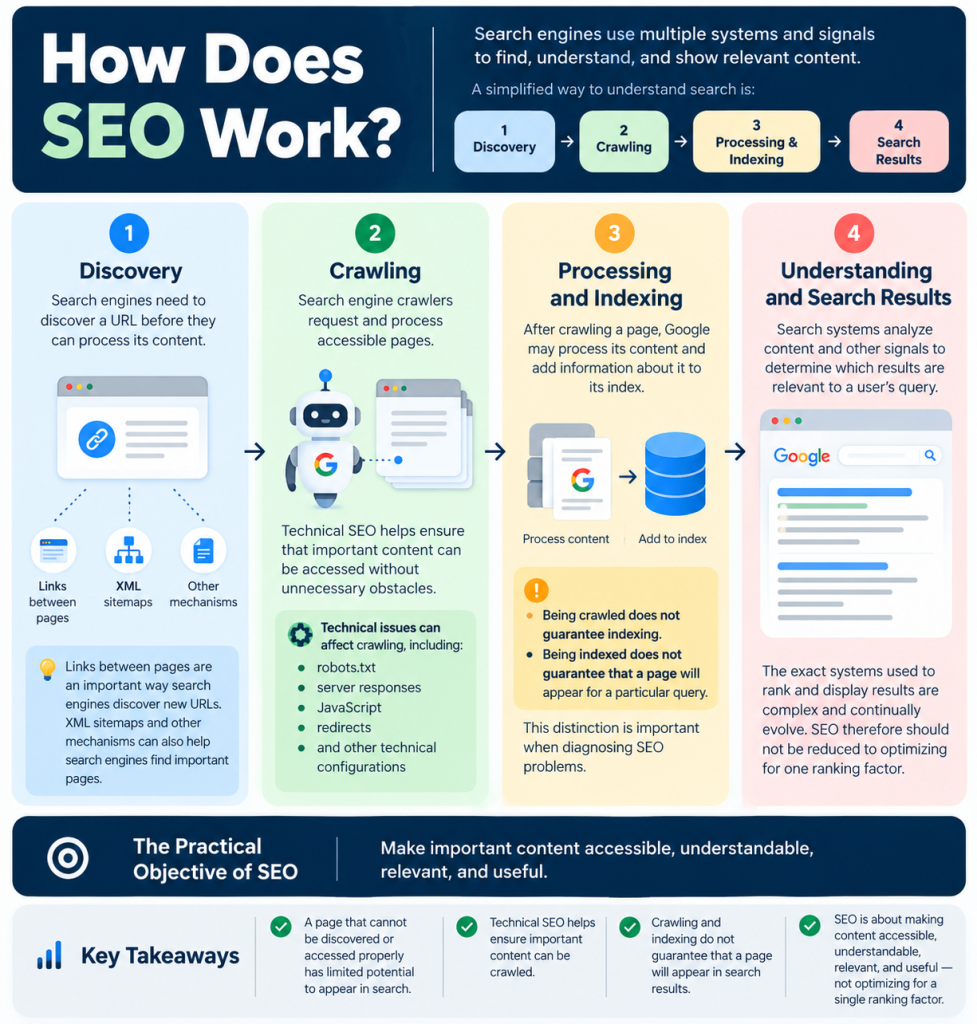
How Does SEO Work?
A simplified way to understand search is:
Discovery → Crawling → Processing & Indexing → Search Results
These stages should not be treated as a rigid step-by-step ranking formula. Google’s systems use many processes and signals to understand content and determine which results are relevant to a particular search.
1. Discovery
Search engines need to discover a URL before they can process its content.
Links between pages are an important way search engines discover new URLs. XML sitemaps and other mechanisms can also help search engines find important pages.
A page that cannot be discovered or accessed properly has limited potential to appear in search.
2. Crawling
Search engine crawlers request and process accessible pages.
Technical SEO helps ensure that important content can be accessed without unnecessary obstacles. Issues involving robots.txt, server responses, JavaScript, redirects, or other technical configurations can affect how search engines access a website.
3. Processing and Indexing
After crawling a page, Google may process its content and add information about it to its index.
However, being crawled does not guarantee indexing, and being indexed does not guarantee that a page will appear for a particular query.
This distinction is important when diagnosing SEO problems.
4. Understanding and Search Results
Search systems analyze content and other signals to determine which results are relevant to a user’s query.
The exact systems used to rank and display results are complex and continually evolve. SEO therefore should not be reduced to optimizing for one ranking factor.
The practical objective is to make important content accessible, understandable, relevant, and useful.
A Simple Model for Understanding SEO
SEO can be easier to understand when viewed as five connected questions:
Discover
Can search engines find the content?
This involves crawling, links, sitemaps, and technical accessibility.
Understand
Can search engines determine what the page is about?
Clear content, headings, page structure, descriptive titles, internal links, and relevant context all contribute to understanding.
Match
Does the page satisfy the searcher’s intent?
A page should address the actual information need behind the search rather than simply repeat the words used in the query.
Experience
Can people use and trust the page effectively?
This includes readable content, mobile usability, secure delivery, appropriate page performance, and an overall experience that does not interfere with the main content.
Measure
What happens after the page is published?
Search Console and analytics can help website owners understand visibility, search traffic, engagement, and conversions, then identify opportunities for improvement.
This is an educational model for understanding SEO, not a description of Google’s internal ranking process.
The Main Areas of SEO
SEO is often discussed through several overlapping areas rather than one official set of categories.
On-Page SEO
On-page SEO focuses on elements of individual pages that help users and search engines understand their content.
These may include:
Page titles
Headings
Main content
Relevant terminology
Internal links
Image descriptions
URLs
Search intent alignment
The goal is not to repeat a keyword as many times as possible. It is to make the page’s subject and purpose clear while providing useful information.
Technical SEO
Technical SEO focuses on the technical foundation that allows search engines to access, process, and understand a website.
Common areas include:
Crawlability
Indexing controls
Site architecture
Canonical URLs
XML sitemaps
Mobile presentation
JavaScript implementation
Website performance
HTTPS
Technical SEO supports content rather than replacing it. A technically accessible website still needs useful, relevant content to satisfy searchers.
Content and Search Intent
Content is central to SEO because search engines need useful information to satisfy search queries.
Good SEO content focuses on the user’s actual need instead of producing pages simply because a keyword has search volume.
For example, someone searching “what is technical SEO“ is looking for an explanation. Someone searching “technical SEO agency” may have a commercial or service-related intent.
The pages that address these different needs should not necessarily be the same.
This is why search intent is an important part of content strategy.
Off-Page SEO
Off-page SEO refers to signals and activities that occur outside a website.
Links from other websites can help search engines discover pages, and links are among the signals considered by Google’s systems. However, Google Search uses many signals, and links are not the whole ranking system.
The objective should therefore not be to collect backlinks purely as a numbers game.
Links earned because a website publishes useful, original, or authoritative information are fundamentally different from attempts to manipulate search rankings through artificial link schemes.
Local SEO
Local SEO focuses on visibility for searches connected to a specific geographic area.
It is particularly relevant to businesses that serve customers in particular cities, regions, or physical locations.
Local SEO can involve:
Business information
Google Business Profile
Location-specific pages
Reviews
Local relevance
Consistent business details
Not every website needs a local SEO strategy. It depends on the business model and whether location is relevant to the user’s search.
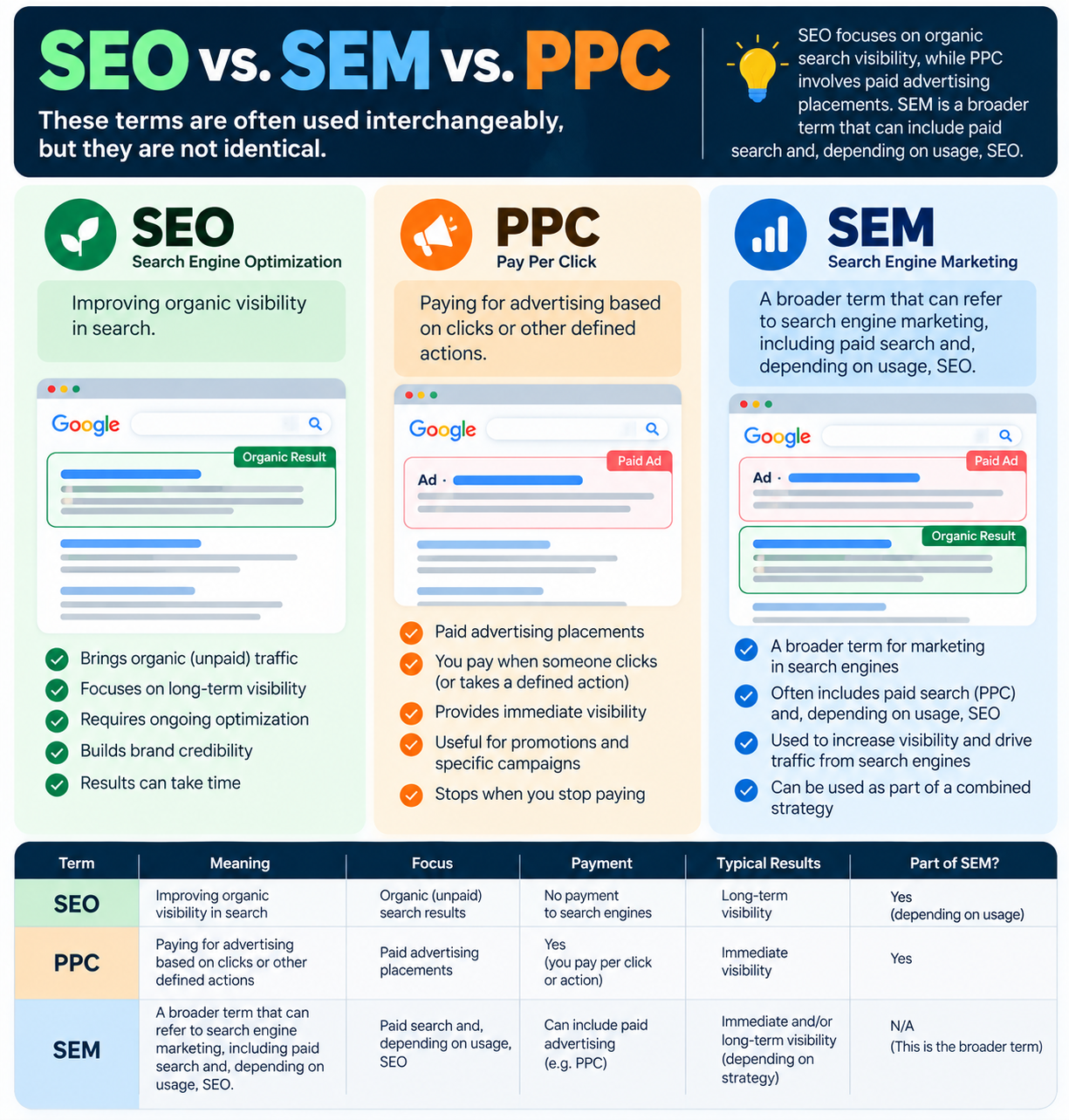
SEO vs. SEM vs. PPC
These terms are often used interchangeably, but they are not identical.
| Term | Meaning |
|---|---|
| SEO | Improving organic visibility in search |
| PPC | Paying for advertising based on clicks or other defined actions |
| SEM | A broader term that can refer to search engine marketing, including paid search and, depending on usage, SEO |
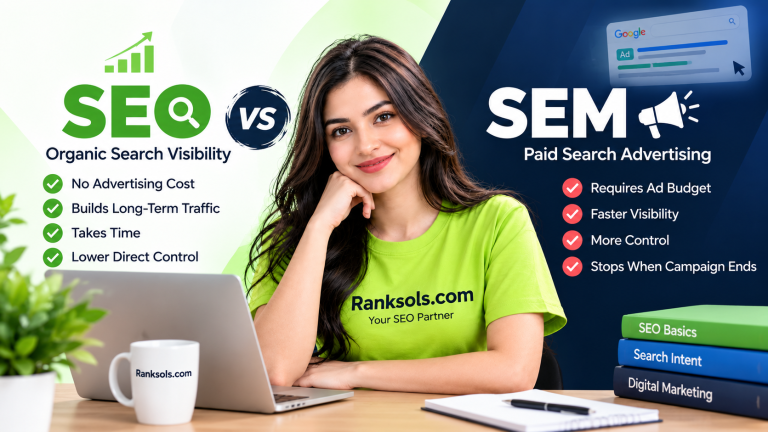
SEO focuses on organic search visibility, while PPC involves paid advertising placements.
A business can use SEO, PPC, or both depending on its goals.
SEO vs. Keywords
Keywords are useful for understanding how people search, but SEO is much broader than keyword placement.
Modern search systems can understand relationships between words, concepts, entities, and topics. This means a page does not need to repeat the exact same phrase throughout its content to demonstrate relevance.
For example, a page about technical SEO may naturally discuss crawling, indexing, robots.txt, canonical URLs, JavaScript, site architecture, and XML sitemaps.
These related concepts help establish the subject of the page without forcing the primary keyword into every sentence.
The goal should be topical clarity and usefulness, not keyword density.
Why Search Intent Matters
Search intent describes the underlying reason behind a search.
A person searching:
“What is SEO?”
is probably looking for an explanation.
A person searching:
“SEO company in Lahore”
may be investigating a service provider.
A person searching:
“best SEO tools”
may be comparing available solutions.
These searches may contain related terminology, but they represent different needs.
Effective SEO therefore starts with understanding what the searcher wants to accomplish, then creating or optimizing a page that addresses that need directly.
This is also one reason why publishing multiple pages targeting almost identical search intent can create unnecessary overlap within a website.
SEO and Page Experience
Page experience is one part of a broader SEO picture.
Google’s ranking systems use Core Web Vitals, while other aspects of page experience can contribute to making a website more satisfying to use.
Important considerations include:
Good Core Web Vitals
Secure page delivery
Mobile-friendly presentation
Clear separation between the main content and distracting elements
Avoiding intrusive interstitials
Easy navigation and readable content
A good page-experience score does not guarantee high rankings.
Likewise, SEO should not become a race to achieve a perfect technical score while neglecting the actual information users came to find.
The priority remains the overall usefulness of the page.
What Is E-E-A-T in SEO?
E-E-A-T stands for:
Experience
Expertise
Authoritativeness
Trustworthiness
These concepts help describe qualities associated with helpful and reliable content.
However, an important distinction is often missed:
E-E-A-T itself is not a single Google ranking factor.
Google’s systems use a variety of signals, some of which can identify characteristics associated with E-E-A-T. Trust is particularly important, and stronger E-E-A-T matters especially for topics that can significantly affect people’s health, financial stability, safety, or well-being.
For publishers, practical E-E-A-T improvements can include:
Showing who created the content
Providing accurate author information
Demonstrating relevant experience or expertise
Supporting important claims with reliable sources
Keeping information accurate and current
Being transparent about how content was created when that information would help readers
For a Ranksols knowledge article, a genuine author byline and author profile can therefore be more meaningful than simply adding the phrase “E-E-A-T” to the page.
Is SEO About Manipulating Rankings?
No.
SEO can legitimately help search engines understand a website and help users find useful content. Problems arise when SEO becomes primarily focused on manipulating ranking systems rather than helping people.
Examples of problematic approaches include:
Producing large amounts of low-value content solely for search traffic
Keyword stuffing
Creating deceptive pages
Manipulating links
Publishing copied or automatically generated content without meaningful value
Creating pages primarily to capture search variations rather than satisfy users
Google’s current guidance emphasizes helpful, reliable, people-first content rather than content created primarily to manipulate rankings.
A useful test is simple:
Would this page still be valuable to someone who arrived without knowing anything about SEO?
If the answer is no, the content strategy probably needs reconsideration.
SEO and AI Search
Search is evolving beyond traditional lists of links.
Google now provides AI-powered experiences such as AI Overviews and AI Mode, which can synthesize information and provide links to supporting webpages.
This does not mean that websites need an entirely separate form of “AI SEO.”
Google’s current guidance says that existing SEO best practices remain relevant to its generative AI search experiences. Pages still need to meet the technical requirements for Search, be indexable, and provide useful, reliable, people-first content.
Google also states that there are no special requirements or special schema markup needed specifically to appear in AI Overviews or AI Mode.
This has an important implication:
The foundation of SEO remains valuable even as the search interface changes.
Rather than trying to optimize for every new AI-search acronym or tactic, websites should focus on:
Unique and useful information
Clear website structure
Crawlable and indexable content
Strong internal linking
Relevant supporting information
Original expertise and experience
Good page experience
Accurate business information where applicable
Google’s current guidance also warns against creating separate pages for every conceivable search variation simply to influence AI responses or rankings.
Does AI-Generated Content Work for SEO?
AI can assist with research, outlining, editing, analysis, and other parts of content production.
But using AI to generate large quantities of low-value pages primarily to manipulate search rankings can violate Google’s spam policies.
The important question is therefore not simply:
“Was AI used?”
A better question is:
“Does the finished content provide genuine value to the reader?”
Human expertise, original information, first-hand experience where relevant, fact-checking, editing, and meaningful analysis can make content substantially more useful than generic AI-generated summaries.
Does SEO Guarantee Higher Rankings?
No.
There is no legitimate SEO technique that can guarantee a specific Google ranking.
Search systems use many signals, and the systems themselves change over time.
SEO should therefore be treated as an ongoing process of improving a website’s:
Discoverability
Relevance
Content quality
Technical accessibility
Structure
User experience
Trustworthiness
A successful SEO strategy improves the conditions under which a website can be discovered and considered relevant. It does not provide control over Google’s ranking decisions.
Common SEO Misconceptions
“SEO means adding keywords.”
Keywords are useful for understanding search behavior, but SEO involves much more than keyword placement.
“More content always means better SEO.”
Publishing more pages does not automatically make a website more useful or authoritative. Quality and relevance matter more than volume.
“E-E-A-T is a ranking factor.”
E-E-A-T is not a single ranking factor. It describes qualities that Google’s systems seek to identify through various signals.
“Perfect Core Web Vitals guarantee rankings.”
They do not. Google explicitly states that good Core Web Vitals do not guarantee top search rankings.
“AI search means traditional SEO is dead.”
Google’s current guidance says the opposite: its AI search experiences continue to rely on core Search ranking and quality systems, so foundational SEO remains relevant.
“Every keyword needs its own page.”
Not necessarily. Creating pages simply for every variation of a search can create unnecessary duplication and may result in low-value content.
How to Start With SEO
A practical SEO process can begin with a few fundamental steps:
Understand your audience and their search needs.
Research relevant topics and search intent.
Create useful content that genuinely satisfies those needs.
Make important pages accessible to search engines.
Improve page structure, titles, headings, and internal links.
Resolve important technical SEO issues.
Build credibility through accurate, trustworthy, and useful information.
Monitor search performance using Google Search Console and other appropriate analytics tools.
Improve pages based on evidence and changing user needs.
SEO is not a one-time website setup. Search behavior, websites, competitors, and search systems all evolve.
What Should You Learn After Understanding SEO?
SEO is a broad discipline, so learning it effectively means studying its individual components rather than trying to understand everything at once.
Useful next topics include:
Search Intent
Keyword Research
On-Page SEO
Technical SEO
Semantic SEO
Internal Linking
Content Optimization
Topical Authority
Local SEO
Google Search Console
Structured Data
Each topic answers a different part of the larger SEO process.
For example, keyword research helps identify what people search for, search intent helps explain what they actually need, and on-page SEO helps make individual pages clearer and more useful.
Frequently Asked Questions
What does SEO stand for?
SEO stands for Search Engine Optimization. It is the practice of improving a website so search engines can discover, understand, and appropriately surface its content for relevant searches.
What is SEO in simple words?
SEO helps people find useful information through search engines by making a website’s content, structure, and technical foundation easier for search systems to understand and users to navigate.
What are the main types of SEO?
SEO is commonly discussed through areas such as on-page SEO, technical SEO, content-focused SEO, off-page SEO, and local SEO. These areas overlap and work together rather than functioning as completely separate disciplines.
Is SEO the same as PPC?
No. SEO focuses on organic search visibility, while PPC involves paid advertising. Businesses may use either approach or combine both.
Does SEO still matter with AI search?
Yes. Google’s current guidance states that its AI search experiences continue to rely on core Search ranking and quality systems, so foundational SEO practices remain relevant.
How long does SEO take?
There is no universal SEO timeline. Results can vary according to competition, website history, technical condition, content quality, search demand, authority, and many other factors.
Summary
SEO is the practice of improving a website so search engines can discover, understand, and appropriately surface its content for relevant searches.
It is broader than keywords and rankings.
Effective SEO connects several areas:
Useful content + search intent + technical accessibility + clear structure + internal linking + trustworthy information + good user experience
The most useful way to think about SEO is not as a collection of tricks for manipulating rankings, but as a process of making valuable information easier to discover, understand, and use.
As search evolves toward AI-powered experiences, this foundation remains important. The interface may change, but websites still need content that is accessible, useful, relevant, trustworthy, and genuinely valuable to the people they serve.
Sources and Further Reading
For authoritative information about Google Search and SEO, consult:
Google Search Central — SEO Starter Guide
Google Search Central — Creating Helpful, Reliable, People-First Content
Google Search Central — Search Essentials
Google Search Central — AI Features and Your Website
Google Search Central — Optimizing Your Website for Generative AI Features
Google Search Central — Understanding Page Experience
Google Search Console Help