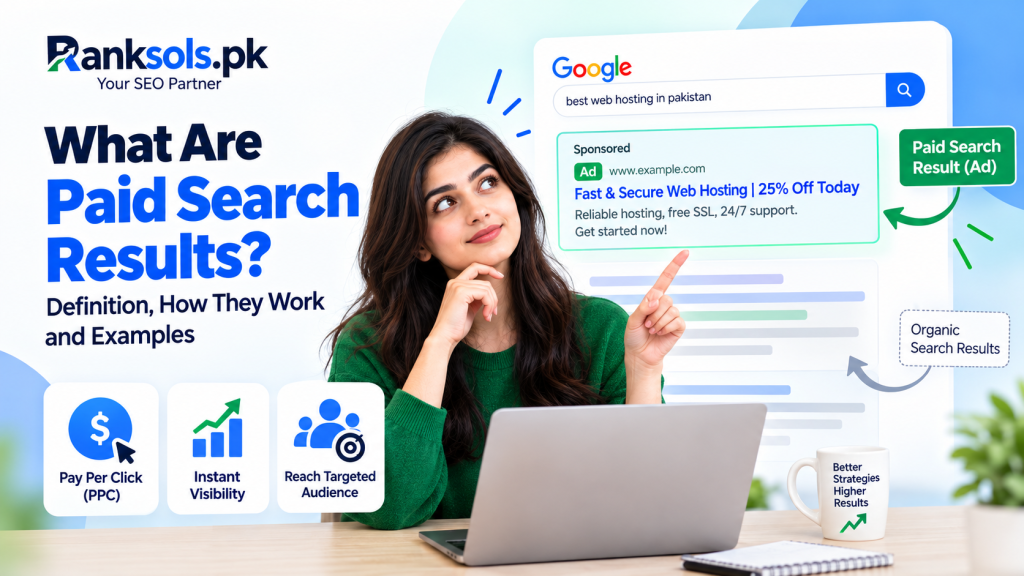
Paid search results are sponsored listings that appear on search engine results pages (SERPs) when businesses advertise their products or services. These listings commonly appear above or below organic search results and are typically marked with labels such as “Sponsored” or “Ad.”
Businesses use paid search advertising platforms, such as Google Ads, to reach users searching for relevant products, services, and solutions. Understanding how paid search results work helps website owners distinguish advertisements from organic listings and understand how businesses gain visibility through search advertising.
What Are Paid Search Results?
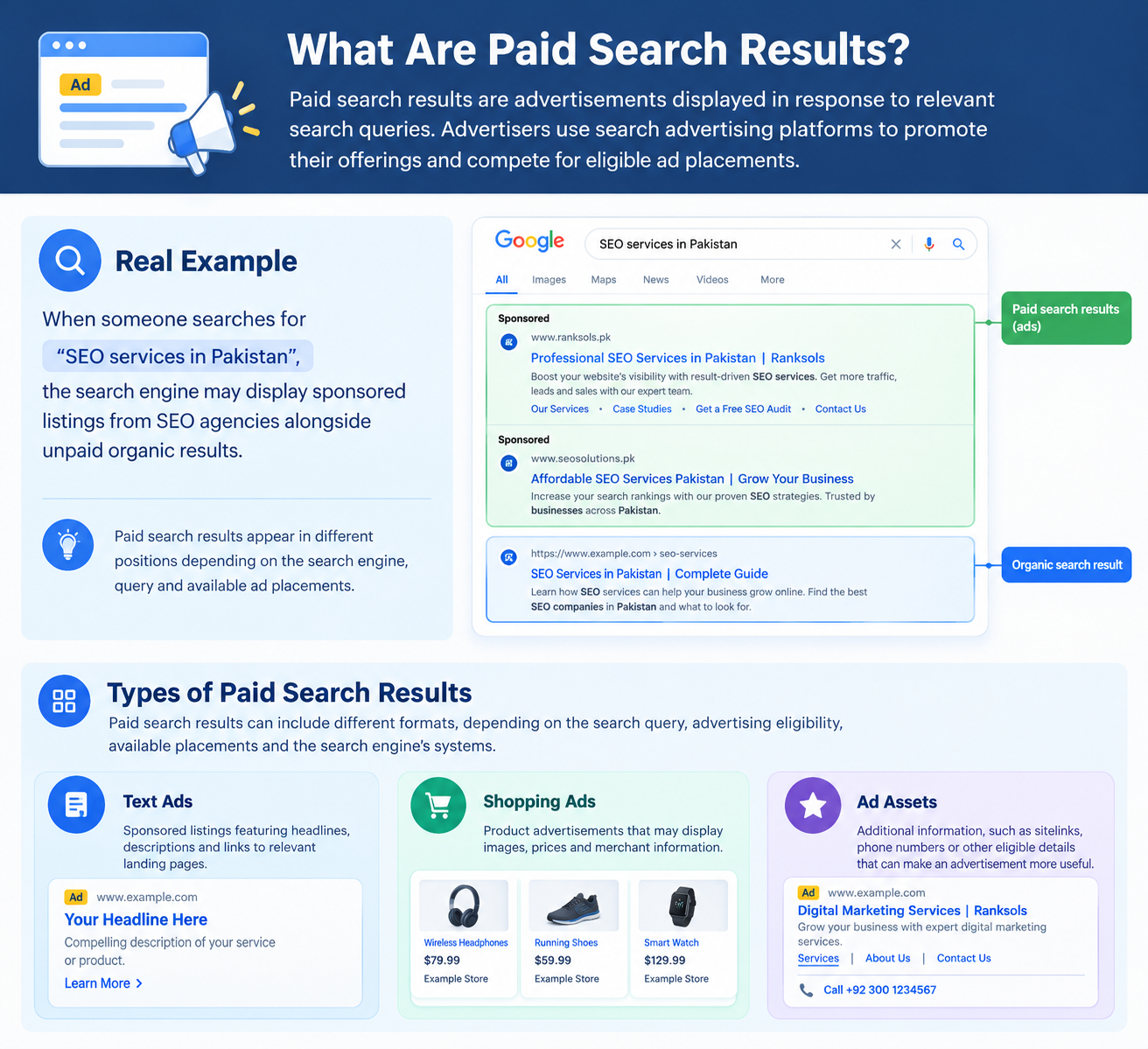
Paid search results are advertisements displayed in response to relevant search queries. Advertisers use search advertising platforms to promote their offerings and compete for eligible ad placements.
For example, when someone searches for “SEO services in Pakistan,” the search engine may display sponsored listings from SEO agencies alongside unpaid organic results.
Paid search results can include:
Text ads: Sponsored listings featuring headlines, descriptions, and links to relevant landing pages.
Shopping ads: Product advertisements that may display images, prices, and merchant information.
Ad assets: Additional information, such as sitelinks, phone numbers, or other eligible details that can make an advertisement more useful.
The formats displayed depend on the search query, advertising eligibility, available placements, and the search engine’s systems.
How Do Paid Search Results Work?
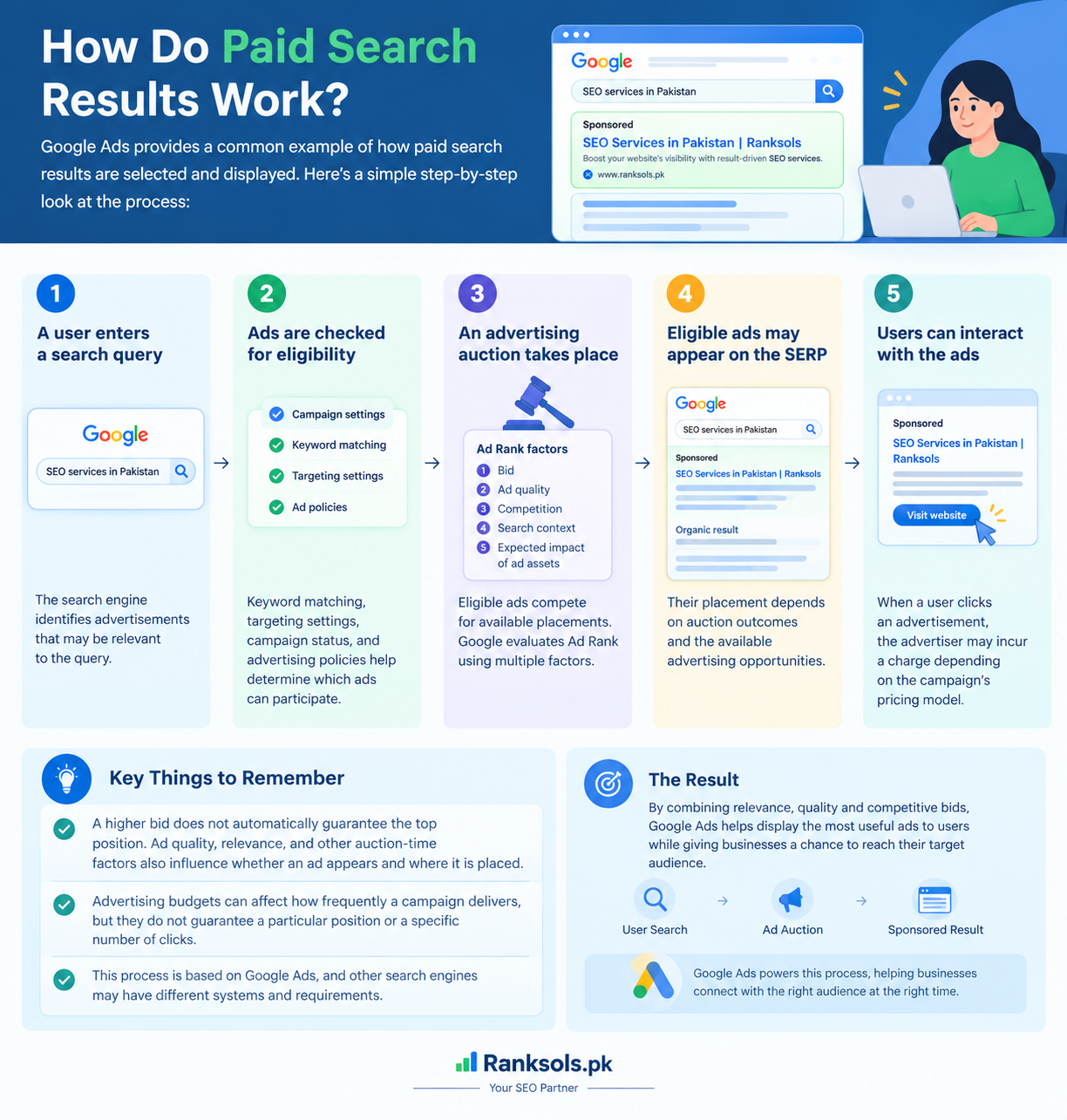
Google Ads provides a common example of how paid search results are selected and displayed.
A user enters a search query. The search engine identifies advertisements that may be relevant to the query.
Ads are checked for eligibility. Keyword matching, targeting settings, campaign status, and advertising policies help determine which ads can participate.
An advertising auction takes place. Eligible ads compete for available placements. Google evaluates Ad Rank using factors such as the bid, ad quality, competition, search context, and the expected impact of ad assets.
Eligible ads may appear on the results page. Their placement depends on auction outcomes and the available advertising opportunities.
Users can interact with the ads. When a user clicks an advertisement, the advertiser may incur a charge depending on the campaign’s pricing model.
A higher bid does not automatically guarantee the top position. Ad quality, relevance, and other auction-time factors also influence whether an ad appears and where it is placed.
Advertising budgets can affect how frequently a campaign delivers, but they do not guarantee a particular position or a specific number of clicks.
How to Identify Paid Search Results
Paid search listings are generally identified by labels such as “Sponsored” or “Ad.” Their appearance varies by search engine, device, and advertising format.
Look for these common characteristics:
Sponsored labels: Indicate that a listing is an advertisement.
Promotional headlines: Highlight a business, product, service, or offer.
Ad descriptions: Provide information intended to encourage relevant clicks.
Destination links: Direct users to the advertiser’s website or landing page.
Additional ad information: May include sitelinks, contact details, prices, or other eligible assets.
Shopping ads may display product images and prices, while text ads usually contain headlines and descriptions.
Example of Paid Search Results
Suppose a user searches for “best SEO agency in Pakistan.” The results page may contain:
A sponsored advertisement from an SEO agency, clearly marked as an ad.
Organic listings from SEO agencies, directories, or informational websites.
Other search features, depending on the query and the search engine.
The sponsored listing is a paid placement, whereas the organic listings are selected through the search engine’s organic ranking systems.
Not every search displays advertisements, and paid listings do not always appear above organic results.
Paid Search Results vs. Organic Search Results
Paid and organic search results can appear together on the same SERP, but they differ in how their placements are determined.
| Feature | Paid Search Results | Organic Search Results |
|---|---|---|
| Placement | Influenced by advertising auctions and ad eligibility | Determined by organic search ranking systems |
| Payment | Advertising costs may apply, often per click | No payment is required for an organic search click |
| Identification | Usually marked as sponsored or an ad | Not labelled as a paid advertisement |
| Visibility | Depends on targeting, budget, auction outcomes, and eligibility | Depends on relevance, ranking systems, and other organic search factors |
| Duration | Depends on campaign delivery and settings | Can continue without an active advertising campaign |
Paying for search advertisements does not directly improve a website’s organic rankings. Paid advertising and organic search optimization are separate approaches to gaining search visibility.
For a broader comparison of the two approaches, readers can explore a dedicated guide to SEO vs. PPC.
How Are Paid Search Results Measured?
Businesses can evaluate paid search performance through advertising reports, including those available in Google Ads. These reports help advertisers understand how frequently their ads appear, how users interact with them, and whether campaigns generate valuable actions.
Important metrics include:
Impressions: The number of times an advertisement is shown.
Clicks: The number of times users click an advertisement.
Click-through rate (CTR): The percentage of impressions that result in clicks. It is calculated as clicks divided by impressions, multiplied by 100.
Average cost per click (CPC): The average amount paid for each click under a CPC pricing model.
Conversions: Valuable actions attributed to advertising interactions, such as purchases, form submissions, or calls, when properly configured and measured.
Cost per conversion: The average advertising cost associated with each recorded conversion.
These metrics provide different perspectives on campaign performance. For example, a high CTR indicates that a relatively large share of recorded impressions resulted in clicks, but it does not necessarily mean that the campaign generated sales or leads.
Advertisers should interpret these metrics in relation to their campaign objectives, costs, and conversion data.
Frequently Asked Questions
Are paid search results the same as sponsored results?
Yes. Sponsored search results are paid advertisements displayed on a search engine results page. They are generally identified by a label such as “Sponsored” or “Ad.”
Do paid search results always appear above organic results?
No. Advertisements may appear above or below organic listings, depending on the search engine, available placements, and advertising auction outcomes. Some searches display no ads.
Do paid search results improve organic rankings?
No. Buying search advertisements does not directly improve a website’s organic ranking positions. Organic rankings are determined by separate search ranking systems.
Do advertisers pay every time their ads appear?
Not necessarily. Many search campaigns use cost-per-click pricing, meaning advertisers pay when users click their ads. Other campaigns may use different bidding and billing arrangements, depending on the campaign type and advertising platform.
Conclusion
Paid search results are sponsored advertisements that help businesses gain visibility for relevant search queries. Their appearance and placement depend on advertising eligibility, auction outcomes, targeting, and other factors.
Understanding the difference between paid and organic search results helps businesses make informed decisions about their search marketing strategies and helps users recognize advertisements on search engine results pages.
For businesses seeking to improve their unpaid search visibility, Ranksols provides SEO services focused on organic search performance. A well-planned SEO strategy can complement paid advertising by helping a website earn relevant visibility in organic search results.