Attracting customers from nearby neighborhoods requires more than promoting a business across an entire city. Hyperlocal marketing helps businesses reach potential customers in specific geographic areas through location-based advertising, neighborhood-focused content, local search visibility, and community engagement.
By understanding the needs of nearby communities and targeting relevant audiences, businesses can increase local awareness, generate qualified enquiries, encourage store visits, and build stronger customer relationships.
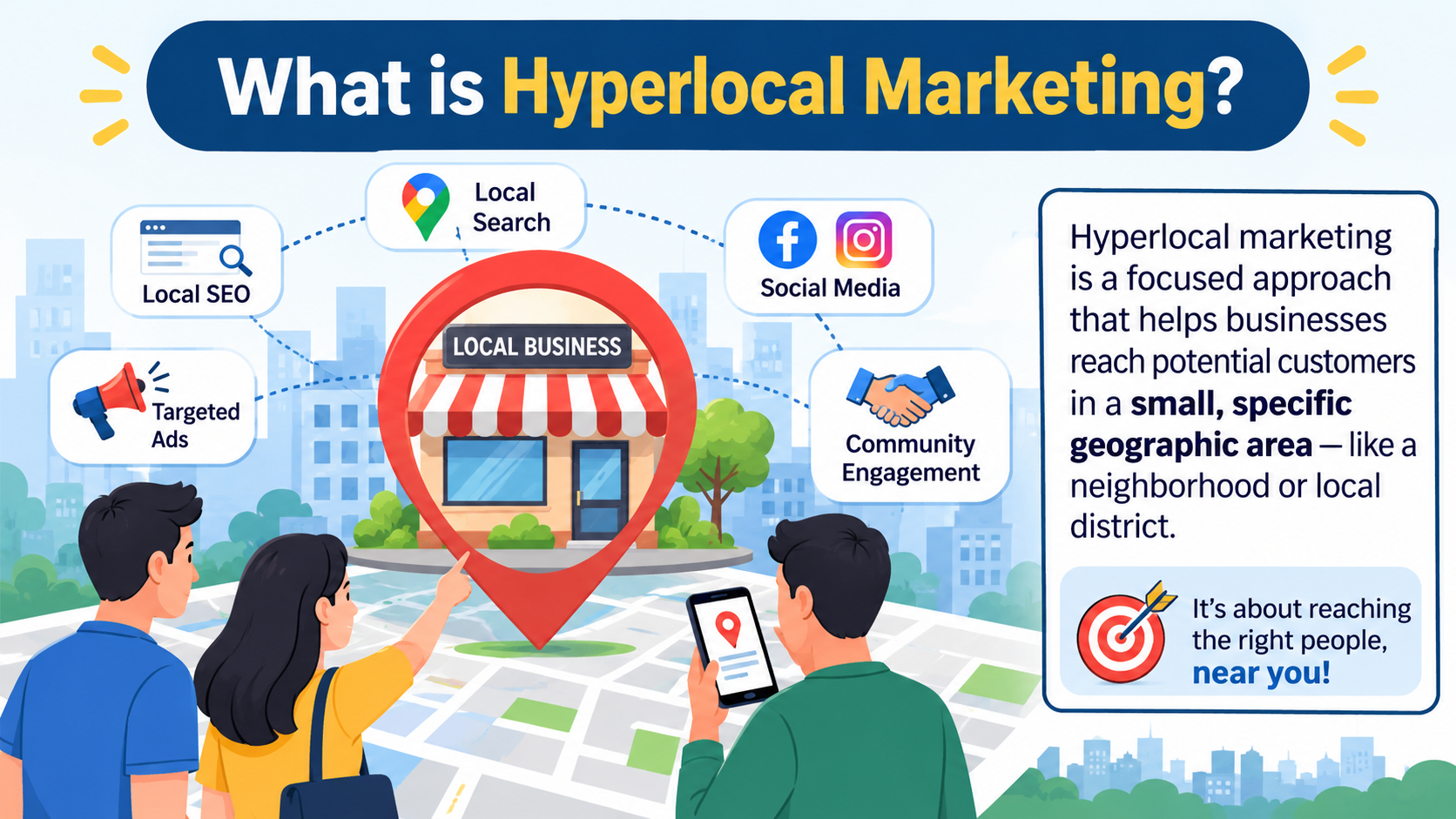
What Is Hyperlocal Marketing?
Hyperlocal marketing is a marketing approach that focuses on reaching potential customers within a small, clearly defined geographic area, such as a neighborhood, commercial district, or the area surrounding a business.
Unlike broader local marketing, which may target an entire city or service region, hyperlocal marketing concentrates on smaller communities and their specific interests, preferences, and purchasing needs.
For example, a coffee shop in Johar Town, Lahore, might promote its breakfast offers to people living or working in nearby neighborhoods instead of advertising to the entire city.
Hyperlocal marketing can combine digital and offline activities, including location-based advertising, local SEO, social media campaigns, neighborhood promotions, and community partnerships.
Its main objective is to make marketing messages more relevant to people who are geographically close to a business and more likely to become customers.
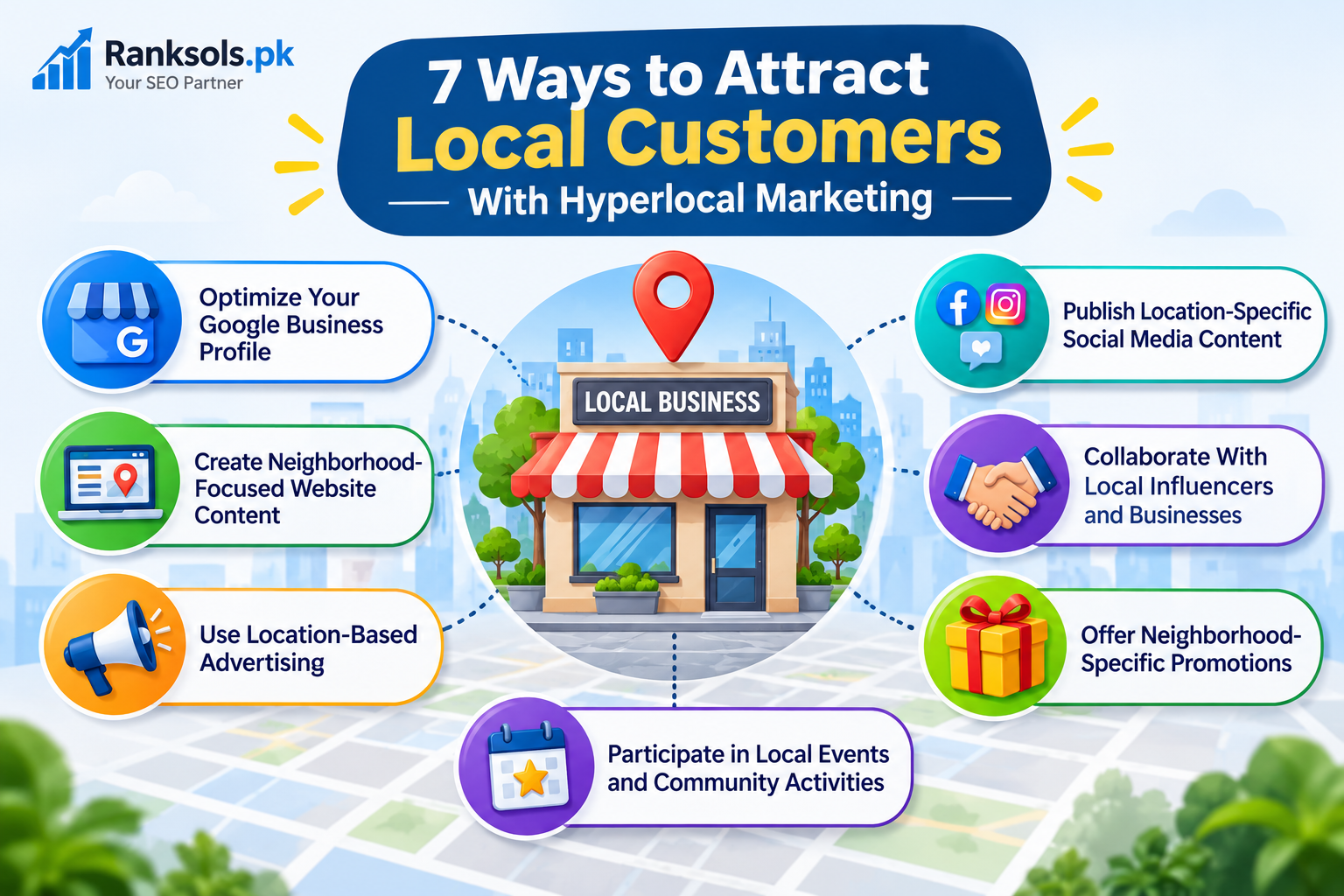
7 Ways to Attract Local Customers With Hyperlocal Marketing
Businesses can use different marketing channels to connect with nearby audiences. The most effective approach depends on their location, target customers, service coverage, and business objectives.
1. Optimize Your Google Business Profile
A well-maintained Google Business Profile helps customers discover local businesses through Google Search and Google Maps.
When people search for terms such as “restaurant near me,” “dentist in Johar Town,” or “plumber nearby,” Google may display relevant businesses based on factors such as relevance, distance, and prominence.
To improve your business profile:
Complete your business information, including address, phone number, and operating hours.
Select accurate primary and additional business categories.
Add genuine photographs of your business, products, and services.
Keep business hours and contact information updated.
Provide accurate service-area information if your business serves customers at their locations.
Encourage genuine customer reviews and respond to feedback professionally.
Add relevant products and services where these features are available.
An accurate and informative Google Business Profile helps potential customers understand what your business offers and how they can contact or visit you.
2. Create Neighborhood-Focused Website Content
Your website can attract customers who search for products and services in specific neighborhoods.
Instead of relying only on general location keywords, develop useful content that reflects the areas your business genuinely serves.
For example, a plumbing company operating across Lahore could provide relevant service information for customers in DHA, Johar Town, and Model Town.
Useful neighborhood-focused content may include:
Services available in specific neighborhoods.
Delivery and service coverage information.
Local customer questions and concerns.
Directions and nearby landmarks.
Relevant projects or genuine customer experiences.
Location-specific service details and availability.
Each location page should provide meaningful information that helps visitors understand how your business serves that area.
Avoid creating multiple pages that simply replace one neighborhood name with another. Location pages should offer distinct value rather than repetitive content designed only to target additional geographic keywords.
3. Use Location-Based Advertising
Location-based advertising allows businesses to promote their products and services to audiences in selected geographic areas.
Platforms such as Google Ads and Meta Ads provide location-targeting options that help businesses focus their advertising on relevant cities, neighborhoods, and eligible geographic areas.
For example, a restaurant can target advertisements toward nearby neighborhoods and promote its lunch menu, takeaway options, or delivery service.
To improve location-based advertising campaigns:
Select geographic areas where your business can realistically serve customers.
Use relevant advertising messages and neighborhood-specific offers.
Include clear calls to action, such as calling, ordering, or visiting.
Exclude locations outside your service coverage when appropriate.
Monitor campaign performance and adjust geographic targeting.
Test different locations to understand where enquiries and conversions originate.
The appropriate targeting area depends on your business model. A restaurant offering local delivery may focus on nearby neighborhoods, while a professional service provider may target a wider service region.
Keep in mind that advertising platforms use location signals and targeting settings rather than guaranteeing the exact physical location of every person who sees an advertisement.
4. Publish Location-Specific Social Media Content
Social media provides opportunities to connect with people who live, work, and spend time around your business.
Instead of publishing only general promotional posts, create content that reflects local interests, activities, and customer needs.
For example, a clothing store can share seasonal collections, new arrivals, and shopping offers relevant to its surrounding community.
Effective hyperlocal social media activities include:
Sharing updates about products and services available locally.
Tagging your actual business location where appropriate.
Publishing offers relevant to nearby customers.
Featuring genuine customer experiences and feedback.
Using relevant neighborhood hashtags naturally.
Sharing useful updates about local activities and events.
Businesses can also participate in relevant local social media groups where community members discuss recommendations, services, and neighborhood activities.
The goal is to build recognition among nearby audiences through useful and relevant content rather than relying entirely on promotional messages.
5. Collaborate With Local Influencers and Businesses
Working with local influencers and complementary businesses can introduce your brand to audiences who already have an interest in your area or industry.
Instead of focusing only on influencers with large followings, consider collaborating with smaller local creators who have relevant and engaged audiences.
For example, a fitness studio could partner with a nearby healthy food café to promote complementary services and introduce both businesses to potential customers.
Other opportunities include:
Inviting local creators to experience your products or services.
Organizing joint promotions with nearby businesses.
Collaborating with relevant neighborhood content creators.
Exchanging recommendations with complementary service providers.
Developing referral partnerships with businesses serving similar customers.
Choose partners based on audience relevance, credibility, and geographic connection rather than follower count alone.
These collaborations can increase local brand awareness, encourage referrals, and introduce your business to potential customers through trusted community connections.
6. Offer Neighborhood-Specific Promotions
Special offers designed for nearby customers can encourage people to visit your business, try your services, or make their first purchase.
Instead of using identical promotions for every audience, develop offers that address the needs and interests of particular customer groups.
For example:
A restaurant can offer lunch deals for employees working in nearby offices.
A salon can introduce weekday promotions for customers in surrounding neighborhoods.
A retail store can provide convenient local pickup options.
A service provider can offer introductory consultations in selected service areas.
Make each promotion easy to understand and redeem. Clearly communicate its benefits, eligibility, and availability.
You can also use campaign-specific promotional codes to identify which neighborhoods generate the most customer responses.
7. Participate in Local Events and Community Activities
Hyperlocal marketing is not limited to digital advertising. Building relationships within the community can also help businesses become more familiar and trusted among nearby customers.
Participating in local events provides opportunities to interact directly with potential customers and introduce them to your products or services.
Consider activities such as:
Supporting neighborhood events and community programs.
Organizing product demonstrations or workshops.
Participating in local exhibitions and markets.
Sponsoring relevant community activities.
Offering special promotions during local events.
These activities create opportunities for direct customer interaction and can encourage word-of-mouth recommendations within the surrounding community.
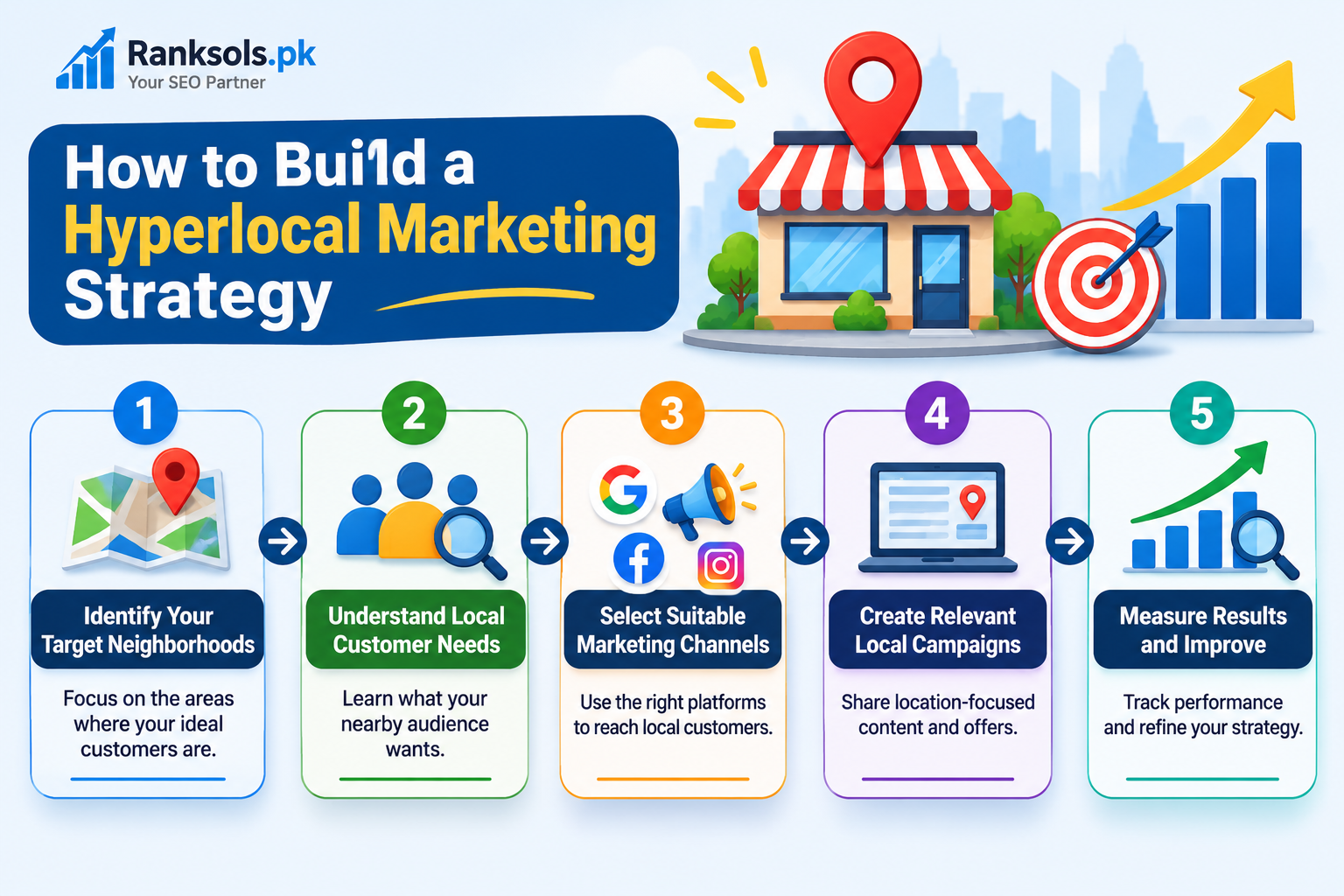
How to Build a Hyperlocal Marketing Strategy
An effective hyperlocal marketing strategy starts with understanding your target area and selecting activities that match local customer needs.
Businesses can follow these practical steps:
Identify Your Target Neighborhoods
Determine which neighborhoods or commercial areas are most relevant to your business.
Consider where potential customers live, work, shop, and access the services you provide. Focus on locations where your business can realistically serve customer demand.
Understand Local Customer Needs
Research the preferences, questions, and purchasing requirements of people in your target areas.
Customer reviews, local search queries, social media discussions, and direct customer feedback can help identify relevant local interests.
Select Suitable Marketing Channels
Choose marketing channels according to your business objectives and audience.
For example, a restaurant may benefit from Google Business Profile optimization, local social media content, and location-based advertising. A home service provider may prioritize local search visibility, neighborhood-focused website content, and customer referrals.
Create Relevant Local Campaigns
Develop advertisements, website content, promotions, and social media posts that address the needs of your selected communities.
Ensure that your messages accurately represent your services, business location, and customer coverage.
Measure Results and Improve
Monitor customer enquiries, calls, bookings, website activity, and purchases.
Use these results to identify which locations and marketing channels generate meaningful business outcomes. Adjust your campaigns based on actual customer responses rather than assumptions.
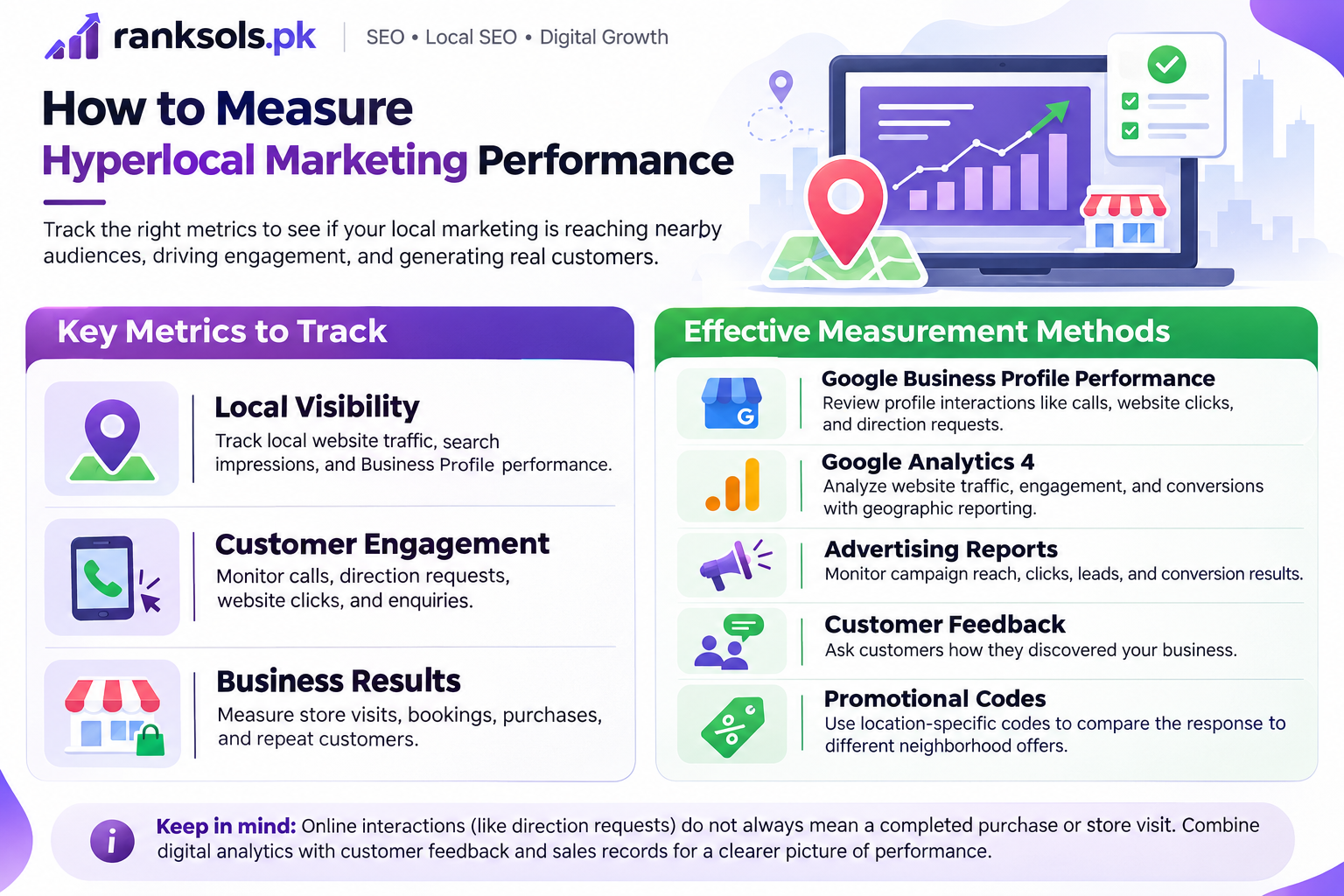
How to Measure Hyperlocal Marketing Performance
Measuring performance helps businesses understand whether their marketing activities are reaching relevant local audiences and generating customers.
Instead of focusing only on advertising impressions and social media reach, monitor metrics that reflect customer engagement and business results.
| Measurement Category | Important Metrics |
|---|---|
| Local visibility | Local website traffic, search impressions, Business Profile performance |
| Customer engagement | Calls, direction requests, website clicks, enquiries |
| Business results | Store visits, bookings, purchases, repeat customers |
Some useful measurement methods include:
Google Business Profile performance: Review available profile interactions, including calls, website clicks, and direction requests.
Google Analytics 4: Analyze website traffic, engagement, and conversions where geographic reporting is available.
Advertising reports: Monitor campaign reach, clicks, leads, and conversion performance.
Customer feedback: Ask customers how they discovered your business.
Promotional codes: Use location-specific codes to compare the response to different neighborhood offers.
Remember that online interactions do not automatically represent completed purchases or physical store visits. Direction requests, for example, do not confirm that someone actually visited your business.
Combining digital analytics with customer feedback and sales records provides a more useful picture of campaign performance.
Common Hyperlocal Marketing Mistakes to Avoid
Even well-planned campaigns can produce poor results when businesses target unsuitable locations or use irrelevant marketing messages.
Avoid these common mistakes:
Targeting areas outside your service coverage: Focus on neighborhoods where customers can realistically access your products or services.
Targeting too many neighborhoods: Expanding campaigns without understanding local demand can waste marketing resources.
Using generic content: Create messages that reflect the needs and interests of your intended community.
Creating low-value location pages: Every location page should provide genuinely useful and distinct information.
Ignoring local customer preferences: Different communities may have different purchasing needs and expectations.
Neglecting customer reviews: Respond professionally to feedback and use it to improve customer experience.
Running advertisements without tracking: Monitor enquiries, conversions, and other meaningful outcomes.
Overusing location keywords: Include neighborhood names naturally instead of repeatedly inserting them into website content.
A successful approach prioritizes geographic relevance, customer needs, accurate information, and measurable business results.
Conclusion
Hyperlocal marketing helps businesses attract nearby customers by focusing on the specific communities and geographic areas they serve. Through Google Business Profile optimization, neighborhood-focused content, location-based advertising, social media engagement, local partnerships, and community activities, businesses can build stronger connections with potential customers.
The key is to understand where your target audience is, what they need, and how your business can serve them effectively. A focused strategy supported by relevant campaigns and performance measurement can help businesses improve local awareness and generate more meaningful customer opportunities.
Want to improve your business’s local online visibility? Ranksols helps businesses strengthen their online presence through professional SEO and digital marketing solutions. Visit Ranksols.pk to explore how a focused digital strategy can support your business growth.
