
Keyword research involves finding, analyzing, and selecting search terms relevant to your website and target audience. A structured keyword research process helps you identify search opportunities, understand user intent, and select suitable keywords for your website pages.
Effective keyword research goes beyond collecting search terms. It requires evaluating search demand, understanding competition, examining search engine results pages (SERPs), and organizing keywords according to their relevance and purpose.
This guide explains the key steps involved in keyword research, from identifying seed keywords to analyzing competition, prioritizing opportunities, and mapping keywords to relevant website pages.
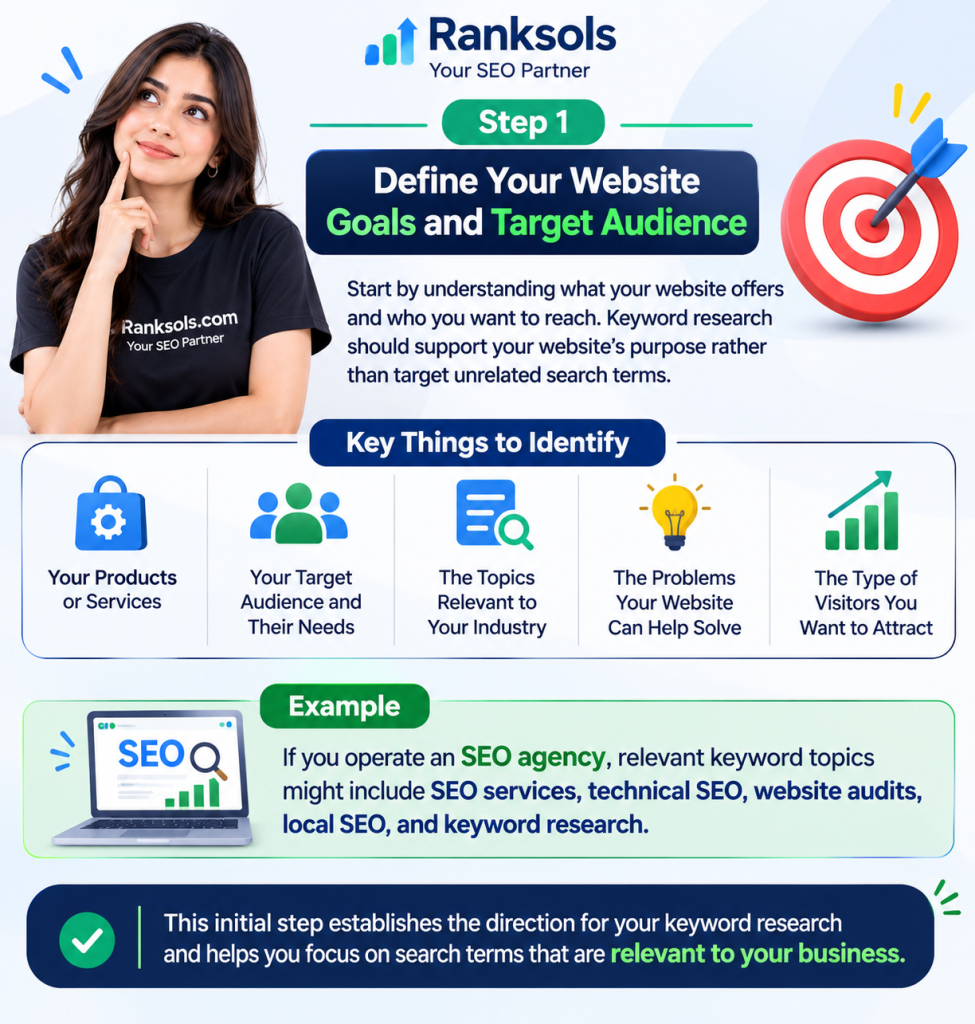
1. Define Your Website Goals and Target Audience
Start by understanding what your website offers and who you want to reach. Keyword research should support your website’s purpose rather than target unrelated search terms simply because they have high search volume.
Identify:
Your products or services.
Your target audience and their needs.
The topics relevant to your industry.
The problems your website can help solve.
The type of visitors you want to attract.
Example: If you operate an SEO agency, relevant keyword topics might include SEO services, technical SEO, website audits, local SEO, and keyword research.
This initial step establishes the direction for your keyword research and helps you focus on search terms that are relevant to your business.
2. Identify Seed Keywords
Seed keywords are the basic search terms that describe your business, products, services, or website topics. They provide a starting point for discovering more specific keyword opportunities.
Create an initial list of relevant terms based on your industry, services, and audience.
For example, an SEO agency might start with:
Search engine optimization
Website SEO audit
Keyword research
At this stage, prioritize relevance rather than search volume. These initial keywords will help you discover related search queries and expand your keyword list.
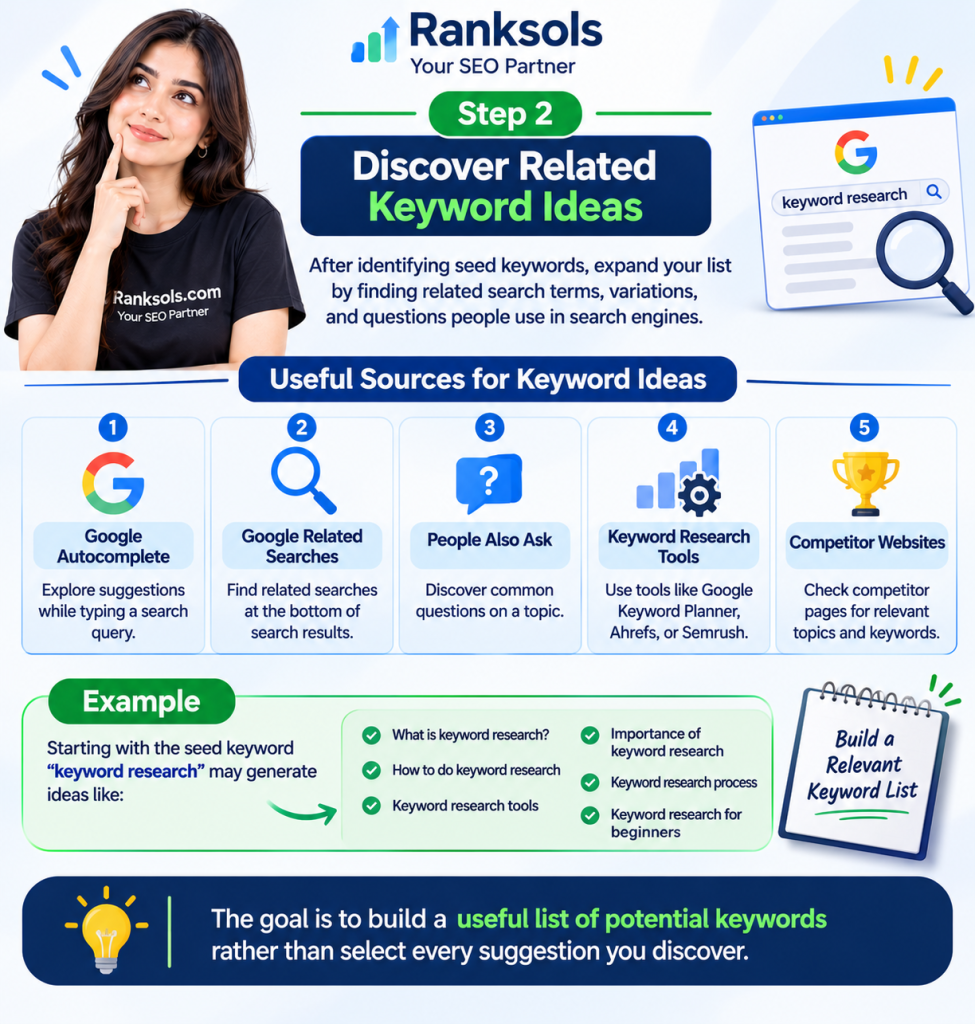
3. Discover Related Keyword Ideas
After identifying seed keywords, expand your list by discovering related search terms, variations, and questions that people use in search engines.
You can find keyword ideas through several sources:
Google Autocomplete: Explore suggestions that appear while typing a search query.
Google Related Searches: Discover related searches displayed near the bottom of Google search results.
People Also Ask: Identify questions that users commonly explore around a topic.
Keyword Research Tools: Use platforms such as Google Keyword Planner, Ahrefs, or Semrush to discover keyword suggestions and related metrics.
Competitor Websites: Examine relevant competitor pages to identify topics and search terms they cover.
For example, starting with the seed keyword keyword research may generate ideas such as:
What is keyword research?
How to do keyword research
Keyword research tools
Importance of keyword research
Keyword research process
Keyword research for beginners
Collect relevant suggestions in a spreadsheet or keyword research document for further evaluation.
The objective is to build a useful list of potential keywords rather than select every suggestion you discover.
4. Analyze Keyword Metrics
Finding keyword ideas is not enough. You also need to evaluate their potential before deciding which ones deserve attention.
Consider the following metrics:
Search Volume
Search volume estimates how frequently users search for a particular keyword within a specific location and period.
It helps identify search demand and compare keyword opportunities. However, high search volume does not automatically make a keyword valuable for your website.
Keyword Difficulty
Keyword difficulty is a third-party SEO tool metric that estimates how challenging it may be to rank for a particular search term.
It can help compare keyword opportunities, but different SEO tools calculate difficulty using different methodologies. It should not be treated as a guaranteed prediction of ranking performance.
Advertising Competition
Google Keyword Planner provides an advertising competition metric that indicates how competitive a keyword is among advertisers bidding on it through Google Ads.
This metric is different from organic keyword difficulty. Advertising competition should not be interpreted as a direct measurement of how difficult it is to rank in unpaid search results.
Search Intent
Search intent refers to the purpose behind a user’s search query.
Understanding whether users want information, navigate to a website, compare options, or purchase something helps you select keywords that match their expectations.
Business Relevance
Evaluate how closely each keyword relates to your website, products, services, and target audience.
A keyword with lower search volume may offer more value than a broad search term if it attracts visitors who are genuinely interested in what your business provides.
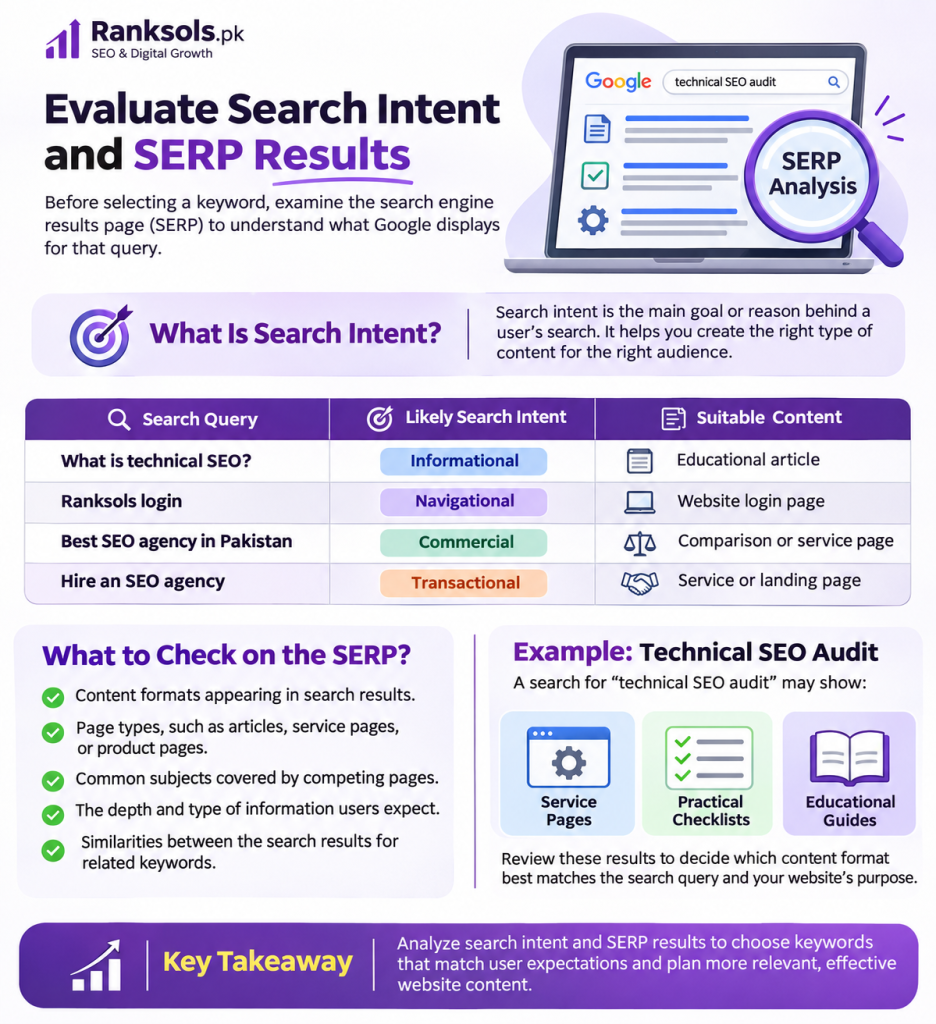
5. Evaluate Search Intent and SERP Results
Before selecting a keyword, examine the search engine results page (SERP) to understand what Google displays for that query.
Search intent analysis helps determine the type of content users expect to find.
For example:
Search query | Likely search intent | Suitable content |
|---|---|---|
What is technical SEO? | Informational | Educational article |
Ranksols login | Navigational | Website login page |
Best SEO agency in Pakistan | Commercial | Comparison or service page |
Hire an SEO agency | Transactional | Service or landing page |
Search intent should not be determined by keyword wording alone. Examine the actual search results to understand what types of pages Google displays.
Look for:
Content formats appearing in search results.
Page types, such as articles, service pages, or product pages.
Common subjects covered by competing pages.
The depth and type of information users expect.
Similarities between the search results for related keywords.
For example, a search for technical SEO audit may display service pages, practical checklists, or educational guides. Examine these results to determine which content format best matches the search query and your website’s purpose.
This analysis helps you select keywords that align with user expectations and plan more relevant website content.
6. Analyze Keyword Competition
Once you understand search intent, evaluate the competition for your shortlisted keywords.
Review the websites and pages currently ranking for those search terms. Consider their:
Topical relevance.
Content quality and usefulness.
Website authority and backlink profiles.
Coverage of important user questions.
Ability to satisfy the search intent.
Do not rely exclusively on keyword difficulty scores.
Look for opportunities where your website can provide more relevant, useful, or complete information than existing results.
For example, the broad keyword SEO may have substantial competition and unclear intent. A more specific term such as technical SEO audit checklist may offer a clearer content opportunity.
The objective is to identify realistic keywords that align with your website’s expertise, resources, and audience.
7. Select and Prioritize Target Keywords
After evaluating relevance, search intent, metrics, and competition, select the keywords that best support your SEO objectives.
Prioritize them according to:
Relevance: How closely does the keyword relate to your website and audience?
Intent alignment: Can your website provide the type of content users expect?
Business or informational value: Does the keyword support your website’s objectives?
Search demand: Is there measurable interest in the topic?
Competition: Is the opportunity realistic considering your website’s current position and resources?
For example:
Keyword | Relevance | Intent clarity | Illustrative priority |
|---|---|---|---|
SEO | Broad | Unclear | Low |
Technical SEO audit | High | Clear | High |
Website crawling | High | Informational | Medium |
SEO services | High | Commercial | High |
These priorities are illustrative rather than universal. Actual keyword selection depends on your website’s goals, existing content, competition, and available resources.
The best keyword is not necessarily the one with the highest search volume. It is the one that offers the strongest combination of relevance, search intent, and potential value.
8. Organize Keywords and Map Them to Pages
After selecting your target keywords, organize them into meaningful groups and assign them to appropriate website pages. This process is commonly known as keyword mapping.
Keyword mapping helps establish which keywords each page should target and reduces unnecessary overlap between pages.
For example:
Website page | Primary keyword | Related keywords |
|---|---|---|
Keyword Research Guide | Keyword research | Keyword research fundamentals, keyword research guide |
Keyword Research Process | Keyword research process | How to do keyword research, keyword research steps |
Keyword Research Benefits | Importance of keyword research | Benefits of keyword research |
Related keywords can be covered together when they share similar search intent and can be addressed naturally within the same page.
However, keywords with different purposes may require separate pages.
For example, someone searching for keyword research benefits wants to understand why keyword research matters, while someone searching for keyword research process wants to learn how to perform it.
Although both searches relate to keyword research, their primary purposes are different.
Before creating a new page, review your existing website content to determine whether an existing page already satisfies the same search intent.
9. Use Selected Keywords for Content Planning
Once keyword research and keyword mapping are complete, use the findings to plan relevant website content.
Choose a content format that matches the search intent and provides the information users expect.
For example:
Informational keywords: Educational articles, tutorials, and guides.
Commercial keywords: Comparison pages, service descriptions, and evaluation guides.
Transactional keywords: Service pages and landing pages.
Navigational keywords: Relevant branded website pages.
Use the primary keyword naturally in appropriate page elements, such as the SEO title, main heading, and relevant sections.
Include secondary and semantically related keywords when they improve context and help explain the subject.
Avoid forcing keywords into sentences or repeating them unnecessarily.
Google recommends creating helpful, reliable, people-first content rather than content designed primarily to manipulate search rankings.
10. Monitor Keyword Performance and Refine Your Research
Keyword research should not end after publishing content. Search behavior, competition, and website performance can change over time.
Use Google Search Console to evaluate how your pages perform for different search queries.
Review the following performance metrics:
Impressions: How often your website appears in Google Search results.
Clicks: How often users visit your website from search results.
Click-through rate (CTR): The percentage of impressions that result in clicks.
Average position: The average position of your website’s topmost result across the measured impressions.
You can use this information to:
Identify queries already generating impressions.
Discover pages gaining organic search visibility.
Find relevant search terms that may indicate content opportunities.
Identify pages that may benefit from content improvements.
Monitor changes in organic search performance.
Search Console does not provide a complete record of every query users search for. Its reported query data has limitations, so use it alongside other keyword research sources.
Review your keyword opportunities periodically and update your research when new search trends, audience needs, or business priorities emerge.
Common Keyword Research Mistakes to Avoid
Even a well-organized keyword research process can produce poor results if important factors are overlooked.
Avoid these common mistakes:
Choosing keywords only by search volume: High search demand does not necessarily mean high relevance or business value.
Ignoring search intent: Content that does not match what users expect may fail to satisfy their needs.
Relying entirely on keyword difficulty: Third-party difficulty scores are estimates, not guaranteed ranking predictions.
Confusing advertising competition with organic difficulty: Google Ads competition and organic keyword difficulty measure different things.
Targeting unrelated keywords: Keywords should remain relevant to your website’s subject and audience.
Creating unnecessary pages: Similar keywords do not always require separate pages. Consider their search intent before creating new content.
Ignoring existing website content: Review your current pages before targeting similar search queries.
Never updating keyword research: Revisit keyword opportunities and performance data as your website develops.
Final Thoughts
The keyword research process involves discovering relevant search terms, evaluating their potential, understanding search intent, and selecting appropriate keywords for your website pages.
By following a structured approach, you can make more informed content decisions, organize website topics, and identify relevant organic search opportunities.
For businesses that need professional guidance with keyword selection, search intent analysis, and SEO content planning, Ranksols provides SEO services to support website visibility and organic search growth.