
Seed keywords are the foundational terms used to start the keyword research process. They represent the main topics, products, services, or subjects of a website and help SEO professionals discover related search terms and keyword opportunities.
By starting with relevant seed keywords, businesses can identify how potential customers search for their products or services and develop a more organized keyword strategy.
This guide explains what seed keywords are, why they matter, how to find suitable starting terms, and how to use them effectively in SEO.
What Are Seed Keywords in SEO?
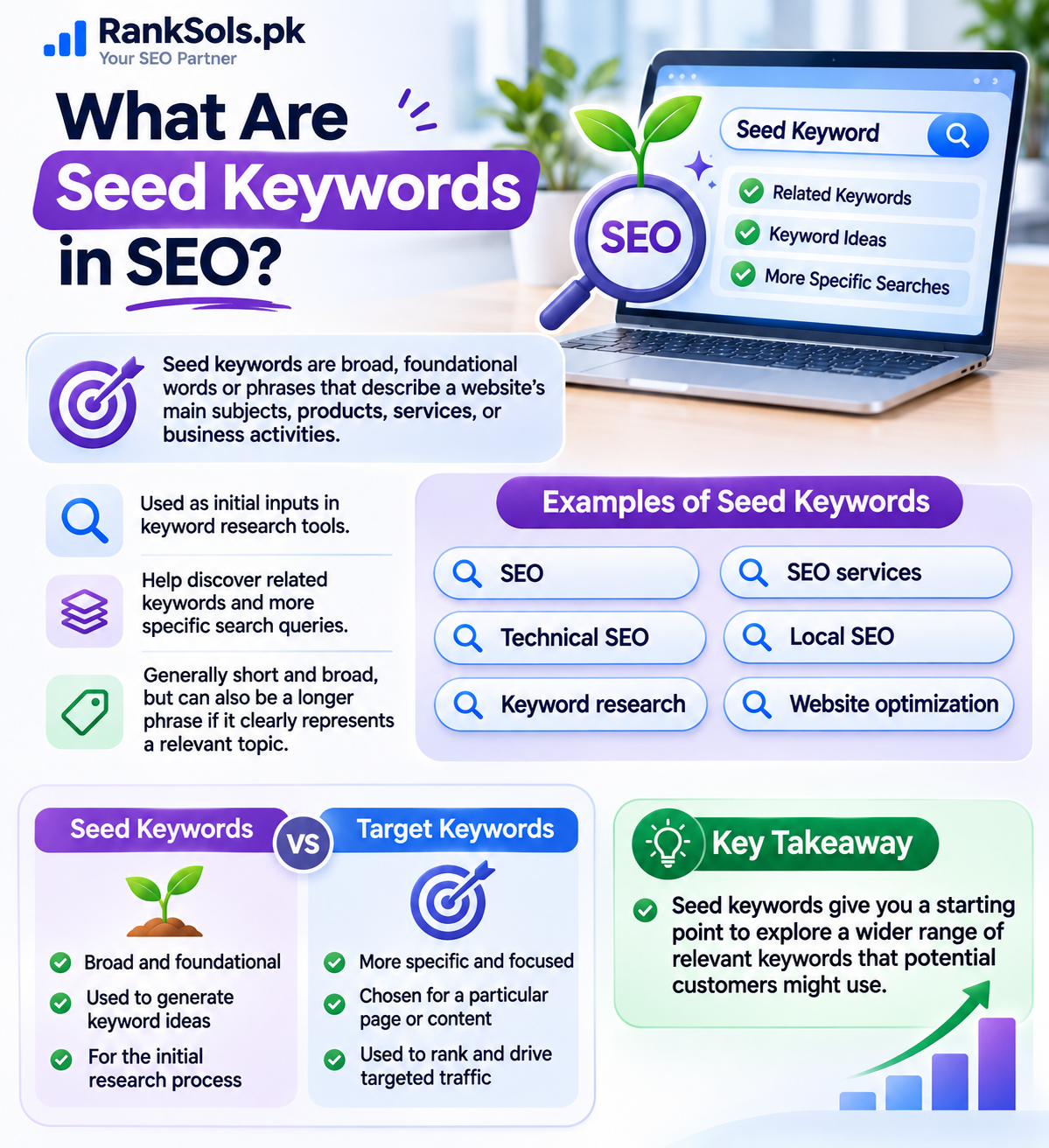
Seed keywords are broad, foundational words or phrases that describe a website’s main subjects, products, services, or business activities. They serve as initial inputs in keyword research tools to generate related keywords and more specific search queries.
Seed keywords are generally short and broad, but they are not limited to one or two words. A longer phrase can also work as a seed keyword when it clearly represents a relevant topic.
For example, an SEO agency might use the following seed keywords:
Website optimization
These terms provide a starting point for discovering more specific search queries that potential customers might use.
Unlike target keywords, which are selected for specific pages or content, seed keywords primarily help generate and explore keyword ideas during the initial research process.
Why Are Seed Keywords Important?
Seed keywords help establish the direction of keyword research. Starting with relevant terms makes it easier to discover search queries that align with a website’s subject, audience, and business objectives.
Their importance includes:
1. Generate Keyword Ideas
A single seed keyword can produce numerous related terms, keyword variations, questions, and specific search queries. These suggestions help expand an initial keyword list.
2. Discover Content Opportunities
Seed keywords help identify related topics that can be developed into blog posts, service pages, and other website content.
3. Understand Your Industry
Identifying relevant seed terms helps businesses understand the main subjects, products, services, and terminology associated with their industry.
4. Support Topic Clusters
Multiple seed keywords can reveal related subtopics that can be organized into broader content groups. This helps businesses develop a more structured website content strategy.
Examples of Seed Keywords and Related Keywords
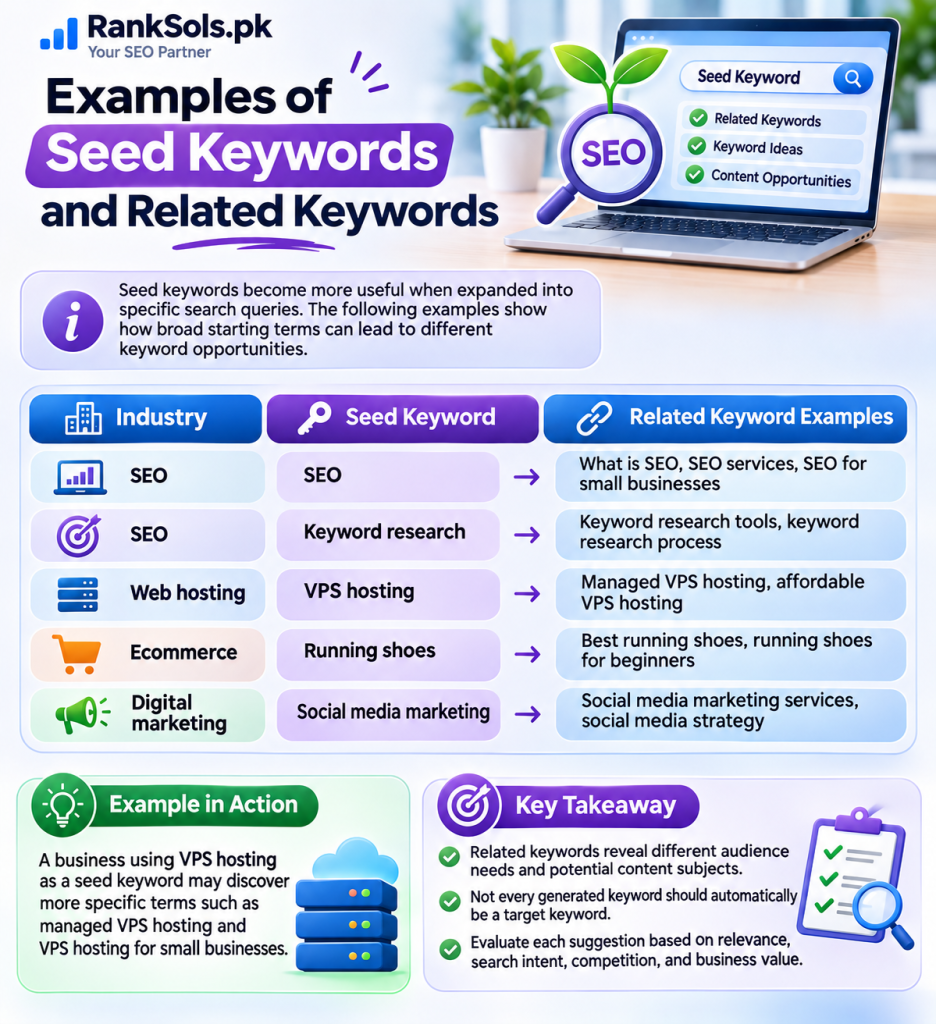
Seed keywords become more useful when expanded into specific search queries. The following examples demonstrate how broad starting terms can lead to different keyword opportunities.
Industry | Seed keyword | Related keyword examples |
|---|---|---|
SEO | SEO | What is SEO, SEO services, SEO for small businesses |
SEO | Keyword research | Keyword research tools, keyword research process |
Web hosting | VPS hosting | Managed VPS hosting, affordable VPS hosting |
Ecommerce | Running shoes | Best running shoes, running shoes for beginners |
Digital marketing | Social media marketing | Social media marketing services, social media strategy |
For example, a business using VPS hosting as a seed keyword may discover more specific terms such as managed VPS hosting and VPS hosting for small businesses.
These suggestions can reveal different audience needs and potential content subjects.
However, not every generated keyword should automatically become a target keyword. Each suggestion requires further evaluation based on relevance, search intent, competition, and business value.
How to Find Seed Keywords for Your Website
Finding seed keywords does not require complicated research. Start with your business knowledge and use available customer and search data to identify relevant starting terms.
1. Identify Your Main Products and Services
Start by listing the primary products, services, and subjects your website covers.
Think about how potential customers would describe what your business offers.
For example, an SEO agency might identify:
SEO services
Technical SEO
Local SEO
Ecommerce SEO
Website SEO audit
These terms represent different areas of the business and can serve as separate starting points for keyword research.
2. Understand Your Target Audience
Consider the problems your audience wants to solve and the terminology they use when searching online.
For example, people looking for website optimization might search for:
Improve website rankings
Website SEO
SEO audit
Increase organic traffic
Customer questions, sales conversations, feedback, and support requests can help identify relevant terms that might otherwise be overlooked.
3. Analyze Competitor Websites
Review websites that offer similar products or services. Examine their main service pages, website categories, and the topics they cover.
You can also use competitor analysis tools to identify the organic search queries for which competing websites appear in search results.
Look for broad, relevant terms that represent their main topics rather than copying every keyword they target.
4. Use Google Search Suggestions
Google Autocomplete can help identify related search language and possible keyword variations.
Start typing a relevant topic into Google and review the suggestions that appear.
For example, entering SEO services may reveal suggestions such as:
SEO services in Pakistan
Affordable SEO services
SEO services for small businesses
Google’s related searches and People Also Ask results can provide additional ideas about subjects connected to your initial terms.
These suggestions are useful for discovering possible keyword variations, but they should not be treated as proof of search volume or business value.
5. Review Existing Website Search Data
If your website already receives organic impressions, Google Search Console can help identify the queries people use to discover it.
Open the Performance report and review the Queries section. Look for relevant terms that represent your website’s main subjects, products, or services.
These queries can provide additional seed keyword ideas and help identify topics that deserve further research.
However, Search Console is more useful for expanding an existing keyword list than generating the initial seed keywords for a new website.
How to Choose Effective Seed Keywords
Selecting suitable seed keywords is important because irrelevant starting terms can produce keyword suggestions that have little connection with your website or business.
Consider the following factors when choosing seed keywords:
Business Relevance: Choose terms that accurately represent your products, services, or website topics. Avoid unrelated keywords simply because they have high search demand.
Topic Coverage: Include terms representing the main areas of your website instead of focusing on a single subject. This helps discover opportunities across different sections of your business.
Audience Relevance: Consider whether your target audience would naturally use these terms when searching for information, products, or services.
Search Context: Make sure each term has a clear relationship with the subject you want to research. A keyword with multiple unrelated meanings may generate less relevant suggestions.
For example, an SEO agency should prioritize terms such as SEO services, technical SEO, and local SEO rather than unrelated broad terms that do not represent its services.
How to Use Seed Keywords in Keyword Research
Once you have collected relevant seed keywords, use them as inputs in keyword research tools to discover additional search terms.
Follow this process:
Identify relevant seed keywords
Create an initial list based on your website’s products, services, and main topics.
Enter seeds into keyword research tools
Use tools such as Google Keyword Planner, Ahrefs, or Semrush to generate keyword suggestions.
Generate related keyword ideas
Review keyword variations, questions, and more specific search queries.
Evaluate keyword opportunities
Examine relevance, search intent, search volume, keyword difficulty, and business value.
Organize relevant keywords
Group related terms into suitable topics and identify appropriate content opportunities.
Google Ads Keyword Planner supports keyword discovery by allowing users to generate keyword ideas from words, phrases, or websites that describe a business, product, or service.
It can provide useful keyword suggestions for SEO research, although its primary purpose is planning Google Search advertising campaigns.
Other keyword research platforms, including Ahrefs and Semrush, also offer features for expanding seed keywords into related search terms.
Remember that keyword research tools generate suggestions, not guaranteed content opportunities. Each keyword should be reviewed before deciding whether it deserves a dedicated page or should be covered within existing content.
Common Mistakes to Avoid When Selecting Seed Keywords
Choosing unsuitable seed keywords can lead to irrelevant keyword suggestions and an inefficient research process.
Avoid these common mistakes:
Choosing overly broad terms: Generic words may produce suggestions that have little connection to your actual business.
Ignoring customer language: Using internal business terminology instead of the words customers search for can limit relevant keyword discoveries.
Focusing only on search volume: A high-volume keyword is not necessarily valuable if it does not match your products, services, or audience.
Using too few seed keywords: Relying on a single starting term may overlook important areas of your industry.
Treating every suggestion as a target keyword: Generated keyword ideas require further evaluation before being included in your SEO strategy.
Ignoring search intent: Related keywords may represent different user needs and may require different types of content.
Final Thoughts
Seed keywords provide the foundation for discovering relevant search terms and developing a structured keyword research strategy. By starting with terms that accurately represent your business and expanding them through keyword research tools, you can uncover related queries and valuable content opportunities.
Selecting relevant seed keywords also makes it easier to understand your industry, explore audience search behavior, and identify subjects worth covering on your website.
For businesses looking to develop a stronger organic search strategy, Ranksols can help with professional keyword research and SEO planning to identify relevant opportunities aligned with business goals.
Explore our Keyword Research Fundamentals resources to learn more about finding and evaluating keywords for SEO.