
Keyword research is a structured SEO process of discovering, analyzing, and selecting the search terms people use to find information, products, or services online. It helps businesses understand their target audience’s search behavior and identify relevant opportunities for website content.
The process involves more than finding keywords with high search volume. SEO professionals evaluate search intent, keyword relevance, competition, and potential business value to determine which search terms deserve attention.
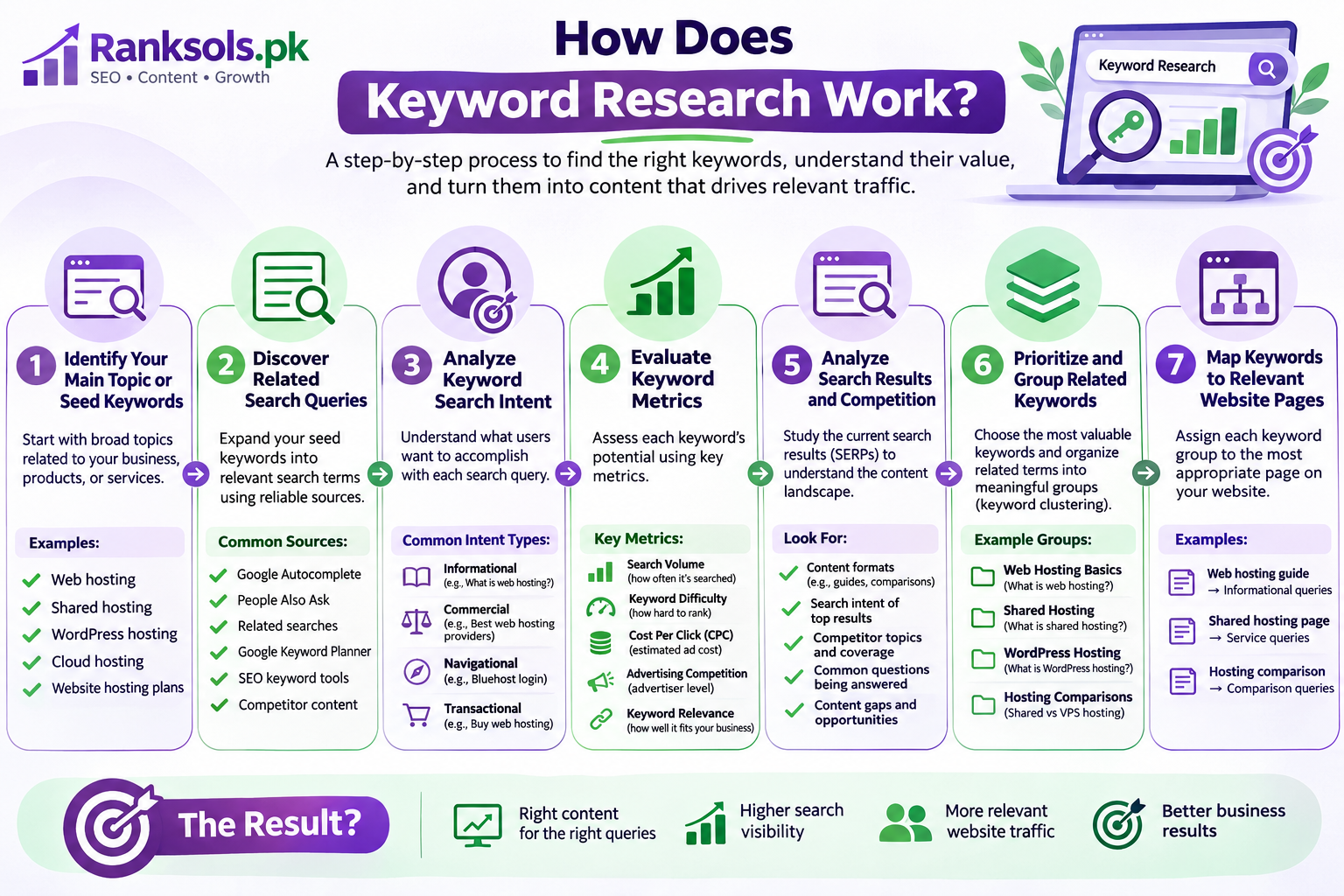
How Does Keyword Research Work?
Keyword research works by starting with a topic or business offering and expanding it into relevant search queries. These queries are then analyzed, prioritized, grouped, and mapped to suitable website pages.
The process generally involves the following steps.
1. Identify Your Main Topic or Seed Keywords
The first step is to identify the main topics related to your website, business, products, or services. These topics provide a starting point for discovering relevant search terms.
These initial terms are commonly called seed keywords. They are broad phrases that describe a website’s subject or the products and services it offers.
For example, a web hosting company might start with:
Shared hosting
Cloud hosting
Website hosting plans
Seed keywords establish the subject area for further keyword research. They help generate more specific search queries that reflect different audience interests and needs.
2. Discover Related Search Queries
After identifying seed keywords, the next step is to expand them into related search terms that people use in search engines.
SEO professionals use keyword research tools and search engine features to discover keyword variations, questions, and related queries.
Common sources include:
Google Autocomplete suggestions.
People Also Ask questions.
Related searches in Google.
Google Keyword Planner.
SEO keyword research tools.
Competitor website content.
For example, starting with the seed keyword web hosting may reveal related queries such as:
What is web hosting?
How does web hosting work?
Best web hosting for small businesses.
Shared hosting vs VPS hosting.
How much does web hosting cost?
These suggestions provide ideas for further research. However, a suggested query does not automatically indicate substantial search demand or a valuable content opportunity. Each keyword should be evaluated before being selected.
3. Analyze Keyword Search Intent
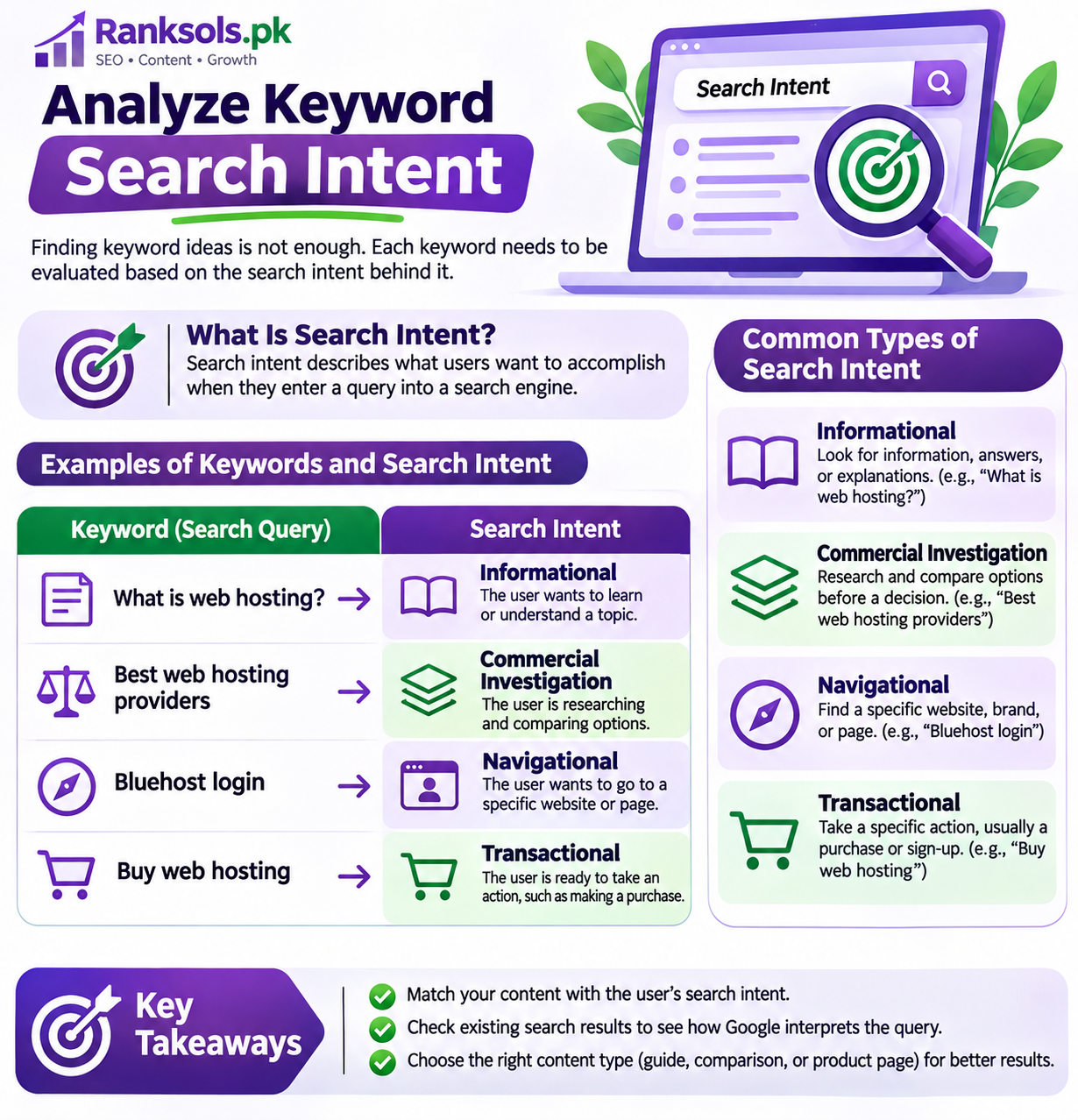
Finding keyword ideas is not enough. Each keyword needs to be evaluated according to the search intent behind it.
Search intent describes what users want to accomplish when they enter a query into a search engine.
Common examples include:
Keyword | Search Intent |
|---|---|
What is web hosting? | Informational |
Best web hosting providers | Commercial investigation |
Bluehost login | Navigational |
Buy web hosting | Transactional |
Understanding search intent helps determine what type of content is appropriate for each keyword.
For example, an informational query generally requires an educational article, while a transactional query may be better served by a product or pricing page.
SEO professionals also examine existing search results to understand how Google interprets a query. If the results mainly display comparison articles, publishing a general definition may not satisfy the dominant search intent.
Analyzing search intent helps ensure that selected keywords align with the purpose of the page and the information users expect to find.
4. Evaluate Keyword Metrics
Once relevant keyword ideas have been identified, the next step is to evaluate their potential using available keyword metrics.
Common metrics include:
Search Volume: Estimates how frequently users search for a particular keyword within a given period. Estimates can vary by location, language, and keyword research tool.
Keyword Difficulty: Estimates how challenging it may be to rank organically for a keyword. Different SEO tools calculate this metric using their own methods.
Cost Per Click (CPC): Indicates the estimated amount advertisers pay for clicks on a keyword in paid search advertising.
Advertising Competition: Indicates the level of competition among advertisers targeting a keyword in advertising platforms.
Keyword Relevance: Describes how closely a search term relates to a website’s subject, products, services, or audience.
These metrics help SEO professionals compare keyword opportunities and make informed content planning decisions.
It is important to distinguish between organic keyword difficulty and advertising competition. Google Keyword Planner’s competition metric relates to paid advertising, while SEO tools provide separate estimates of organic ranking difficulty. They should not be treated as interchangeable.
Keyword metrics are estimates rather than direct Google ranking factors. A keyword with high search volume is not automatically more valuable than a specific, lower-volume query that attracts relevant visitors.
5. Analyze Search Results and Competition
The next step is to examine the existing search engine results pages (SERPs) for selected keywords.
SERP analysis helps SEO professionals understand the types of pages and content formats currently appearing for a particular search query.
During this process, they examine:
Content formats appearing in search results.
Search intent reflected by ranking pages.
Competitor topics and content coverage.
Common questions addressed by existing pages.
Content gaps and opportunities to provide more useful information.
For example, if search results for a keyword mainly display comparison articles, publishing a general informational definition may not align with the dominant search intent.
Competitor analysis can also reveal subjects that existing pages cover and questions they may not address adequately.
The purpose is not simply to reproduce competing content. It is to identify opportunities to create relevant, accurate, and more useful resources for the intended audience.
6. Prioritize and Group Related Keywords
After evaluating keyword opportunities, the next step is to determine which keywords deserve priority and organize related search terms into meaningful groups.
Keyword prioritization involves considering several factors:
Relevance to the website’s subject or business.
Search intent and audience needs.
Estimated search demand.
Organic ranking competition.
Potential business or informational value.
Availability of suitable content resources.
For example, a web hosting company may prioritize WordPress hosting over a broad keyword such as technology because it is more closely connected to its services.
After prioritization, related keywords can be organized into groups based on their meaning and search intent. This process is commonly known as keyword clustering.
For example:
Keyword Group | Related Keywords |
|---|---|
Web Hosting Basics | What is web hosting, how does web hosting work |
Shared Hosting | What is shared hosting, shared hosting benefits |
WordPress Hosting | What is WordPress hosting, WordPress hosting requirements |
Hosting Comparisons | Shared hosting vs VPS hosting, VPS vs cloud hosting |
Keywords should be grouped according to their meaning and search intent, not simply because they contain similar words.
For example, what is web hosting and how does web hosting work may fit naturally into one informational resource.
However, what is web hosting and buy web hosting represent different user needs and may require separate pages.
7. Map Keywords to Relevant Website Pages
The final step is to assign selected keywords to suitable website pages. This process is known as keyword mapping.
Each page should have a clearly defined primary topic, supported by closely related secondary keywords where appropriate.
For example:
A web hosting guide can target informational hosting-related searches.
A shared hosting service page can target shared hosting service queries.
A hosting comparison article can address users researching different hosting options.
Keyword mapping helps establish a clear relationship between search queries and website content.
It also reduces unnecessary overlap between pages. When multiple pages target nearly identical search intent, they may compete for similar queries and create confusion about which page best addresses the topic.
A structured keyword map helps maintain clear content targets and supports a more organized website architecture.
How Do Keyword Research Tools Help?
Keyword research tools simplify the process by providing keyword suggestions, estimated search volumes, competition metrics, and related search information.
Popular tools include:
Google Keyword Planner: Provides keyword ideas and advertising-related search estimates.
Google Search Console: Identifies queries that already generate impressions and clicks for an existing website.
Ahrefs Keywords Explorer: Provides keyword ideas and estimated organic keyword metrics.
Semrush Keyword Magic Tool: Helps discover related keywords and analyze keyword opportunities.
Ubersuggest: Provides keyword suggestions and estimated SEO metrics.
Each tool serves a different purpose. Some help discover new keyword opportunities, while others provide insights into existing website performance.
For example, Google Search Console’s Performance report allows website owners to examine:
Search queries generating impressions and clicks.
Pages appearing in Google Search.
Click-through rates (CTR).
Average search positions.
This information helps identify queries for which a website already has search visibility and opportunities to improve relevant pages. However, Search Console is primarily a performance monitoring tool, not a replacement for dedicated keyword discovery tools.
Search Console Help+1
Example of How Keyword Research Works
Consider a digital marketing agency planning content about SEO services.
The keyword research process might look like this:
Starting topic: SEO services.
Keyword discovery: Find related queries such as SEO services for small businesses, SEO agency, and professional SEO services.
Intent analysis: Determine whether users want information, service comparisons, or an SEO provider.
Metric evaluation: Compare search demand, estimated difficulty, and business relevance.
SERP analysis: Examine existing results to understand search intent, competing pages, and content opportunities.
Keyword prioritization and clustering: Select valuable opportunities and organize related search queries into groups.
Keyword mapping: Assign selected keywords to suitable service pages, comparison articles, or informational resources.
This process turns a broad business topic into a structured content plan based on audience search behavior and relevant search opportunities.
How Do You Refine Keyword Research Over Time?
Keyword research does not necessarily end after publishing website content. Search behavior, industry terminology, competitors, and audience interests can change over time.
Reviewing website performance helps identify new keyword opportunities and areas where existing content may need improvement.
SEO professionals can use Google Search Console to monitor search queries, impressions, clicks, click-through rates, and average positions.
For example, a website may discover that an existing article receives impressions for related queries that are not adequately covered in its content. These insights can help identify opportunities to improve the page or develop a separate resource when the search intent is different.
Comparing performance across different periods can also help identify changes in search visibility and audience interest.
Search Console Help+1
Regular keyword research and performance reviews help businesses keep their content aligned with relevant search demand.
Frequently Asked Questions
Is keyword research necessary before creating content?
Yes. Keyword research helps identify relevant search queries, understand user intent, and select appropriate content topics before publishing. It reduces reliance on assumptions when planning website content.
Does keyword research guarantee higher Google rankings?
No. Keyword research helps guide content planning and optimization, but it does not guarantee rankings. Search visibility also depends on content relevance, quality, technical accessibility, competition, and other search-related factors.
How many keywords should one page target?
There is no fixed number. A page should focus on one primary topic and naturally cover closely related keywords that share the same search intent. Unrelated keywords should generally be addressed through separate pages.
How often should keyword research be performed?
Keyword research should be reviewed when planning new content, entering a new market, expanding a website’s subject coverage, or identifying changes in search performance. The review frequency depends on the website, industry, and audience.
Final Thoughts
Keyword research works by connecting audience search behavior with relevant website content. From identifying seed keywords and discovering related queries to evaluating search intent, prioritizing opportunities, and mapping keywords to pages, each step helps make SEO content planning more informed and structured.
For businesses looking to develop a focused organic search strategy, Ranksols provides SEO expertise to help identify relevant search opportunities and develop content strategies aligned with business objectives.