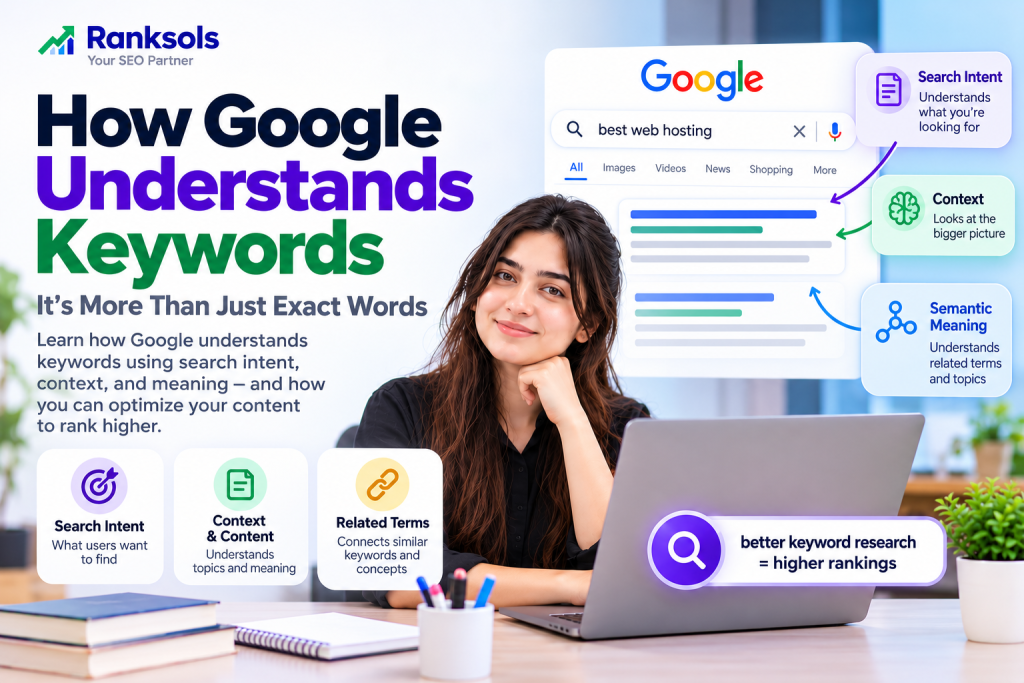
Google does not rely only on exact keyword matches to understand webpage content. It uses language understanding systems, contextual information, and automated ranking technologies to interpret search queries and identify relevant content.
These systems help Google understand the meaning behind search terms, recognize synonyms, and connect related concepts with relevant webpages.
Understanding how Google interprets keywords helps website owners create content that communicates topics clearly, addresses search intent, and uses related terminology naturally instead of repeating exact search phrases.
How Does Google Understand Keywords?
Google understands keywords by analyzing the words, meaning, and context of search queries and webpage content. Its language understanding systems help interpret what users are looking for, even when their searches contain different wording or phrases with multiple meanings.
For example, someone searching for “how to improve website speed” may also find relevant information on pages discussing website performance, page loading time, and website speed optimization.
Although these phrases are different, they relate to the same subject.
Google can recognize these relationships and identify relevant content without requiring every webpage to repeat the exact search query.
How Google Interprets the Meaning of Keywords
Google uses language models and other automated systems to understand search queries. These technologies help it interpret user intent, recognize relationships between words, and understand the context in which keywords appear.
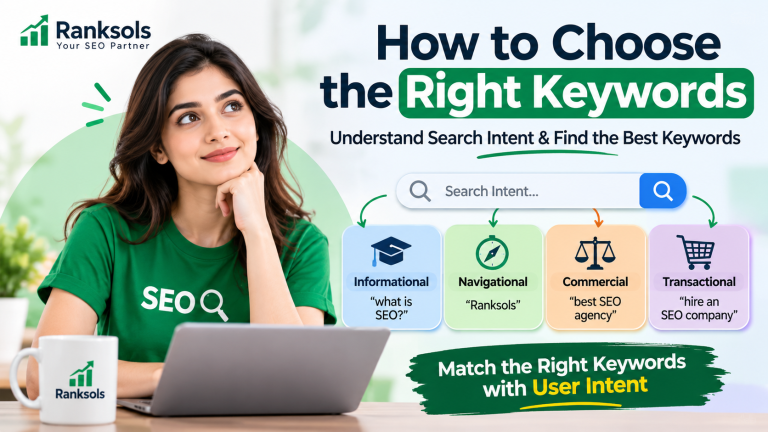
1. Understanding Search Intent
Google tries to determine what users want to accomplish rather than interpreting a search query as a simple collection of words.
For example:
Search query | Likely search intent |
|---|---|
What is SEO? | Informational |
Best SEO agency in Pakistan | Commercial investigation |
Hire an SEO company | Transactional |
Although these searches relate to the same subject, they represent different user needs.
Understanding search intent helps Google identify content that is relevant to the purpose behind a search. This is why a detailed educational article may be suitable for an informational query, while a service page may be more relevant for someone looking to hire an SEO company.
2. Recognizing Synonyms and Related Terms
Google can recognize relationships between words with similar meanings. This allows it to identify relevant webpages even when they do not contain the exact keywords used in a search.
For example:
Search keyword | Related phrase |
|---|---|
Improve website speed | Optimize website performance |
Buy running shoes | Purchase jogging shoes |
SEO services | Search engine optimization services |
Website design | Web design |
These variations help Google connect related search queries with relevant content.
Website owners should therefore use natural language and relevant terminology rather than repeating one exact keyword throughout a webpage.
3. Understanding Context and Word Relationships
Some words have different meanings depending on the context in which they appear.
For example, the word “Apple” could refer to a fruit or a technology company.
Google uses surrounding language and query context to interpret the likely meaning.
If a webpage discusses smartphones, iPhones, MacBooks, and technology products, the surrounding information helps establish that Apple refers to the technology company rather than the fruit.
This demonstrates why the overall subject and supporting information of a webpage are important for communicating topical relevance.
Google’s Language Understanding Systems
Google uses different AI-powered systems to understand language, relationships between concepts, and webpage relevance. Some notable systems include RankBrain, BERT, Neural Matching, and Passage Ranking.
These systems have different functions. They are not sequential steps that website owners need to optimize individually.
RankBrain
RankBrain is an AI system that helps Google understand how words relate to concepts. It allows Google to identify relevant content even when a webpage does not contain all the exact words used in a search query.
For example, a search for “change laptop brightness” may connect with content that explains how to “adjust laptop brightness.”
BERT
BERT (Bidirectional Encoder Representations from Transformers) helps Google understand how combinations of words express different meanings and intent.
It considers the relationships between words in a sentence, helping Google interpret language more accurately than relying on individual words alone.
Neural Matching
Neural Matching helps Google connect representations of concepts in search queries with related concepts in webpage content.
It helps identify relationships between ideas even when the wording used in a search query differs from the wording on a webpage.
Passage Ranking
Passage Ranking helps Google identify individual sections or passages within a webpage that are relevant to a search query.
For example, a comprehensive article about website optimization may contain a section specifically explaining image compression. Google can use passage-level understanding to identify that section as relevant to a search about reducing image file sizes.
These technologies help Google’s search systems understand and match information. They should not be treated as separate SEO ranking factors that require specific keyword optimization.
How Google Matches Search Queries With Webpage Content
Understanding a search query and evaluating webpage relevance are related but different processes.
Google generally needs to understand what a user is searching for, identify potentially relevant information in its index, and determine which results are most useful for that query.
Three important concepts help explain this process.
1. Understanding the Search Query
Google interprets the words and context of a search to identify what the user wants.
For example, a search for “best ways to speed up a website” indicates an interest in website performance improvements.
2. Evaluating Webpage Relevance
Google analyzes webpage content to determine whether it provides information related to the search.
Elements that can help communicate relevance include:
Page titles: Describe the main subject of a webpage.
Headings: Organize information into relevant sections.
Main content: Explains the topic and provides useful information.
Related terminology: Establishes connections between relevant concepts.
Links: Provide additional context about pages and their relationships.
For example, a webpage about website speed optimization may discuss image compression, browser caching, page loading time, and website performance.
These related concepts help explain the subject in greater depth.
3. Selecting and Ranking Search Results
After identifying potentially relevant webpages, Google’s automated ranking systems consider multiple signals to determine which results should appear and in what order.
These may include relevance, content quality, usability, source reliability, and other factors depending on the search query.
Important: A webpage can be relevant to a search query without automatically ranking highly for it. Understanding keywords is only one part of the broader Google Search process.
How to Create Content Google Can Understand
Website owners do not need to write content specifically for individual Google algorithms. Instead, they should create clear, relevant content that communicates a subject effectively.
Consider these practices:
1. Focus on One Primary Topic
Give each webpage a clear subject and ensure its content consistently addresses that topic.
For example, an article about website speed optimization should focus on improving website performance rather than covering unrelated SEO subjects.
2. Use Natural Keyword Variations
Include relevant synonyms, related search terms, and alternative phrases where they genuinely fit the explanation.
For example, an article about website speed may naturally include:
Website performance.
Page loading time.
Website speed optimization.
Page performance.
There is no need to force every variation into the content.
3. Cover Relevant Supporting Concepts
Explain important subtopics that help readers understand the main subject.
For example, an article about keyword research may discuss search demand, keyword relevance, and search intent where appropriate.
Supporting concepts should strengthen the main topic rather than introduce unrelated discussions.
4. Organize Content With Descriptive Headings
Use meaningful H2 and H3 headings to organize information into logical sections.
Clear headings help readers navigate content and communicate the structure of a webpage.
5. Write According to Search Intent
Understand what users expect from a search query and create content that addresses their needs.
An informational query generally requires educational content, while a commercial query may require comparisons, product information, or service details.
6. Avoid Unnecessary Keyword Repetition
Repeating exact keywords does not automatically improve search relevance.
Instead, prioritize meaningful explanations, natural language, and information that satisfies the user’s search.
These practices align with Google’s guidance on creating helpful, reliable, people-first content.
Common Misconceptions About How Google Understands Keywords
Several SEO misconceptions can lead website owners to focus on keyword placement instead of content relevance.
Misconception | What actually happens |
|---|---|
Google only understands exact keywords. | Google can recognize synonyms and related concepts. |
Every related keyword must appear on a page. | Relevant terminology should be included naturally. |
Keyword repetition improves rankings. | Repetition alone does not establish content relevance. |
Every page needs a specific keyword density. | Google does not require a fixed keyword density. |
Semantic SEO means adding as many related keywords as possible. | Semantic relevance comes from meaningful relationships between concepts. |
LSI keywords are a Google ranking requirement. | Google does not provide an LSI keyword optimization method for website owners. |
What About LSI Keywords?
LSI (Latent Semantic Indexing) is a mathematical information retrieval technique. However, the term LSI keywords is frequently misused in SEO.
There is no need to collect so-called LSI keywords or follow an assumed Google LSI optimization method.
Instead, focus on relevant synonyms, related concepts, and terminology that naturally supports your subject.
Frequently Asked Questions
Does Google understand synonyms?
Yes. Google’s language understanding systems can recognize synonyms and related terms, helping it identify relevant webpages even when they use different wording from the original search query.
Does Google understand the meaning of keywords?
Yes. Google uses language models and AI-powered systems to interpret search queries, understand word relationships, and identify the likely meaning behind searches.
Does Google rank pages based on exact keyword matching?
Exact keyword matches can help establish relevance, but they are not the only consideration. Google also uses language understanding systems and other ranking signals to identify relevant content.
Should I use LSI keywords in my content?
You should include relevant synonyms, related phrases, and supporting concepts where they improve the explanation. However, Google does not require a specific LSI keyword strategy.
Can Google understand content without the exact target keyword?
Yes. Google can identify relationships between search queries and webpage content even when the exact search phrase is absent. However, clear and relevant terminology still helps communicate the page’s subject.
Does using related keywords guarantee better rankings?
No. Related keywords can help provide context, but their presence does not guarantee improved rankings. Google evaluates multiple relevance and quality signals when selecting search results.
Conclusion
Google understands keywords through language processing, contextual analysis, and automated search systems. It interprets the meaning behind search queries, recognizes relationships between words, and evaluates how webpage content relates to users’ needs.
For website owners, the practical approach is to create focused content that explains topics clearly, uses relevant terminology naturally, and addresses search intent.
At Ranksols, we help businesses improve their organic search visibility through strategic SEO, relevant content optimization, and search-focused website improvements. Explore Ranksols.pk to learn more about building an effective SEO strategy.