
Keyword research is the process of discovering, analyzing, and selecting the search terms people use in search engines to find information, products, or services. It helps website owners understand their target audience’s search behavior and identify relevant opportunities for organic search visibility.
In SEO, keyword research provides direction for content planning and optimization. By understanding search demand, keyword relevance, and user intent, businesses can create content that addresses what their potential customers are looking for.
Why Is Keyword Research Important?
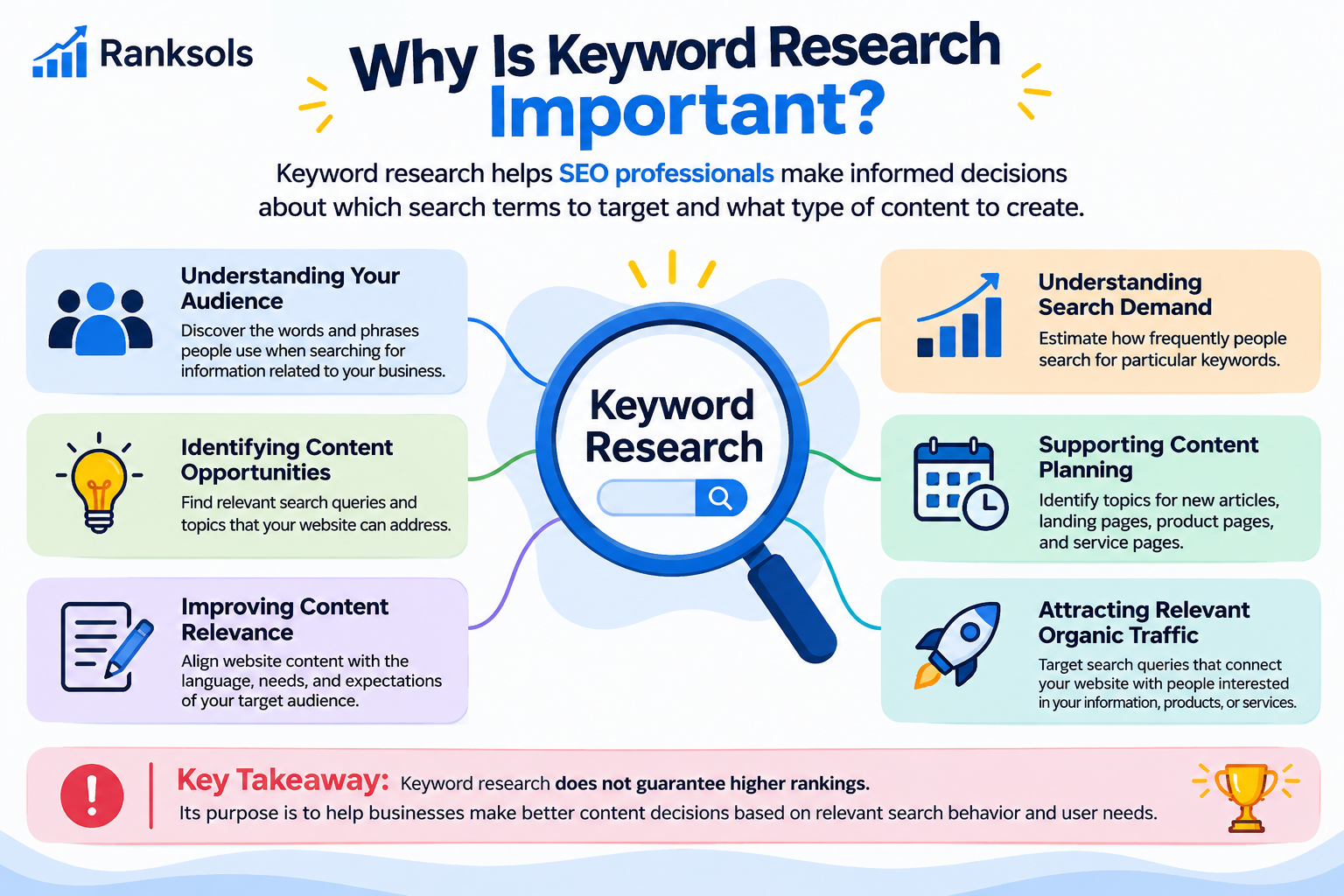
Keyword research helps SEO professionals make informed decisions about which search terms to target and what type of content to create. Without proper research, a website may focus on irrelevant keywords or publish content that does not satisfy users’ search needs.
Its main benefits include:
Understanding your audience: Discover the words and phrases people use when searching for information related to your business.
Identifying content opportunities: Find relevant search queries and topics that your website can address.
Improving content relevance: Align website content with the language, needs, and expectations of your target audience.
Understanding search demand: Estimate how frequently people search for particular keywords.
Supporting content planning: Identify topics for new articles, landing pages, product pages, and service pages.
Attracting relevant organic traffic: Target search queries that connect your website with people interested in your information, products, or services.
Keyword research does not guarantee higher rankings. Its purpose is to help businesses make better content decisions based on relevant search behavior and user needs.
What Does Keyword Research Involve?
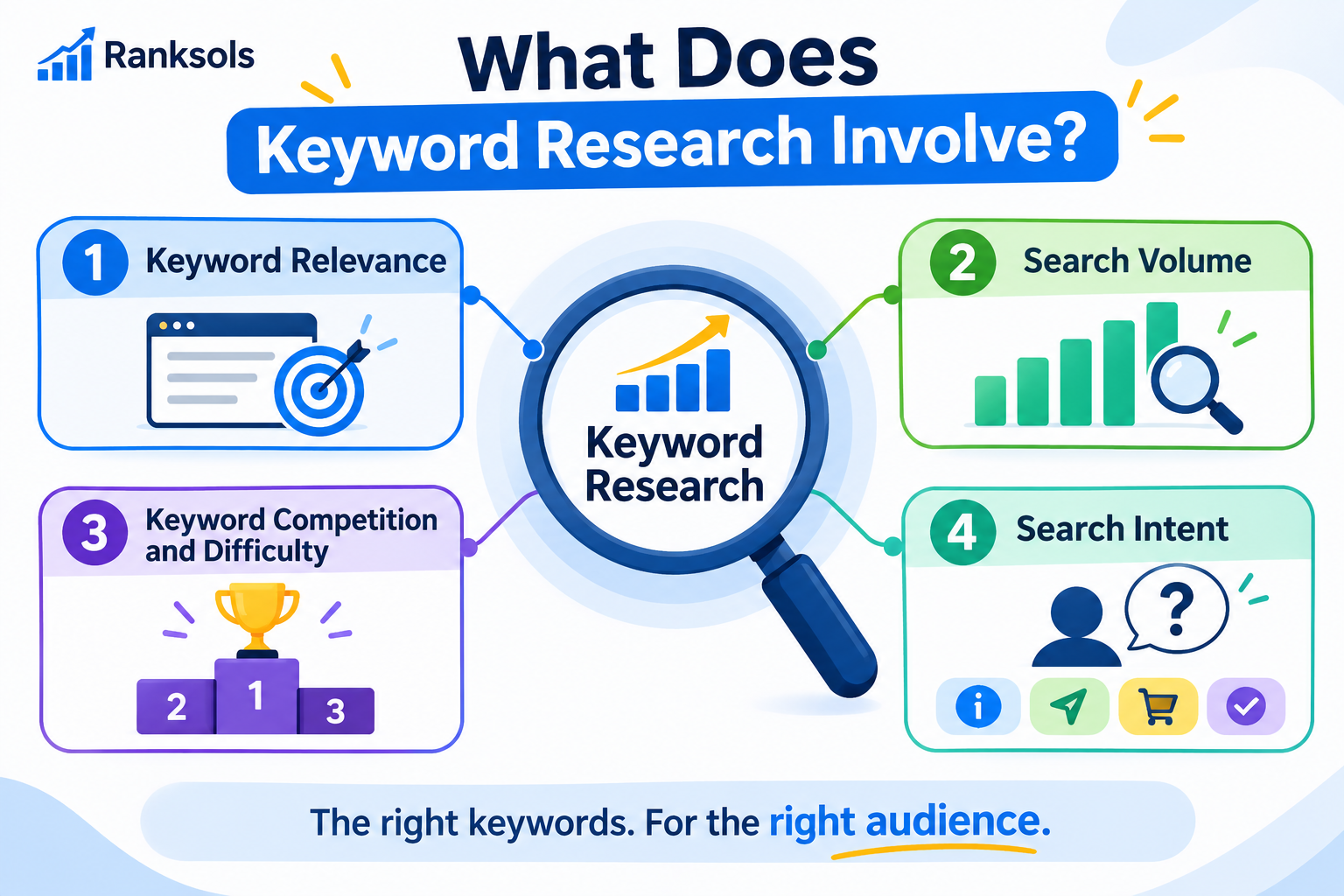
Effective keyword research involves evaluating several characteristics of search terms rather than simply collecting a list of popular keywords.
1. Keyword Relevance
Keyword relevance describes how closely a search term relates to your website, business, products, or content.
For example, if a website provides SEO services, relevant keywords might include:
A keyword may have high search volume, but it is not necessarily valuable if it does not relate to your website or target audience.
2. Search Volume
Search volume refers to the estimated number of times a particular keyword is searched within a specific period, usually a month.
It helps SEO professionals identify search demand and compare the popularity of different keywords.
However, search volume is an estimate, not a guarantee of website traffic. Actual clicks depend on factors such as search results, competition, search intent, and user behavior.
3. Keyword Competition and Difficulty
Keyword competition describes how challenging it may be to gain visibility for a particular search term.
It is important to distinguish between two types of competition:
Organic keyword difficulty: SEO tools estimate how challenging it may be to rank organically for a keyword based on their own data and methods.
Paid search competition: Advertising platforms estimate competition among advertisers bidding on particular keywords.
These metrics are not interchangeable. Third-party keyword difficulty scores are estimates, not official Google ranking metrics or guarantees of ranking performance.
When evaluating organic competition, examine the existing search results, the relevance and quality of competing pages, and the level of authority required to compete.
4. Search Intent
Search intent refers to the reason behind a user’s search query. Understanding it helps determine what type of content is appropriate for a particular keyword.
Common search intent categories used in SEO include:
Informational: Users want to learn something, such as “what is keyword research?”
Navigational: Users want to find a particular website or page, such as “Google Search Console login.”
Commercial investigation: Users compare products or services before making a decision, such as “best SEO tools.”
Transactional: Users intend to take an action, such as “buy SEO software.”
These are commonly used industry classifications rather than an official Google keyword classification system.
A relevant keyword should match both the subject and the purpose of the content you plan to create. For a deeper explanation, explore our guide to [Types of Search Intent: A Practical SEO Guide.
Types of Keywords in SEO
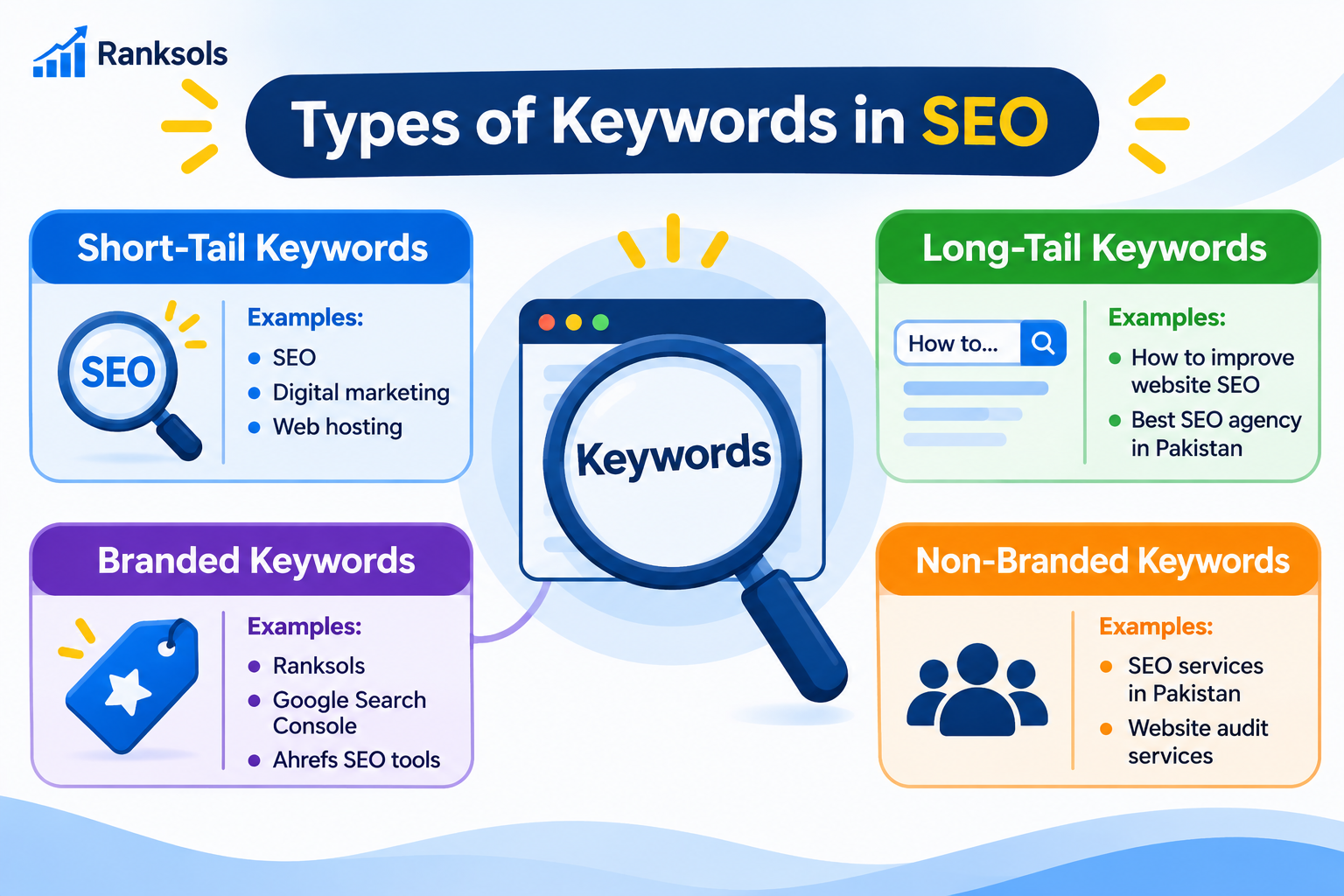
Keywords can be classified according to their length, specificity, and relationship with a brand. These classifications help SEO professionals understand different search patterns and identify suitable content opportunities.
Short-Tail Keywords
Short-tail keywords are broad search terms that usually contain one or two words.
Examples include:
SEO
Digital marketing
Web hosting
These keywords often have broader meanings and may attract substantial search demand. However, their search intent can be less specific, making it difficult to determine exactly what users expect.
Long-Tail Keywords
Long-tail keywords are more specific search phrases that usually express a narrower user need. They often contain three or more words, but specificity and intent are more important than word count.
Examples include:
How to improve website SEO
Best SEO agency in Pakistan
How to conduct keyword research for a business website
Long-tail keywords can help identify specific audience needs and content opportunities. However, their search volume and competition can vary.
Branded Keywords
Branded keywords include the name of a particular company, product, or brand.
Examples include:
Ranksols
Google Search Console
Ahrefs SEO tools
These searches indicate that users are looking for information about a specific brand or its products and services.
Non-Branded Keywords
Non-branded keywords do not include a specific company or product name. Instead, they describe a general topic, product, service, or user need.
Examples include:
SEO services in Pakistan
Website audit services
Best keyword research tools
These keywords can help businesses reach people who are searching for relevant solutions without already knowing their brand.
How Does Keyword Research Work?
Keyword research generally follows a structured process that helps identify relevant search terms and evaluate their potential value.
Identify your main topic: Start with your website’s primary subject, business offering, products, or services.
Generate seed keywords: List broad terms that describe your business or the topics your audience is interested in.
Discover related keywords: Use keyword research tools, search suggestions, and competitor analysis to find additional search terms.
Evaluate keyword metrics: Examine search volume, relevance, and estimated competition to understand potential opportunities.
Analyze search intent: Review the search results to understand what users expect to find and which content formats appear most relevant.
Select suitable keywords: Choose terms that align with your website’s purpose, audience, and existing or planned content.
The selected keywords can then inform content planning and page optimization. More detailed processes, such as keyword clustering and keyword mapping, can be covered in dedicated guides.
Practical Keyword Research Example
Consider an SEO agency that wants to attract potential customers through its website. It may research different search terms related to its services and educational content.
| Keyword | Relevance | Search intent |
|---|---|---|
| What is SEO? | High | Informational |
| SEO services in Pakistan | High | Commercial investigation |
| Best SEO agency in Lahore | High | Commercial investigation |
| How to improve website SEO | High | Informational |
| Hire an SEO agency | High | Transactional |
This example demonstrates that related keywords can represent different user needs.
For example, “what is SEO?” is suitable for an educational article, while “SEO services in Pakistan” may be more appropriate for a service or landing page.
Targeting every keyword with the same page would not necessarily satisfy users. Instead, keywords should be evaluated according to their relevance, intent, and the type of content needed to address them.
Which Tools Are Used for Keyword Research?
Several SEO and search marketing tools help discover keyword ideas, evaluate search demand, and understand search behavior.
| Tool | Primary purpose |
|---|---|
| Google Keyword Planner | Discover keyword ideas and review estimated search volume and advertising metrics. |
| Google Search Console | Identify queries that already generate impressions and clicks for your website. |
| Ahrefs | Research keyword ideas, estimated keyword difficulty, and competitor keyword opportunities. |
| Semrush | Explore keyword opportunities, search demand, and competitor visibility. |
| Google Trends | Compare changes in search interest over time and across locations. |
Each tool provides different types of information. For example, Google Keyword Planner is primarily designed for advertising research, while Google Search Console provides performance data from your existing website.
Important: Google Keyword Planner’s competition metric represents advertiser competition, not organic SEO ranking difficulty. Its search volume figures are also estimates.
Tool data should be considered alongside actual search results, website relevance, and audience needs.
Common Keyword Research Mistakes
Keyword research can become less effective when search terms are selected without considering their relevance, intent, and practical value.
Avoid these common mistakes:
Choosing keywords based only on search volume: A popular keyword may attract visitors who are not interested in your content or services.
Ignoring search intent: Content that does not satisfy the purpose of a search may fail to meet user expectations.
Targeting irrelevant keywords: Search terms should relate directly to your website’s subject and target audience.
Treating keyword difficulty as an exact measurement: Third-party difficulty scores are estimates, not guaranteed predictions of ranking performance.
Ignoring existing keyword performance: Google Search Console data can reveal queries that already generate impressions but may offer opportunities to improve existing pages.
Targeting unrelated search intents on one page: Combining different user needs without a clear purpose can make content less focused.
Ignoring changes in search demand: Some keywords experience seasonal changes or declining interest over time.
Repeating keywords unnaturally: Content should use relevant terminology naturally instead of forcing exact-match phrases into every section.
Effective keyword research focuses on finding relevant search opportunities rather than maximizing keyword frequency or search volume.
Frequently Asked Questions
Is keyword research necessary for SEO?
Keyword research is an important part of SEO because it helps identify relevant search queries, understand audience needs, and plan useful website content. It provides direction for content creation and optimization.
Is keyword research only about finding high-volume keywords?
No. Effective keyword research considers relevance, search intent, competition, and search demand. A keyword with lower search volume may be more valuable when it attracts a highly relevant audience.
What is the difference between a keyword and a search query?
A keyword is a term or phrase selected by an SEO professional for research and optimization. A search query is the actual word or phrase entered by a user into a search engine. The two are related, but they are not always identical.
How often should keyword research be updated?
Keyword research should be reviewed when creating new content, entering a new market, updating existing pages, or responding to changes in search behavior. Periodic reviews can also reveal emerging opportunities and changes in search demand.
Can the same keyword be targeted on multiple pages?
Multiple pages can naturally appear for related search terms, but creating several pages with the same primary purpose may lead to unnecessary overlap. It is generally better to give each page a distinct purpose and ensure that its content satisfies a specific user need.
Conclusion
Keyword research helps businesses understand what their target audience searches for and identify relevant opportunities for organic search visibility. By evaluating keyword relevance, search volume, competition, and search intent, website owners can make better decisions about content creation and optimization.
A well-planned keyword strategy focuses on user needs rather than simply targeting popular search terms. It provides a foundation for relevant content, better audience targeting, and a more organized website structure.
For businesses looking to identify relevant search opportunities and develop an effective organic search strategy, Ranksols provides SEO services that include keyword research, search intent analysis, and content planning to help businesses connect their websites with relevant audiences.